

Capping back-to-back news that emphatically heralded the United States’ return to space exploration, Jeff Bezos on Wednesday unveiled plans for “a 21st century” rocket engine developed by his private aerospace company that could help reduce Russia’s role in U.S. orbital flights.
At a news conference at the National Press Club in Washington, D.C., Bezos showed off a model of the BE-4, a liquid-propellant engine that will be used to power new version of the Atlas rockets now used to launch telecommunications and spy satellites and other payloads into space.
The BE-4 will be jointly funded by Bezos’ Kent-based Blue Origin and United Launch Alliance, a 50-50 venture between Boeing and Lockheed Martin. Work on the liquid oxygen, liquefied natural-gas engine has been under way for three years in Kent and in West Texas, and four more years of development are expected before first flight.
Bezos’ Blue Origin plans 21st century rocket engine The Seattle Times
Shields up ready for Mars shot Cosmos
It takes a couple of years for a crew of astronauts to sojourn to Mars and back. In that time the team would be exposed to enough radiation to significantly increase the chances of each of them dying of cancer, says Roberto Battiston, Professor of Physics at the University of Trento in Italy. With a crew of five there is a 20% probability that one will die of a cancer caused by radiation damage from the trip, he says.
So Battiston and his colleagues are developing a remedy that sounds like something from the starship Enterprise. It’s called the Space Radiation Superconductive Shield (SR2S). It is effectively a superconducting magnetic energy shield that mimics the protective effect of our planet’s own magnetic field, deflecting cosmic rays away from the crew’s precious cells.
Space Launch System approved, we’re going to Mars Nerd Reactor
Hey, want to go to Mars? Well, in a few years you can…kind of. The Space Launch System is the most powerful rocket we’ve built yet. The spacecraft needed approval from the SPAR agency before putting it to test. On August 27th, they gave us the okay and now, we are officially going to try and bring humans to Mars. Isn’t that crazy?
In 2018, which isn’t too far away if you think about it, we’re going to send the Space Launch System carrying the Orion spacecraft up into orbit. The SLS will be configured with a 70-metric-ton lift capacity. The final version of the SLS will be able to carry 130 metric tons.
Curiosity wheel damage: The problem and solutions Nerd Reactor
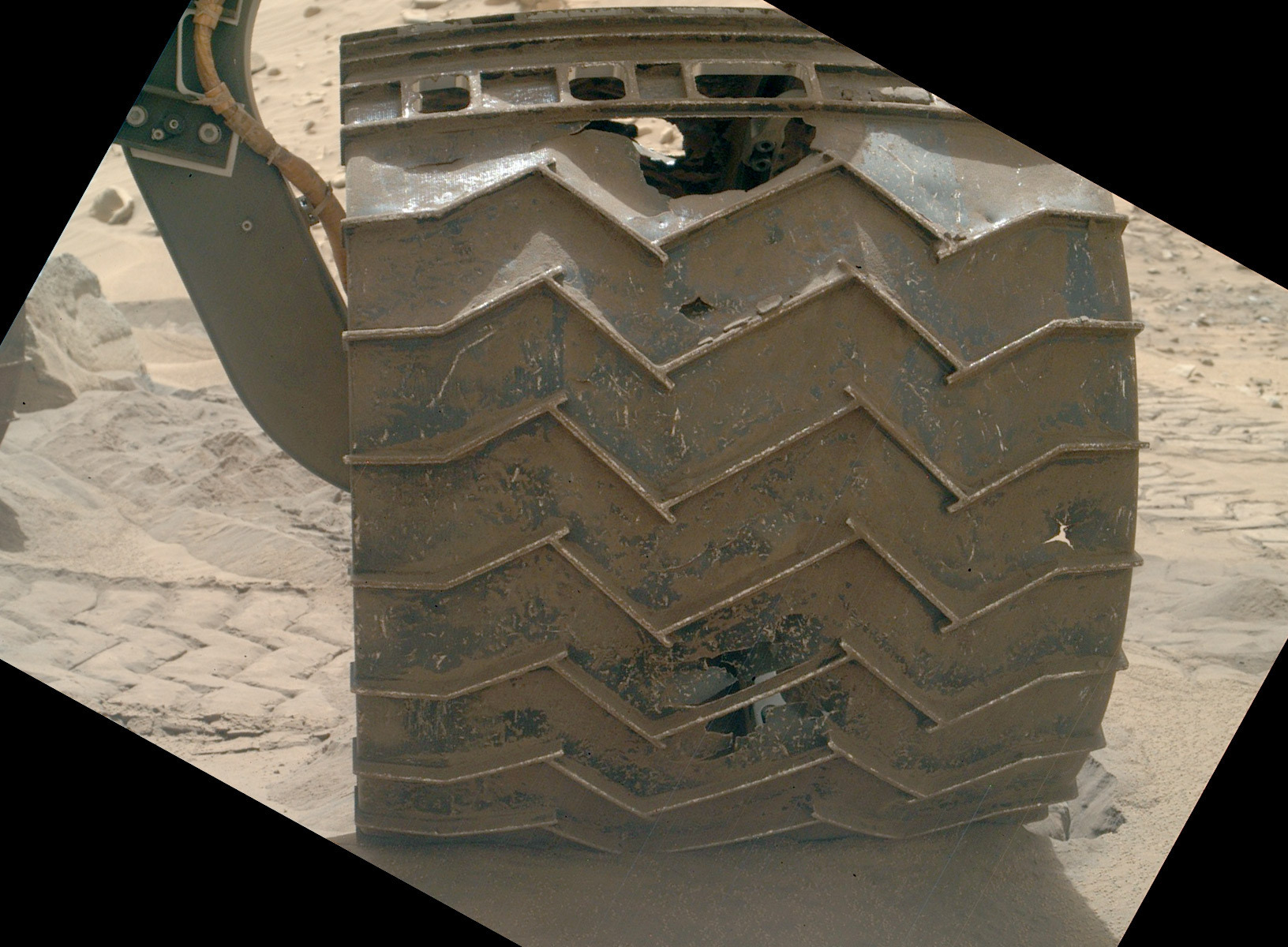
CURIOSITY’S LEFT FRONT WHEEL, SOL 713 NASA / JPL / MSSS / Emily Lakdawalla
ExoLance Indiegogo
Explore Mars has devised a simple system capable of being delivered to the Martian surface to detect microorganisms living on or under the surface.
ExoLance leverages a delivery system that was originally designed for military purposes. As each small, lightweight penetrator probe (“arrow”) impacts the surface, it leaves behind a radio transmitter at the surface to communicate with an orbiter, and then kinetically burrows to emplace a life-detection experiment one to two meters below the surface. ExoLance combines the experiments of the 1970s Viking landers and the Curiosity rover with bunker-busting weapons technology.
Going to the Red Planet MIT
Whenever the first NASA astronauts arrive on Mars, they will likely have MIT to thank for the oxygen they breathe — and for the oxygen needed to burn rocket fuel that will launch them back home to Earth.
On Thursday, NASA announced the seven instruments that will accompany Mars 2020, a planned $1.9 billion roving laboratory similar to the Mars Curiosity rover currently cruising the Red Planet. Key among these instruments is an MIT-led payload known as MOXIE, which will play a leading role in paving the way for human exploration of our ruddy planetary neighbor.
MOXIE — short for Mars OXygen In situ resource utilization Experiment — was selected from 58 instrument proposals submitted by research teams around the world. The experiment, currently scheduled to launch in the summer of 2020, is a specialized reverse fuel cell whose primary function is to consume electricity in order to produce oxygen on Mars, where the atmosphere is 96 percent carbon dioxide. If proven to work on the Mars 2020 mission, a MOXIE-like system could later be used to produce oxygen on a larger scale, both for life-sustaining activities for human travelers and to provide liquid oxygen needed to burn the rocket fuel for a return trip to Earth.
SpaceX Launches 3D-Printed Part To Space, Creates Printed Engine Chamber For Crewed Spaceflight SpaceX
Through 3D printing, or additive manufacturing, robust and high-performing rocket parts can be created and offer improvements over traditional manufacturing methods. SpaceX is pushing the boundaries of what additive manufacturing can do in the 21st century, ultimately making the Falcon 9 rocket and Dragon spacecraft more reliable, robust and efficient than ever before.
On January 6, 2014, SpaceX launched its Falcon 9 rocket with a 3D-printed Main Oxidizer Valve (MOV) body in one of the nine Merlin 1D engines. The mission marked the first time SpaceX had ever flown a 3D-printed part, with the valve operating successfully with high pressure liquid oxygen, under cryogenic temperatures and high vibration.
Field Tests in Mojave Desert Pave Way for Human Exploration of Small Bodies Mars Institute
A team of researchers from the SETI Institute, the Mars Institute, NASA Ames Research Center, and the space robotics company Honeybee Robotics, has successfully completed a first series of field tests aimed at investigating how humans will explore and work on Near-Earth Asteroids (NEAs) and eventually the two moons of Mars, Phobos and Deimos.
From 13 to 15 April 2013, field experiments were conducted at the U.S. Army’s National Training Center (NTC) at Fort Irwin, California, to evaluate geotechnical methods and systems that will enable humans to be productive explorers in the low gravity environment of small rocky bodies. Sub-kilometer sized NEAs, Phobos, and Deimos are among destinations currently considered by NASA for future human missions into Deep Space.
NASA Seeks Proposals for Commercial Mars Data Relay Satellites

NASA has issued a Request for Information (RFI) to investigate the possibility of using commercial Mars-orbiting satellites to provide telecommunications capabilities for future robotic missions to the Red Planet.
“We are looking to broaden participation in the exploration of Mars to include new models for government and commercial partnerships,” said John Grunsfeld, associate administrator of NASA’s Science Mission Directorate at the agency’s headquarters in Washington. “Depending on the outcome, the new model could be a vital component in future science missions and the path for humans to Mars.”
The RFI details possible new business models that would involve NASA contracting to purchase services from a commercial service provider, which would own and operate one or more communication relay orbiters. The solicitation is open to all types of organizations including U.S. industry, universities, nonprofits, NASA centers, and federally funded research and development centers, in addition to U.S. government and international organizations.
Spinning to Mars The Space Review
Thirty years ago today a group of scientists, grad students, and all around Mars enthusiasts wrapped up the four-day Case for Mars conference in Boulder, Colorado. While there, they drafted plans for a human Mars spacecraft that became enshrined—at least for a little while—in popular culture. A large spinning vessel consisting of three nearly identical ships and their landing craft, it was a serious attempt at defining a human mission to Mars. By the early 1990s, one of the Case for Mars participants, Carter Emmart, produced a beautifully detailed model of the spinning spacecraft that was placed on display in the Smithsonian’s National Air and Space Museum in Washington, DC. Now, after a long absence, that model is back in public view.